
Is Your Soul Trapped in Invisible Dust? The Jain Path to Freedom
Walking as if every step mattered
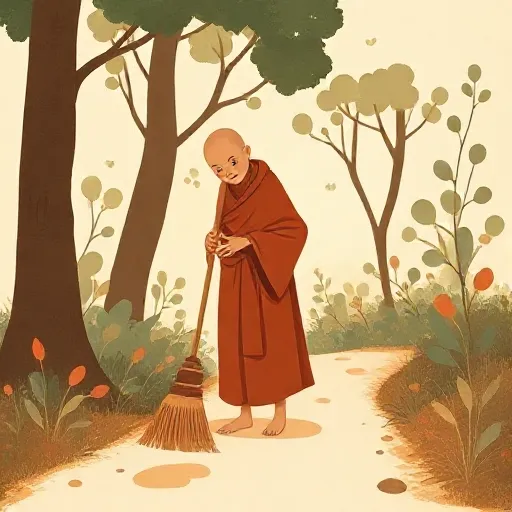
Imagine a monk stepping onto a dirt road. Before she moves a single foot, she crouches and sweeps the ground with a tiny broom made of soft cotton. She is not cleaning away leaves. She is gently pushing aside ants, beetles, and microscopic creatures so she will not injure them. If you followed her all day, you would see her strain drinking water through a cloth to avoid swallowing tiny life, and watch her refuse to breathe through her mouth for fear of harming airborne beings. This seems impossible. Why would anyone go this far?
For Jain philosophers, the answer lies in what they believe you really are. Your true self—called the jīva—is a point of pure, unobstructed consciousness, like an eternal light. In everyday life, you barely feel that light because it is buried under layers of invisible dust. That dust is karma, but not karma in the sense of “what goes around comes around.” In Jainism, karma is a real, material substance—a fine, sticky powder that fills the universe. Every harmful or even careless action, thought, or spoken word makes a little of that dust cling to your jīva. Passions like anger, greed, and pride act like glue, holding the dust in place. The dust clouds your awareness, keeps you trapped in an endless cycle of rebirths, and makes you suffer.
Jainism is a path to scrub that dust away. If you can stop attracting new karma and burn off the old, your jīva will finally shine as unobstructed consciousness—a state of total perception and absolute knowledge, sometimes called mokṣa (liberation). And the first step on that path is to stop doing harm, because every act of violence attracts more dust.
The invisible dust that clouds your true self

To understand how this works, think of a mirror. The Sanskrit word rāga can mean both “red color” and “passionate attachment.” Imagine an ordinary mirror. Now imagine that you paint the glass red. When you look into it, you see yourself, but everything looks red. The mirror did not change—the red coating distorts your view. Likewise, Jain teachers say, your jīva is naturally clear and purely aware, but karma dust colored by your passions gets on it, and suddenly you see the world not as it is, but as your attachments and aversions want it to be.
The philosopher Umāsvāmin (c. 150–400 CE) wrote that the defining power of the jīva is upayoga—experience, both in the form of definite cognition and a more indeterminate kind of perception. In its pure state, this experience would be unlimited: you would know everything directly, without needing senses or a mind. But while karma blocks it, your knowing is cramped, partial, and full of mistakes. The path to liberation is a double movement: you must stop new karma from flowing in by acting with right conduct, and you must destroy the karma already packed onto you by ascetic practices like fasting, meditation, and above all by not harming any living thing.
Because karma is material, the process is almost like physics. Jaina texts even calculate the mass of karmic particles that stick after a given act, or the exact duration a certain kind of karma will stay attached. As Samantabhadra (530–590 CE) and later thinkers insisted, the bond between the jīva and karma is not a permanent mixing. It is more like muddy water: the water itself stays water, the dust stays dust, and given enough time and stillness they will separate. Liberation is simply the complete falling away of all karmic particles, leaving the jīva alone in its original clarity.
Why even breathing can be a problem

If all harm creates karma, you need a map of what can be harmed. Jain thinkers produced a detailed taxonomy of living beings ranked by how many senses they have. At the bottom are one-sensed beings that possess only touch: earth-beings in clods of soil, water-beings in a puddle, fire-beings, air-beings, and every blade of grass or moss. Above them come worms with touch and taste; then ants that also smell; then bees, flies, and scorpions with sight added; and finally five-sensed beings like fish, reptiles, birds, mammals, humans, and gods. Some of these five-sensed beings also have an inner mental sense called manas. Only humans can achieve liberation, but every single being—down to the microscopic nigoda clusters that fill everything—is a jīva, a divine-like center of consciousness.
This makes ahiṃsā (non-violence) the core rule of Jain life, and it expands responsibility far beyond what most of us imagine. Directly hurting someone is violent. Ordering someone else to hurt them is violent. Even silently allowing harm when you could prevent it is violent. And the harm can be physical, verbal, or mental.
For a Jain monk or nun, the ideal is to harm nothing at all. But since merely walking, drinking, or breathing involves destroying invisible life, the practice often comes astonishingly close to not acting. This extreme standard created a tough puzzle. Early texts treated the bare external act as the main factor binding karma. If you accidentally stepped on an ant, karma stuck anyway. But later thinkers gave more weight to intention. A non-intentional harmful act became less serious than one driven by anger or greed. This shift opened space for a characteristically Jain move: what counts as harmful can depend on the perspective you adopt, and the same action can be permissible from one side and forbidden from another.
One pot, two truths: the art of many-sided seeing

You are sitting with a potter. She shapes a lump of clay into a water jar. What is really happening? You could say the clay has not changed at all—it is still clay, the same substance it always was. Or you could say a completely new thing, the pot, has come into being, because the shape, function, and name are utterly different. Which is correct?
According to Jainism, both are correct, and you need both to tell the whole truth. Every real thing has a permanent dravya (substance) and changing paryāya (modes). The pot exists as clay eternally, but it did not exist as a pot before the potter shaped it. So you can truthfully say, “the pot exists” (from the substance side) and “the pot does not exist” (from the mode side at an earlier time). This is the idea of anekāntavāda, the many-sidedness of reality. Nothing is simply one thing; everything is a knot of permanence and change, being and non-being, at the same time.
Haribhadrasūri (c. 8th century) and other Jain logicians took this even further. They said there are seven ways to describe any object: (1) it exists in some respect; (2) it does not exist in some respect; (3) it exists and does not exist in different respects; (4) it is inexpressible when those two are considered together simultaneously; (5) it exists and is inexpressible; (6) it does not exist and is inexpressible; (7) it exists, does not exist, and is inexpressible. This is not wordplay. It is a careful method to remind you that any statement about the world is incomplete if you do not specify “from what angle, at what time, and in what sense.”
Seven ways to look at the world

If objects themselves are many-sided, what about the way we know them? Jains developed the doctrine of nayavāda, a map of seven epistemic perspectives—seven typical ways our minds zoom in or zoom out when we make a claim about something.
At one extreme is the “synthesizing” perspective, which focuses on what all things share and treats differences as temporary. At the other is the “actual” perspective, which cares only about what is immediately present to the senses and denies that anything permanent lies underneath. Between them lies the “comprehensive” stance, which tries to hold unity and difference together, though not at exactly the same moment.
Jain thinkers used this map to explain why other Indian philosophical schools, each brilliant in its own way, seemed to fight over reality. The Vedāntins and Sāṁkhyas got stuck in the synthesizing perspective: they saw the deep oneness of everything but rejected the equally real differences. The Buddhists got stuck in the actual perspective: they saw the constant flux of experience but denied any lasting substance. The Nyāya-Vaiśeṣika philosophers meticulously distinguished substances and properties, but missed that it is the same object grasped in two ways. Each school, in Jain eyes, was like someone examining an elephant with only one hand: they touched a real part, but then insisted the rest was mistake.
The Jain answer is not to blend all views into a vague mixture. It is to approach every debate with the awareness that your opponent might be looking at the same reality through a different lens, and that a fuller truth requires all of them working together. As the Jain commentator Pūjyapāda (540–600 CE) put it, isolated perspectives are useless, like individual threads that cannot hold anything. Only woven together do they become a cloth.
Why it still matters: holding the whole elephant

You are arguing with a friend. She says a school rule is unfair; you think it keeps everyone safe. At first, you each see only your own point. The Jain tradition whispers: before you decide the other person is wrong, ask from what perspective she is speaking. Her lens might be the “empirical” perspective of immediate feelings, yours the “comprehensive” perspective that considers the whole school over time. Neither is meaningless. A full account of the rule would need both.
This is not merely an old debate trick. It is the living heart of Jain philosophy. If every jīva is a valuable, luminous center of awareness, then even the tiniest creature demands your attention, and the person who frustrates you deserves the same care. Non-violence becomes not just a diet or a sweeping broom, but a habit of mind: you try to understand before you react, and you notice the ways your own passions color what you see.
Jains do not claim that you and I can reach the absolute knowledge of an omniscient teacher—the tīrthaṅkara like Mahāvīra (traditional dates 599–527 BCE) who, having burned away all karma, taught from non-attached clarity. But the goal shows a direction. Every step toward cleaner perception, every effort to see from one more side, is already a tiny liberation.
Think about it
- If you learned that a mosquito is also a jīva—a conscious self like you—would that change how you feel about swatting it? Why or why not?
- When you and a friend see a problem completely differently, what would it take for you both to believe that neither of you has the whole truth?
- Think of one strong opinion you hold about someone. What might you notice if you tried to describe the same person from three different perspectives?