
Can You Ever Really See Inside Your Own Mind?
A Kid, a Birthday List, and a Mystery

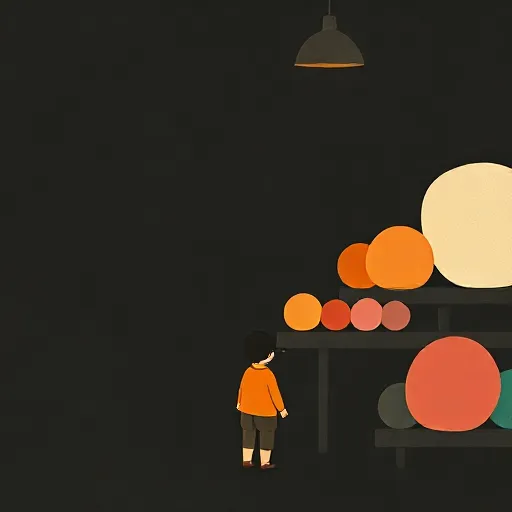
You are lying on your bed, trying to figure out what you really want for your birthday. You close your eyes and “look inside.” What are you actually doing? This inner looking is what philosophers call introspection—the process of knowing your own mind as it is happening. But how can you possibly see your thoughts?
For a process to count as introspection, most philosophers agree, it must be about your own mental states and no one else’s. It also has to focus on the present, or the very recent past. You can’t introspect why you were mad last month, but you can notice that you are feeling annoyed right now. Beyond these basics, the disagreement is huge. Some think introspection works like a sixth sense—an inner eye. Others think it’s something much stranger.
A Telescope into Your Own Brain?
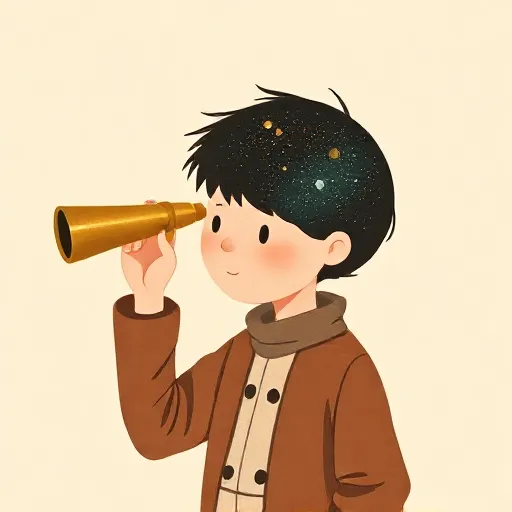
In the 1600s, John Locke (1632–1704) called introspection an “internal sense”—like having a tiny eye that looks at your ideas and feelings. A century later, Immanuel Kant (1724–1804) said we have an “inner sense” parallel to our outer senses. The idea is that you detect your mental states in a way similar to seeing a chair: a special mental faculty scans your mind and reports what it finds. Modern philosopher David Armstrong (1926–2014) described this as a “self-scanning process in the brain.” If this is right, introspection is a kind of self-detection—you are an observer of your own inner theater.
But if introspection is like perception, can it ever go wrong? When you see something, you can mistake a rope for a snake. Does introspection make mistakes too? Most self-detection supporters say yes, just like any sense can. You might think you’re calm but your heart is racing—maybe you detected the wrong feeling. Your inner eye isn’t infallible.
Descartes’ Magic Thought
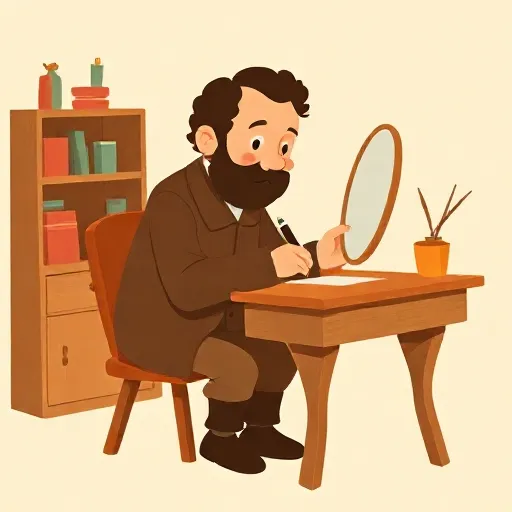
René Descartes (1596–1650) noticed something mysterious. While doubting everything—even whether he had a body—he realized one thing was impossible to doubt: his own thinking. The moment he thought “I am thinking,” it had to be true. Try it: if you silently say to yourself “I am thinking,” you can’t be wrong, because the very act of saying it makes it so. That’s a self-fulfilling thought.
This hints at a different way of knowing your mind. Maybe you don’t detect your thoughts from the outside. Instead, your introspective thought actually contains the thought it is about. Philosopher Tyler Burge (b. 1946) described it this way: when you judge “I am thinking about a banana,” your judgment includes the thought of a banana as part of itself. The thought is true not because it matches a pre‑existing state, but because the state is built into it. Many philosophers think this containment view gives certain introspective thoughts a special, unshakable security.
Look Outside, Not In
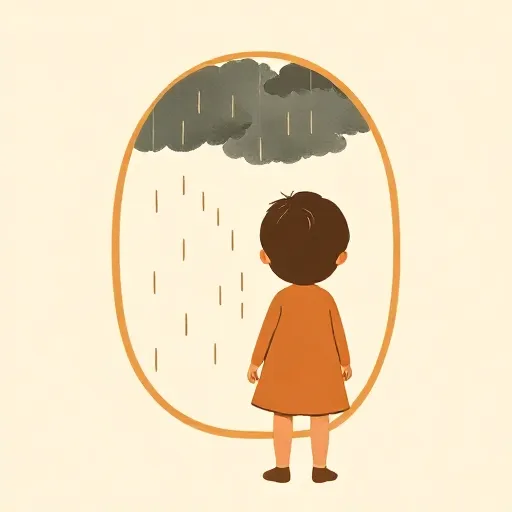
Imagine a friend asks, “Do you think it’ll snow tomorrow?” To answer, you don’t gaze inward at some secret screen. You look out the window at the gray sky and feel the cold. You figure out what you believe by checking the world, not your head. This is the transparency idea, made famous by philosopher Gareth Evans (1946–1980). When we ask ourselves about our beliefs, desires, or even our sensory experiences, we often look through them to the things they are about.
For example, if someone asks “What do you want for dinner?,” you might picture pizza, think about the taste, and then say “I want pizza.” That’s not scanning an inner desire‑o‑meter; it’s making up your mind by evaluating the world. Some transparency thinkers go further: they argue that when you try to look at your own experience of a tree, all you find are features of the tree, not separate “mind stuff.” If transparency is right, introspection isn’t really an inward glance at all. One more radical voice, Ludwig Wittgenstein (1889–1951), claimed that saying “I’m in pain” is not a report of an inner detection but simply a learned replacement for crying—just an expression, not a description.
When Scientists Fought Over What You See

In the late 1800s, psychologists tried to turn introspection into a rigorous science. Wilhelm Wundt (1832–1920) trained people to report their conscious sensations—how bright a light felt, how two colors differed. His student Edward Titchener (1867–1927) wrote a 1,600‑page manual on how to introspect accurately. They believed that with enough practice, you could measure the mind as precisely as you measure temperature.
But trouble brewed. Different labs got different results. A huge fight erupted over “imageless thought”—can you think without any mental pictures? Some introspectors said yes, others no, and neither side would budge. Then behaviorists like John Watson (1878–1958) attacked the whole method as unscientific. By the mid‑20th century, most psychologists trusted only outward behavior.
Today, introspection is back in a new form. Researchers give people beepers that go off at random times, then ask them to instantly jot down what they were just experiencing. Brain‑scanning studies show that when you report seeing a certain image, certain brain areas light up. Yet the old problems linger. In a famous experiment, shoppers choosing stockings were completely unaware that their preference was driven by the position of the stockings, not their quality. They made up reasons afterward. So our introspective reports about causes are often wrong, even while our grasp of our current pain or a color experience may be reliable.
So, Whose Mind Is It Anyway?

Here’s why this ancient puzzle matters for you. If introspection is a kind of inner seeing, you might have privileged access—a special, first‑person view that no one else has. But it could still be fallible, like an eye that sometimes gets fooled. If introspection is self‑fulfilling or transparent, then you can know some parts of your mind with a strange certainty, but you’ll miss other parts entirely, like the hidden reasons behind your choices.
This affects trust. When you say “I’m upset,” is that an unshakable report or a guess? When a friend insists they’re fine but seems angry, who knows better? The argument is not settled. Philosophers and psychologists keep debating whether we really have a window into our souls or just a pocketful of good‑enough tricks. And when we try to build minds in robots, we wonder: could a machine ever actually look inside itself? That question goes back to Descartes, and it’s still wide open.
Think about it
- If a scientist could predict all your choices by scanning your brain, would you still have “privileged access” to your own mind—or would the scientist know you better than you know yourself?
- Imagine you’re trying to decide whether you like a new song. Are you detecting a feeling inside, or are you just testing the song against your taste and then building a preference?
- Suppose a friend says “I know I’m not angry,” but they’re shouting. Could an outside observer ever know their feelings more accurately than they do? Why might that be?