Do We Learn Language Like Tricks? The Great Debate
A Toddler Drops a Plate and Says “I Broke It” — But How Did She Know?
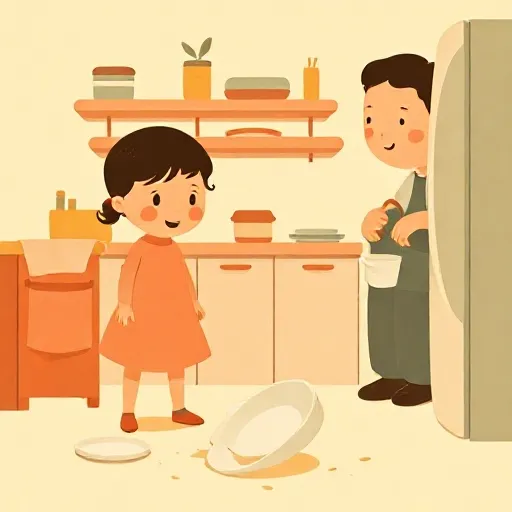
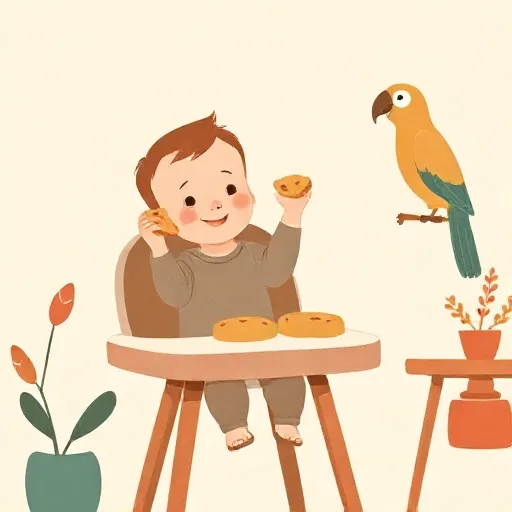
Imagine a three-year-old who has never been taught the word “broke.” One morning she accidentally knocks a plate off the table. It smashes on the floor, and she stares at the pieces and says, “I broke it.” Her father frowns and says, “You broke it? Yes, you did.” But no one ever told her to say “broke” instead of “breaked,” and no one rewarded her for saying “broke” before. How did she know?
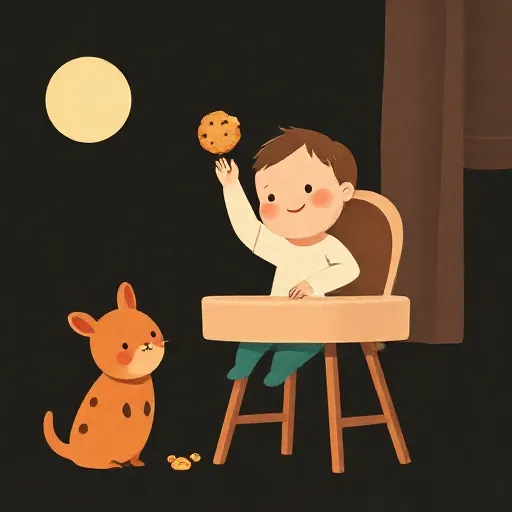
For decades, psychologists thought they had a simple answer. B. F. Skinner (1904–1990), a famous behaviorist, argued in his 1957 book Verbal Behavior that all of language is learned the same way a dog learns to sit. You make a sound, and if it gets you what you want — a cookie, a hug, someone opening the door — you do it again. If people ignore you or misunderstand, you stop. Language, Skinner said, is just a set of behavioral dispositions — habits you pick up through operant conditioning, where rewards and punishments shape your actions. “Knowing” English means having a huge collection of habits: for example, when you feel a cold draft, you are disposed to say “Close the door!”
Two years later, a young linguist named Noam Chomsky (born 1928) published a review of Skinner’s book that tore this idea to pieces. Chomsky pointed out two problems. First, language is stimulus independent — you can say almost anything in any situation, depending on what’s in your mind, not just what’s around you. You might say “Close the door!” if you’re cold, or you might say “I love this breeze.” Second, language is historically unbound — you constantly say sentences you have never been trained to say. A toddler who says “I broke it” has never practiced that exact sentence a hundred times for doggy treats. For Chomsky, Skinner’s picture of a child as a pigeon pecking a disk for food pellets just didn’t match reality. Learning language is not about being conditioned; it is about discovering something far deeper.
The Invisible Rules: What Do You Actually Know When You Know a Language?
Chomsky insisted that knowing a language means knowing a massive set of invisible rules. You don’t just have habits; you have syntactic knowledge — an understanding of how words fit together to make sentences. That knowledge includes things like the fact that “The girl who is in the jumping castle is Kayley’s daughter” is a perfectly good sentence, while “Is the girl who in the jumping castle is Kayley’s daughter?” is not. Even though you’ve probably never seen either sentence before, you instantly know which one sounds right.
Behind those feelings of “right” and “wrong” are abstract structures. Chomsky showed that grammar can be described by rules like phrase structure rules (which say a sentence is made of a noun phrase and a verb phrase) and transformations (which move pieces around — turning “Kate is biting Mark” into “Mark is being bitten by Kate”). Later versions of his theory introduced even more hidden machinery, like traces. A trace is a silent mark left behind when a word moves. In a sentence like “Jacob seems to have vanished,” the word “Jacob” started out next to “vanished” and left a trace behind — something you can’t hear but your mind somehow tracks.
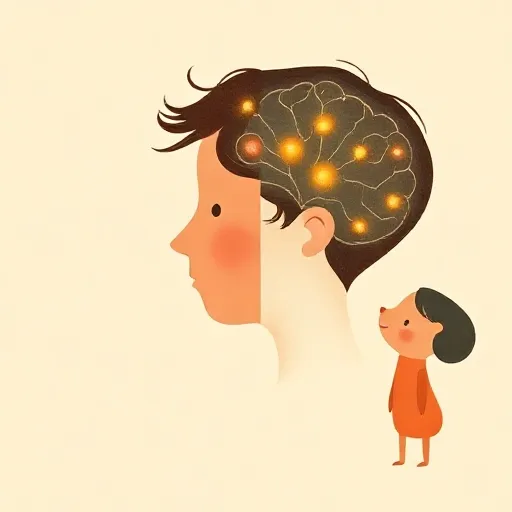
Here’s the puzzle. The rules of language involve ideas like “noun phrase” and “trace” that you can never see or touch. Yet every healthy child masters them by the age of five or six, with no textbooks and almost no direct instruction. How? Chomsky’s answer was innateness. He proposed that children are born with a mental toolbox called Universal Grammar (UG) — a built-in set of rules and constraints that all human languages share. Learning English or Spanish then becomes a matter of turning a few switches, not building the whole machine from scratch.
To make this vivid, Chomsky compared a child learning language to a switchbox. The wiring is already there, but a few switches need to be flicked by experience. For example, all languages need subjects, but some, like Spanish, let you leave the subject out (“Hablo español” — “I speak Spanish,” with the “I” missing). Others, like English, demand a visible subject. The Null Subject Parameter is like a switch: if you hear lots of sentences without subjects, you set it to “subject optional”; if not, you keep it at “subject required.” On this view, you don’t invent grammar; you grow it, guided by the inner plan of Universal Grammar.
The Poverty of the Stimulus: Why Chomsky Thought Experience Could Never Be Enough
Chomsky’s most famous argument for innateness is called the Poverty of the Stimulus. The idea is simple: what children hear around them — the primary linguistic data (PLD) — is nowhere near rich enough to teach them all the rules they end up knowing. The data are like a tiny flashlight in a huge dark room; you simply can’t see enough to figure out the whole layout by trial and error.
He gave a crisp example. Suppose a child hears pairs of sentences like “Jacob is happy today” and “Is Jacob happy today?” She is trying to figure out the rule for making yes-or-no questions. Two possible rules come to mind:
- H₁: Find the first “is” in the sentence and move it to the front.
- H₂: Find the “is” that comes right after the subject noun phrase and move it to the front.
Both work for the examples so far. H₁ is even simpler. But H₁ is wrong — as you can see from a sentence like “The girl who is in the jumping castle is Kayley’s daughter.” Move the first “is” to the front and you get gibberish: “Is the girl who in the jumping castle is Kayley’s daughter?” The correct rule is H₂, which relies on structure dependence — it cares about the sentence’s grammar, not just the flat order of words.
How could a child learn that H₁ is wrong? Parents almost never correct a child’s grammar (“No, sweetie, that’s the wrong ‘is’”). And Chomsky claimed that sentences like the jumping-castle example — the very ones that would falsify H₁ — are extremely rare in adult speech. So rare that a child might never hear one during the whole time she’s learning to talk. If that’s true, then children cannot be rejecting H₁ because they found counterexamples. They must never have considered H₁ in the first place. The brain, Chomsky argued, comes pre-programmed to prefer rules that depend on sentence structure. That built-in bias is a piece of Universal Grammar.
Nativists point to another problem too: the Unlearning Problem. When children overgeneralize — say, producing “I runned” instead of “I ran” — their grammar is generating sentences that aren’t in the target language. To shrink their grammar back to the correct size, they would need negative evidence: information that “runned” is not a sentence. But adults rarely say “That’s wrong,” and they don’t hand out lists of ungrammatical strings. Without negative evidence, the argument goes, learners could never recover from overgeneralization. The fact that children do recover suggests their guesses were never totally open-ended; constraints from Universal Grammar stop them from making certain mistakes in the first place.
Wait, Maybe Kids Are Smarter Than We Thought: The Case Against Innate Grammar
Chomsky’s arguments launched decades of research, but many scientists have pushed back. The first challenge is simple: is the stimulus really so poor? Researchers like Geoffrey Pullum and Barbara Scholz combed through huge collections of everyday speech and found that the “rare” jumping-castle sentence is actually not that rare. Children may in fact hear enough complex yes‑or‑no questions to figure out the correct rule without inborn structure‑dependence. And the idea that parents never correct grammar turns out to be exaggerated. Studies show that adults do give subtle feedback: they repeat a child’s error in corrected form, ask “What?” when a sentence is jumbled, and respond more smoothly when the grammar is correct. A child who says “I runned” might hear a parent reply, “Oh, you ran all the way here?” — that’s negative evidence, wrapped in a conversation.
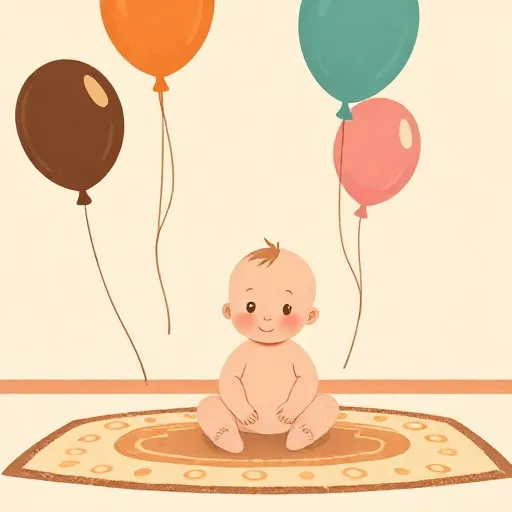
A second line of criticism comes from statistical learning. In one famous experiment, Jenny Saffran and her colleagues played eight‑month‑old babies a made‑up stream of syllables like “bidakupadotigolabu…” After only two minutes, the infants could tell which three‑syllable “words” (like bidaku) belonged together, based on how often one syllable followed another. Their brains were silently doing the math. Newer work shows that children — and even cotton‑top tamarin monkeys — can detect patterns that go beyond word boundaries, reaching into the beginnings of grammar. This suggests that some of the heavy lifting in language learning might be done by general‑purpose abilities to find patterns, not by a language‑specific “machine” in the head.
On a broader front, the developmental psychologist Michael Tomasello has built an entire alternative to Chomsky’s nativism. In his usage‑based theory, children first learn concrete little formulas (“Gimme that!”) and only slowly build up abstract grammatical categories, using skills like analogy and mind‑reading. A child doesn’t need to be born knowing what a noun phrase is; instead, she notices that “the cookie,” “your shoe,” and “that noisy duck” keep showing up in similar spots, and she guesses the pattern. Tomasello’s view also expands what counts as “data.” Children don’t just hear sounds; they watch where a speaker is looking, understand what she’s trying to do, and use that shared attention to crack the linguistic code. On this picture, the gap between input and output shrinks dramatically, and the need for a massive inborn Universal Grammar starts to look less urgent.
Even the existence of linguistic universals — features shared by all languages — can be explained without innate grammar. If all human languages trace back to a common ancestral tongue (like a linguistic Eve), then shared features might just be heirlooms, not blueprints wired into the brain. Likewise, the fact that language processing lights up particular brain areas doesn’t prove those areas are “born for” grammar. Brains are flexible: in deaf people, the areas normally used for hearing jump in to help process sign language. The mind may be shaped by language just as much as language is shaped by the mind.
Why This Still Matters: The Way You Think About Your Own Mind

This is not just a dusty argument among professors. It touches something you carry around every day: your sense of what it means to be human. If Chomsky is right, then underneath your skin you possess a dedicated, invisible grammar organ — a piece of your biology that is as specialized for language as your heart is for pumping blood. Learning to talk would be more like growing taller than like learning to ride a bike. If Tomasello and the statistical‑learning researchers are right, then language is a brilliant, jury‑rigged trick your brain pulls off using many of the same tools you use to recognize faces, make friends, or guess what happens next in a story. You weren’t born with silent rules already etched into your neurons; you were born with a powerful pattern‑spotting engine and a big social appetite.
The answer affects how we teach language, what we expect from artificial intelligence, and whether we think a chimpanzee raised in a human family could ever truly speak. It even changes how you hear your own thoughts. When you know that the sentence you just blurted out was never said before by any human in history, you are touching the mystery that started this whole debate. That toddler in the kitchen, staring at the broken plate, still hasn’t told us all her secrets.
Think about it
- If a baby chimpanzee were raised in a human family and treated exactly like a child, do you think it could ever learn to chat like a three‑year‑old? What would stand in its way?
- When you invent a sentence you have never heard — something like “The purple toaster sang a lullaby to the lonely sock” — where does that sentence come from? Does it feel like you calculated it, or does it just appear?
- Children sometimes say “I goed to the park” even though no one says “goed” around them. Does that prove they are running a rule in their heads, or could they be making an analogy with “played” and “walked”? How could you tell?