

Why "I" Is the Most Dangerous Word in the Grocery Store
The Messy Shopper Mystery

John pushes his cart through the grocery store. At the end of an aisle, a large mirror hangs near the ceiling. In its reflection, he sees a shopper whose cart contains a torn bag of sugar, leaving a white trail on the floor. “He is making a mess,” John says, and sets off to find the culprit.
After circling the store and coming right back to the same spot, John sees the sugar trail again. This time he follows it with his eyes — straight to his own cart. He stops. “I am making a mess,” he says, and finally adjusts the leaking bag.
Something changed in those few minutes. At the start, John thought someone else was the messy shopper. By the end, he realized he was. But why was saying “I” so different, even though the same person — John — was involved the whole time?
What Are Words Like “I” and “Now” Really Doing?
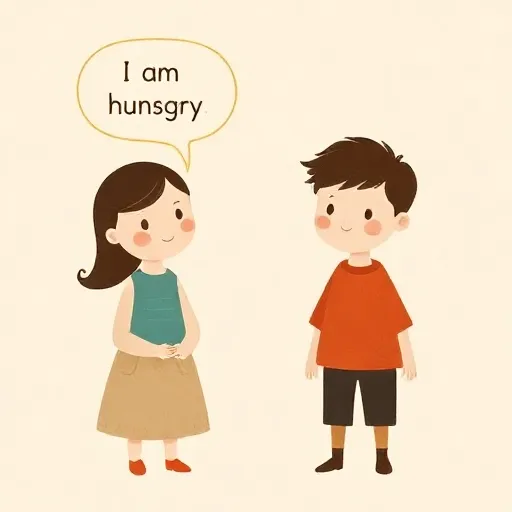
The words that make this puzzle possible are called indexicals. An indexical is an expression whose reference depends on the context in which someone uses it — especially who is speaking, when, and where. The most famous examples are I, you, she, he, it, this, that, here, now, today, tomorrow, yesterday, and actually. If you say “I’m hungry,” “I” picks you out. If your friend says the very same sentence, “I” picks out your friend. So the same unambiguous sentence can say different things — and one of those things can be true while the other is false.
This is not like ambiguity. An ambiguous word, like “bank” (riverbank or money bank), has a fixed handful of meanings you can list in a dictionary. Indexicals don’t work that way. The word “you” seems to have a single stable meaning — it means something like the person being addressed — and yet in different conversations it can refer to an unlimited number of different people. That’s why philosophers call indexicals context-sensitive expressions.
Some context-sensitive words are automatic: the reference of “I” is always the speaker, whether or not the speaker points a finger. But words like “he,” “she,” and “that” often need a little extra help — maybe a pointing gesture, or a speaker’s intention to pick out a particular person. These trickier words get the name true demonstratives.
David Kaplan’s Two-Layer Recipe for Meaning

How can a word have one stable meaning and yet refer to different things? In some very influential work first published in 1989, the philosopher David Kaplan (born 1933) proposed that an indexical carries two layers of meaning: character and content.
The character is like a recipe. For “I,” the recipe is: pick out the person who is speaking. For “now,” it is: pick out the time at which the word is uttered. For “here,” it is: pick out the location. The recipe itself doesn’t point to any particular person, time, or place; it just tells you how to find the right one once you know the context.
The content is what the recipe actually produces in a given situation. Suppose Mary says “I am a philosopher.” The character of “I” is the speakership rule. Applying that rule to the context (speaker = Mary) gives the content: Mary herself. The full sentence’s content is a singular proposition — a structured proposition that has Mary herself as a component along with the property of being a philosopher.
Kaplan also argued that indexicals are rigid designators. Once the context fixes a referent (say, Mary for “I”), that referent stays fixed even when we imagine other possible worlds. If Mary says “I might not have been a philosopher,” the content still picks out Mary across different hypothetical scenarios — it doesn’t slide around to pick out whoever might have been speaking in those other situations.
The Messy Shopper Strikes Back: A Puzzle About Belief

Now the messy shopper returns with a challenge for direct-reference theories like Kaplan’s. At the first moment, John sincerely said, “He is making a mess.” At the second moment, he said, “I am making a mess.” If both “he” (pointing at the reflection) and “I” simply contribute John himself to the content, then the two sentences expressed the very same singular proposition — that John is making a mess. But then John would have believed the same proposition all along, and yet clearly he didn’t. When he circled back and said “I,” he learned something new. So something beyond bare singular propositions matters for what we believe.
Kaplan and John Perry (who invented the messy shopper example in 1979) responded by saying we can believe a singular proposition under different ways. Those ways might be characters — the very recipes that words like “I” and “he” encode. John first believed that John is making a mess under the character of “He is making a mess.” Later he believed the same singular proposition under the character of “I am making a mess.” A rational person can even believe a proposition under one character and its negation under another, like “He is making a mess” and “I am not making a mess,” without being irrational — because the two characters are not logical opposites.
The philosopher David Lewis (1941–2001) took a different path. He proposed that believing is fundamentally self-ascribing properties. When you think “I am hungry,” you aren’t forming a proposition about yourself; you are directly ascribing the property being hungry to yourself, like sticking a mental note onto your own forehead. So when John first spotted the reflection, he self-ascribed a property like see‑a‑man‑in‑a‑mirror‑who‑is‑making‑a‑mess, but he did not self-ascribe the property making a mess until the very end. Lewis’s view avoids singular propositions altogether — for him, all believing starts with properties you ascribe to you.
Pointing and Meaning: When Does “That” Mean What You Think?

Not all indexicals are as tidy as “I.” True demonstratives like “that” and “she” raise a further puzzle: what fixes their reference? Kaplan first thought the answer was demonstrations — pointing gestures that present an object in a certain way. He imagined pairing “that” with a kind of description built into the gesture, so “that” plus a gesture toward a dog meant something like the dog I am pointing at.
But later Kaplan changed his mind. He decided that the speaker’s directing intention — the inner intention to pick out a perceived individual — was really the thing that mattered, and the pointing was just an outward sign of that intention. John Perry called these discretionary indexicals: their reference depends on the speaker’s intentions, unlike automatic ones like “I.”
Disagreement here is real. Some philosophers argue that pointing is still essential. Others say the object that counts is the one a reasonable listener would take the speaker to be referring to, based on all the available cues. A tricky example: a speaker points at Joe while silently intending to refer to Fred, whom she sees but isn’t pointing at. Does “he” refer to Joe or Fred? Different theories give different answers, and no single view has convinced everyone.
Why Your “I” Makes You Special

So why does any of this matter after you leave the grocery store? Indexicals are not just logic puzzles — they sit at the center of what it is to be you. When you think “I am tired,” you access yourself in a way nobody else can. You can be wrong about who you are in a mirror (like John), but you can’t be wrong in the same way about yourself when you consciously think “I.” That special immunity — called immunity to error through misidentification — helps explain why your first-person perspective feels so immediate and hard to doubt.
Philosophers continue to argue about how indexicals work, but almost everyone agrees on this: the little word “I” picks out something that has a whole inner world — feelings, memories, plans. Next time you say “I,” you’ll be doing something that has puzzled some of the smartest minds for decades, all while sounding as ordinary as “hello.”
Think about it
- When John first says “He is making a mess” and later says “I am making a mess,” does he learn a new fact about the world, or does he just come to see an old fact in a new way? How could you tell?
- If a language had no word like “I” or “you,” how might its speakers talk about themselves? Would anything important be missing from their thoughts?
- Imagine you point at a person and say “She is funny,” but you secretly intend to talk about someone else standing behind her. Who are you really talking about — and what should the word mean?