
Is the World Made of Tiny Bits or Smooth Stuff?
The Reed That Never Stops Breaking
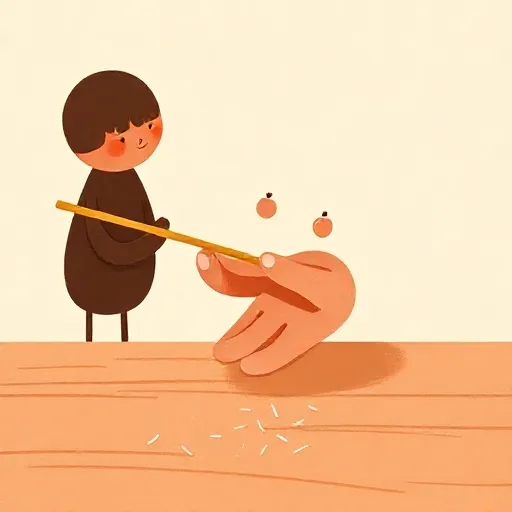
It is the year 1010. In a lamp‑lit room in Persia, a man named Ibn Sīnā — known in the West as Avicenna (980–1037) — picks up a dry reed. He snaps it in two, then snaps one half again, and then again. Can he keep breaking it forever? Or will he eventually reach a splinter so small that it cannot be split, an absolutely final building block?
Avicenna’s answer placed him at the centre of one of the most heated debates in medieval philosophy. A group of Muslim thinkers called the Mutakallimūn, or Kalām theologians, argued that the world is made of tiny, indivisible specks — atoms that cannot be divided even in your imagination. Avicenna disagreed. He believed that bodies are continuous: a smooth whole with no smallest parts, something you can keep dividing in thought without ever hitting an unbreakable floor.
The theologians had a simple reason for siding with atoms. If you could divide a thing forever, you would eventually get an actually infinite number of pieces — and they thought an actual infinity was impossible. So, they reasoned, any body must be built from a finite number of truly indivisible specks. Avicenna would spend years trying to show why that reasoning was wrong.
Why Does Cotton Burn? The Battle Over Hidden Causes
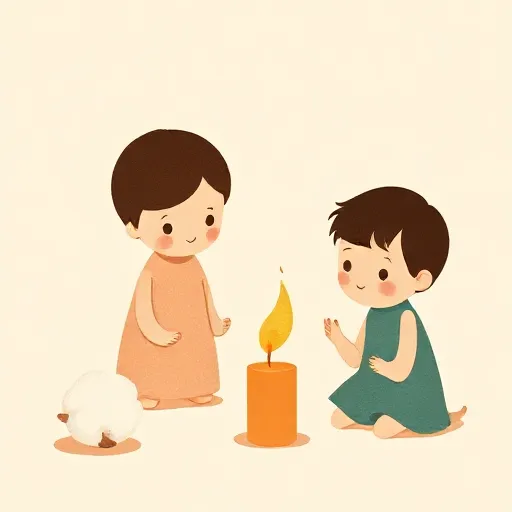
Before tackling atoms head‑on, Avicenna had to defend a deeper idea: that things have inner causes, or natures, that make them behave the way they do. A heavy stone falls because its nature pulls it downward; fire warms because its nature spreads heat. For Avicenna, a nature is an active power inside a body, a sort of built‑in instruction that drives its characteristic actions.
The Kalām theologians rejected this. They pointed out that just because two events always happen together, that doesn’t prove one causes the other. In the summer, the sun’s heat and melting ice cream always go together, and melting seems to be caused by the heat. But in many countries, eating ice cream and a rise in violent crime also go together — yet no one believes ice cream causes crime. The link is mere coincidence. So, the theologians argued, when fire touches cotton and the cotton burns, you cannot be sure that the fire makes it burn. It could simply be God’s habit to create burning whenever fire and cotton meet. Since God is all‑powerful and can cause every event directly, adding hidden natures inside things seems unnecessary. Why not leave all causal power to God alone?
Avicenna replied that proving natures exist is a job for a higher science, not for physics. But once you accept that bodies have their own active principles, you can study them — and that is what natural science does. For him, assuming natures was the only way to explain why different kinds of things behave in regular, predictable ways.
Avicenna’s Chessboard Attack
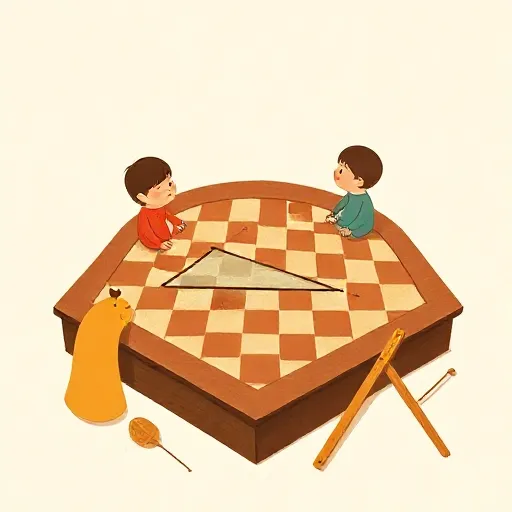
Avicenna’s most famous arguments against atomism used geometry. The Kalām theologians pictured space as a three‑dimensional grid made of indivisible “pixels” — every atom occupies one location, just like a square on a chessboard. Avicenna set out to show that such a world cannot fit with the mathematics everyone trusted.
He asked readers to imagine a right isosceles triangle drawn on a chessboard‑like grid of atoms, with the two equal sides each three squares long. According to the Pythagorean Theorem, the hypotenuse should be about 4.25 squares long. But on a grid of indivisible atoms, you can’t have a fraction of a square. If you simply count the three squares along the diagonal, the hypotenuse comes out as 3 — far too short. If you allow the atoms to be stair‑stepped, the length jumps to 6 — far too long. Atomism can’t even get close to the correct answer. For Avicenna, the choice was clear: stick with the proven mathematics of continuous magnitudes, or accept a physics that produces absurd results.
He offered another thought experiment. Hold up a sheet of indivisible atoms between yourself and the sun. The side facing the sun must be different from the side facing you; otherwise the sheet isn’t really between you and the sun. But if an atom has a sun‑side and a you‑side, it has two distinct faces — and you have just divided it in thought. The supposedly indivisible speck has been broken by logic alone.
For Avicenna, these puzzles showed that the continuous, infinitely divisible picture of bodies was the only one that made sense. Bodies are not built from unbreakable bits; they are unified wholes. You can imagine marking off a left half and a right half, but those parts vanish the moment you stop imagining them. Real division happens only when you physically snap the reed, cutting one form into two new ones.
The Clock That Never Started
The argument about atoms was also an argument about infinity. Avicenna defined infinity (or the infinite) as “that which, no matter how much you take away, always has something left outside it.” He accepted that things could be potentially infinite — you can keep dividing a line in your mind forever without reaching an end — but he denied that an actual, completed infinity could exist in nature.
That led him to a daring conclusion about time. Avicenna thought of time as a measure of motion, especially the smooth, circular spin of the heavens. He then offered a proof that time can have no beginning.
Suppose God created the universe exactly 10,000 solar years ago. Because God is all‑powerful, He could have created it 20,000 years ago instead, with the same sun‑centered clock ticking from that earlier moment. In that longer timeline, the final 10,000 years would exactly match the 10,000 years of the first scenario. But the extra 10,000 years — the ones before the supposed first moment — would be a real possibility of motion before the world began. And that possibility, Avicenna argued, is time itself. So time must have existed before the first moment — a flat contradiction. The only way out, he believed, was to accept that time, motion, and moving bodies have always existed, stretching infinitely into the past and the future.
It was a bold claim. Many later Islamic thinkers, including the theologian al‑Ghazālī (1058–1111), pushed back fiercely. For them, God’s creative act was a free choice, and the world certainly had a beginning. But Avicenna’s argument forced everyone to think deeply about what a “beginning of time” could even mean.
Why a 1,000-Year-Old Debate Still Echoes
Avicenna’s questions feel surprisingly modern. Is space perfectly smooth, or is it made of grain‑like units? Did time have a first tick, or has it been flowing forever? These are not just historical puzzles — they are live questions that scientists and philosophers still wrestle with.
But you don’t need a laboratory to feel the pull of the debate. Next time you snap a stick, stare at a chessboard, or watch a candle burn, you are holding the same problems Avicenna held. Can you keep splitting things forever in your imagination? If the past is infinite, could there ever be a “first morning”? The world may not hand you a final answer — but asking well is what makes you a philosopher.
Think about it
- If a friend claimed that a video game character is made of unbreakable pixels, how would you use a diagonal line to challenge that idea?
- Imagine you see a light turn on every time you flip a switch. Could you ever be certain the switch causes the light, or might some hidden habit be at work?
- If the universe had no beginning, does that make the idea of a creator impossible, or could a creator make an eternal universe without a first day?