
Is the World Made of Tiny Pixels or One Smooth Thing?
A Grain of Sand, Zoomed In Forever?

Take a grain of sand. Imagine you could zoom in on it, closer and closer, forever. Would you eventually hit a smallest possible piece—a tiny, indivisible thing that can’t be cut any further? Or would the sand just keep getting smoother and smoother, with no final piece at all? Over a thousand years ago, in the bustling intellectual world of Baghdad and beyond, Muslim thinkers wrestled with exactly this question. Their debate pitted two powerful pictures of reality against each other: one made of tiny, hard atoms, the other a seamless, continuous whole. And they didn’t stop there—they also asked whether God causes every single change in the world moment by moment, or whether things have their own built-in powers. These arguments remain startlingly alive in both physics and philosophy today.
The earliest group, known as the theologians of kalām (which means “discourse”), built a grand system around atoms and God. Most of them held that the world is made of two kinds of created things: substances, which take up space, and accidents, which don’t. Substances were thought to be indivisible atoms—the smallest possible bits of stuff. Accidents were things like color, taste, heat, or motion, which exist in those atoms but aren’t tiny objects themselves. To this list they added God, the only uncreated being.
One of their key arguments for this view was that the world must have a beginning. They reasoned like this: if the world had no beginning, then an infinite number of past days has already passed. But crossing an actual infinite is impossible—you can never finish counting to infinity. So the world must have started at some first moment. And if it started, it must have a Creator. That Creator, they said, made the atoms and the accidents that ride on them.
The theologians’ case for atoms leaned heavily on paradoxes of the infinite. They argued that if a body were continuous, it could be divided in half, and each half divided again, without end. That would mean a single body contains an actually infinite number of parts—but actually having infinite parts, they insisted, is absurd. Even if you said the parts are only “potential,” the theologians had a sharp comeback: if something is truly possible, an all-powerful God could make it actual. So let God turn all those potential divisions into real ones—suddenly you’d have an actual infinite, which is impossible. One vivid analogy, a twist on Zeno’s paradox, featured an ant creeping across a sandal. If space is continuous, the ant must first reach the halfway point, then the halfway point of that remainder, and so on forever. Since an insect obviously can cross a sandal, they concluded that space cannot be continuous—it must be made of a finite number of atomic steps.
The Atomists: Tiny Building Blocks and God’s Refresh Button
So for most kalām theologians, the world is a vast collection of atoms. But atoms themselves are all alike—like identical, unmarked building blocks. Why then does one chunk of matter feel hot and another cold, or look red and not green? Their answer: accidents. Accidents are qualities that inhere in atoms, making them this way or that. They listed over twenty kinds, from obvious ones like taste and smell to trickier ones like life, willing, and even ceasing to exist.
Change, then, happens when one accident is replaced by its opposite. An atom doesn’t change by itself; instead, an accident like “cold” is annihilated and “heat” takes its place. This view led many later theologians to an especially radical idea: occasionalism. According to occasionalism, God is the only true cause. At every single moment, God recreates the entire world—every atom, every accident—and directly brings about every event. If a stone moves when you throw it, it’s not because your hand transferred force; it’s because God created that motion in the stone at that instant. The same goes for your own choices: God creates them, too.
One argument for occasionalism turned on the notion of possibility. Suppose a creature can perform an action only when it has the possibility to do so. That possibility either is actualized or it’s not. If it’s not actualized but still exists, that seems like an existing thing that also doesn’t exist—a contradiction. But if it is actualized, then the creature must always be doing the action whenever it has that possibility. Yet creatures sometimes act and sometimes don’t. Therefore, the theologians concluded, the possibility to act must be created for the creature whenever it acts—and only God can do that creating. In short, God is the sole agent behind every event.
Not everyone was on board. A bold early theologian named Ibrāhīm al-Naẓẓām (died around 840) rejected atoms entirely. He held that bodies are continuous, and space is continuous, too. But that immediately brought back the ant-sandal problem: if you have a continuous distance, crossing it seems impossible because of the endless halfway points. Al-Naẓẓām offered a daring solution: the leap (ṭafra). A moving object doesn’t pass through every point in between. Instead, it makes a finite number of jumps—leaping over the intervening space without being in it. Like a video game character that teleports between frames, the object is at one location, then suddenly at another, without ever occupying the gaps.
The Leap: al-Naẓẓām Pokes Holes in Atomism
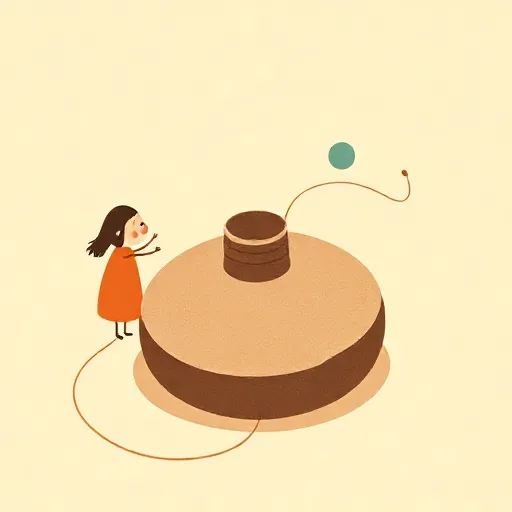
Al-Naẓẓām didn’t just defend his own view; he tried to show that even atomists were forced to accept leaps. He imagined a rotating millstone. An atom near the outer edge travels a much longer circle than one near the hub in the same amount of time. So the outer atom moves faster. On the atomists’ picture, space is a grid of atom-sized cells. There are only two ways to explain the speed difference: either the outer atom skips some cells (a leap), or the inner atom stops and rests at some cells while the outer one catches up. But if the inner atoms rested while neighboring outer atoms kept moving, the atoms that began next to each other would drift apart—the millstone would shatter. Since millstones obviously don’t fly apart, al-Naẓẓām concluded that even atomists must admit leaps. It was a clever challenge, though most atomists simply denied that the resting solution broke the stone.
Meanwhile, a whole different intellectual tradition was developing: falsafa, the Arabic continuation of Greek philosophy, especially Aristotle. These philosophers took a thoroughgoing continuous view and launched detailed attacks on atomism. One of their favorite weapons was mathematics. They asked: imagine space as a chessboard of atomic cells. Now draw a right isosceles triangle with legs four atoms long. The hypotenuse would have to run down four atomic diagonals—so its length would be four atoms. But the Pythagorean theorem says the square of the hypotenuse equals the sum of the squares of the legs: 4² + 4² = 32, but 4² is 16. That’s a flat contradiction. If atoms were real, the most reliable theorem in geometry would fail. The only reasonable fix, they argued, is to reject atoms.
Then they pressed a deeper conceptual point. Atoms were supposed to be conceptually indivisible—you couldn’t even imagine a smaller part of them. But think about three atoms touching in a row: A, B, C. B separates A from C. For B to be in contact with both A and C, B must have one part touching A and a different part touching C. If those two parts are separate, then B is conceptually divisible after all. The atomists were stuck with parts inside the indivisible.
The Philosophers Fight Back: Math and Minima Naturalia

The philosophers did admit one kind of smallest unit, though. Following Aristotle, they accepted minima naturalia—natural minimum sizes below which a particular kind of stuff cannot survive. Water, for example, has a natural minimum. If you keep dividing a cup of water into smaller and smaller drops, eventually the surrounding heat and dryness will overwhelm it. The water’s underlying qualities become so altered that it instantly turns to air. You’ve hit the smallest possible piece of water, even though the underlying matter itself isn’t made of indivisible atoms. This wasn’t a limit on space itself, only on how far a specific substance can be divided and still stay that substance.
Their argument for minima naturalia appealed to experience: a ton of molten iron takes longer to cool than an ounce, because the smaller piece is more easily acted upon by the cooler surroundings. As you divide a substance, its resistance weakens. Below a certain threshold, the surrounding qualities dominate and the original form is replaced. So water, wood, flesh—all have natural minima, but the underlying continuous stuff has no smallest bit.
This picture of continuous matter was tied to a definition of motion that the philosophers inherited from Aristotle and refined. For them, motion was the gradual actualization of a potential—a perfecting of something while it’s still on the way. The greatest Muslim philosopher, Avicenna (980–1037), gave a famous analysis: motion isn’t a single stretched-out thing existing all at once. Instead, it’s a series of instantaneous perfections at each intermediate point, each lasting only an instant. Like the frames of a film running together to create a smooth movement in your mind, the real motion outside your mind is just the moving object being at the right place at each instant, without resting.
Who Causes Change? The Occasionalist Answer

Back to the question of causality: the later theologians’ occasionalism may sound strange, but it had a powerful logic. If God is recreating the world at every instant, no created thing can genuinely cause anything else. An act you will now, in one instant, can’t reach across time to affect a different body in the next instant—because that body is a whole new creation. God alone bridges the moments. This view made human actions directly dependent on divine creation.
The philosophers pushed back, but their alternative also had to handle the same worries about infinity and continuity. When they said matter is continuous, they insisted it was only potentially divisible—you can imagine dividing it forever, but the divisions aren’t already lurking inside as actual parts. The atomists’ demand that God actualize all potential divisions was, to them, like demanding that a painter complete an endless to-do list; it’s not a real power because the task by definition has no finish line.
On the topic of space and void, most philosophers rejected empty space entirely. They defined place as the inner surface of the surrounding body, not a separate container. So the universe as a whole had no place—except perhaps the middle point around which it spins. Absolute empty space, they argued, was a conceptual mess: if void is nothing, how can it have length, width, and depth? But some, like the independent physician-philosopher Abū Bakr al-Rāzī (died about 925), boldly posited five eternal things: God, a World Soul, prime matter, absolute time (duration), and absolute space (void). For him, space and time weren’t relative to objects and motion; they existed independently, as an unchanging backdrop.
Why It Still Matters: Pixels, Physics, and Choices

Today, physicists ask whether space and time are ultimately made of discrete chunks—a smallest length (the Planck scale) or a smallest tick of time. That sounds a lot like the old atomist grid. But other theories suggest the universe is fundamentally continuous. The medieval debate hasn’t disappeared; it’s just dressed in new mathematics.
And here’s a twist that touches your own life: if everything, including your choices, is recreated moment-to-moment by something larger—or determined by prior causes—then in what sense are you actually in charge? The atomist theologians thought that God’s constant recreation meant your actions are His actions. Many modern thinkers, without bringing God into it, still worry that a universe ruled by deterministic laws leaves no room for free will. The medieval struggle over atoms and continuity thus turns out to be a hidden chapter in the story of human autonomy. That grain of sand, and the ant on the sandal, keep asking us: what is the world made of, and who—or what—makes things happen?
Think about it
- If someone proved that the universe is made of tiny, indivisible points, would that change how you think about your own identity from one moment to the next?
- If God (or a supercomputer) re-created the entire world every instant, could you still be praised or blamed for something you “did” yesterday?
- Imagine a world where everything, including your decisions, is physically determined. Can you still feel free? Which matters more: feeling free or actually being free?