Why Did a Philosopher Think Gut Feelings Were Key to Truth?
The Scholar Who Fled Baghdad at Dusk
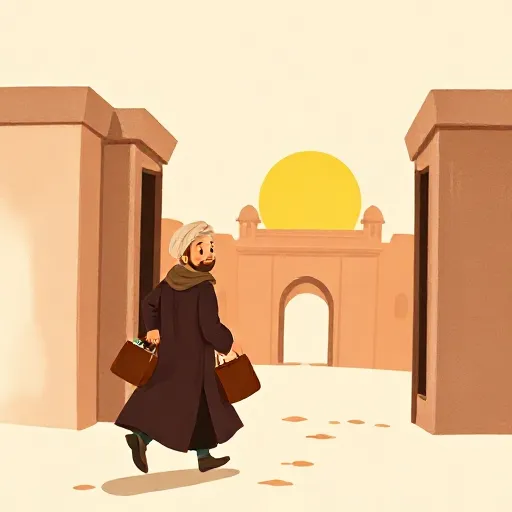
In 1284, an old scholar named Ibn Kammūna grabbed a stack of papers and slipped out of Baghdad. He had written a book comparing Judaism, Christianity, and Islam — not to attack any faith, but to examine them like a scientist. Yet some people were furious. He fled to the nearby town of Hilla and died soon after. Who was this philosopher, and why did his ideas shake his world?
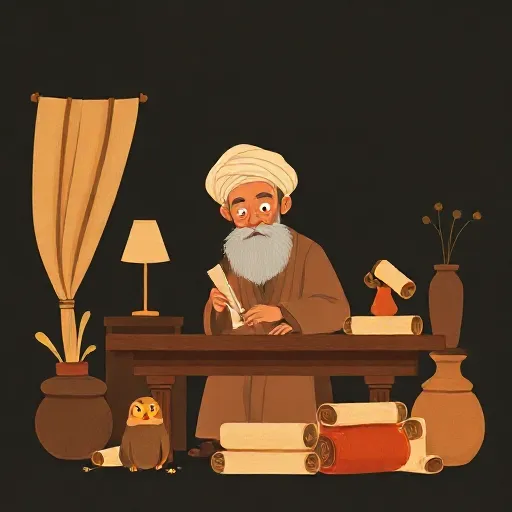
Ibn Kammūna was born into a Jewish family in Baghdad, then a great center of learning. He spent most of his life there, studying logic, physics, and metaphysics. He wrote letters to leading thinkers like Nasir al-Din al-Tusi (1201–1274) and composed long commentaries on difficult works. He may have worked for powerful patrons, and some historians think he fled because a patron was executed. Others blame the anger stirred by his book on religions. Very few facts about his life are certain, and some suggest he may even have converted to Islam late in life — but many researchers doubt that ever happened.
What is clear is that Ibn Kammūna’s work kept busy minds buzzing for centuries. He grappled with enormous questions: What is the soul? Where does real knowledge come from? And can we ever be truly neutral when comparing our deepest beliefs?
What Is the Soul? The Flying Man and the “I”

Long before Ibn Kammūna, the famous Persian thinker Avicenna (Ibn Sīnā, 980–1037) proposed a bold thought experiment. Imagine you are created floating in mid-air, blindfolded, with nothing touching your skin. You cannot see, smell, or hear anything. What would you still know? Avicenna answered: you would still be aware of your own self. That inner “I” is the nafs — the soul, or self.
Ibn Kammūna adopted this as his starting point. In his writings, he explained that the word “soul” simply means that very thing you point to when you say “I did this” or “I thought that.” But he went further than Avicenna. He argued that the soul is really an intellect ( ‘aql ) that gets attached to a body. It existed before the body was born and survives after death.
Most philosophers of his time, including Avicenna, denied that the soul existed before birth. Ibn Kammūna disagreed. He thought that proving the soul’s pre-existence was essential if you wanted to prove it is immortal. If the soul is immaterial and eternal in the past, it makes sense that it continues forever. He even tried to turn Avicenna’s floating‑man argument into a tight logical chain — a syllogism — where each step follows from the last. Imagine solving a puzzle so carefully that the conclusion locks into place. For Ibn Kammūna, the soul’s eternity was a puzzle he felt he had solved.
The Flash of Certainty: Ḥads and the Basis of All Knowledge

If you have ever stared at a math problem and then, suddenly, the answer appeared in your mind like a bulb switching on, you have experienced something like what Ibn Kammūna called ḥads (pronounced “hads”). In strict Arabic logic, ḥads is a flash that reveals the middle term of a syllogism — the secret connector that makes a conclusion inescapably true. But in practice, philosophers used the word for any sudden, certain grasp of a truth that had been hidden.
Ibn Kammūna made a huge claim: ḥads is the ultimate basis of all human knowledge. Some people, he said, are born with a powerful gift for it. They see the middle term in an instant, without a teacher. Others learn those truths second-hand, by being taught what the gifted ones discovered. But everything we know, he argued, traces back to someone’s flash of intuition. Great scientists, wise leaders, and even prophets owe their breakthroughs to a particularly intense and pure ḥads.
He also paired ḥads with tajriba — repeated experience. An astronomer might use ḥads to grasp why planets need several invisible orbs to move the way they do, and then test and refine that insight by watching the sky again and again. A prophet, at the very top of the human scale, might receive knowledge so perfectly that it meets all the standards of a logical demonstration, even if the steps happen without any conscious searching.
Ibn Kammūna did not think you had to be born a genius to benefit from ḥads. In some of his more personal writings, he described how a person can train the soul by retreating to a quiet place, thinking deeply on divine things, and even using music and poetic songs. In that state, a “taste” of the divine might arrive — a flash that cannot be described in words, but that leaves you knowing something new. So for him, intuition was both a natural gift and a skill that could be cultivated.
Can You Compare Religions Without Playing Favorites?

Ibn Kammūna’s most famous book is the Examination of the Three Faiths. He began with a bold move: he argued that Jews, Christians, and Muslims all accept the very same theory of prophecy, and that this theory meets the truth‑standards of philosophy. On that common ground, he thought, you could then compare their different claims like a judge weighing evidence.
He constructed the Jewish position by blending ideas from two great thinkers, Maimonides (1138–1204) and Judah Halevi (c. 1075–1141). The result, he hoped, was a fair presentation of all sides. The Examination has often been hailed as the first calm, scientific comparison of religions — not a shouting match, but a careful study.
Yet when you read closely, the scales tip. Ibn Kammūna clearly favored rabbinic Judaism. Subtle details in the way he framed arguments made his own faith look more reasonable than the others. Christians and Muslims accused him of misrepresenting their beliefs, and both groups wrote rebuttals. No Jewish reaction at all has survived — perhaps because no one felt a need to defend against a book that, however politely, made Judaism look strongest.
The philosopher’s struggle is a vivid reminder: even when we try hardest to be neutral, our deepest commitments often shape what we see. A 13th‑century scholar with a towering intellect could not fully escape his own background. That does not make the Examination worthless — but it does show why we have to keep checking our own blind spots.
Puzzles That Still Bother Philosophers
Ibn Kammūna also left behind a nest of logical puzzles that Iranian thinkers kept debating for centuries. One is the famous liar paradox — a sentence that says “This sentence is false,” which is a true statement only if it is false, and a false statement only if it is true. He examined it in his big book of philosophy, The New Wisdom, and later writers mistakenly thought he had invented it.
Another is the problem of unity. Philosophers often described God as wājib al‑wujūd — “that whose existence is necessary,” a being that cannot fail to exist. But can there be more than one necessary being? Ibn Kammūna said no, and his reasoning was clever. If there were two such beings, then “necessary existence” would not be the unique essence of either one. Instead it would be just a shared trait, like two people both having black hair. For God to be genuinely necessary, there can be only one. Some later critics found holes in the argument, and the debate rattled on.
He even tried to prove that the world was created by twisting a piece of logic about what is “immediately real.” When he sent his proof to Nasir al‑Din al‑Tusi, the master logician quickly found its hidden flaws. Ibn Kammūna’s puzzles remind us that logic is hard, and that very smart people can make subtle mistakes that take generations to untangle.
Why a 13th‑Century Gut‑Feeling Still Matters

You do not need a time machine to meet Ibn Kammūna. The next time you have a hunch that turns out to be right, or a sudden “aha!” that solves a puzzle, you are brushing against the same question he chased: how does a mind leap straight to a truth without plodding through every step? He thought that flash was not magic but a natural power, one that could even be strengthened by meditation, music, and deep thinking.
He also left a challenge about honesty. Can any of us fully set aside our loyalties when we compare beliefs that matter to us? Watching a medieval philosopher struggle with that — and be criticized for it — might make you pause the next time you’re sure your team, your family, or your tradition is obviously right.
And that floating‑man thought experiment? Try it tonight. Close your eyes, block out sounds, and try not to focus on your body. What remains is the simple, stubborn feeling of “I am.” Ibn Kammūna believed that this “I” — your soul — is older than your body and will outlast it. You do not have to agree. But the very fact that you can examine your own existence is the start of philosophy. That is a gift he would recognize immediately.
Think about it
- If you suddenly know the answer to a puzzle without any step-by-step reasoning, is that knowledge as trustworthy as something you proved carefully?
- Can a person who belongs to a religion ever write a completely fair comparison of different faiths? What would it take?
- Imagine you are the floating man — no body sensations, no sights or sounds. What would you still know about yourself, and how would it change how you see other people?