He Left Everything to Find the Truth About Reason and Revelation
The Teacher Who Walked Away

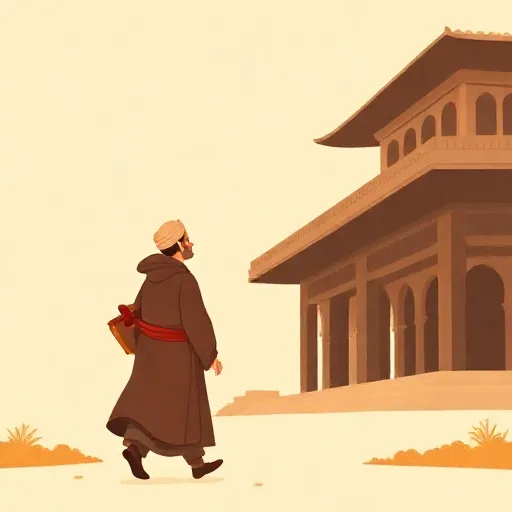
In 1095, the most famous teacher in Baghdad did something shocking. Abū Ḥāmid al-Ghazālī (c. 1058–1111) was a star professor at the Niẓāmiyya madrasa, a trusted advisor of the sultan, and one of the most brilliant minds in the Islamic world. Then, almost overnight, he gave it all up. He walked away from his position, his students, and his life of influence. He left the city and headed into the desert, determined never again to serve rulers or teach in state-run schools.
What could make someone abandon so much? Al-Ghazālī had realized that his comfortable life was tangled up with the corruption of powerful politicians. He worried that chasing worldly success was poisoning his soul. More than that, he was burning with a deeper question: what can human reason really prove about God, the world, and how we should live? And when reason and revelation seem to disagree, which one should we trust?
What the Philosophers Claimed — and Why It Mattered
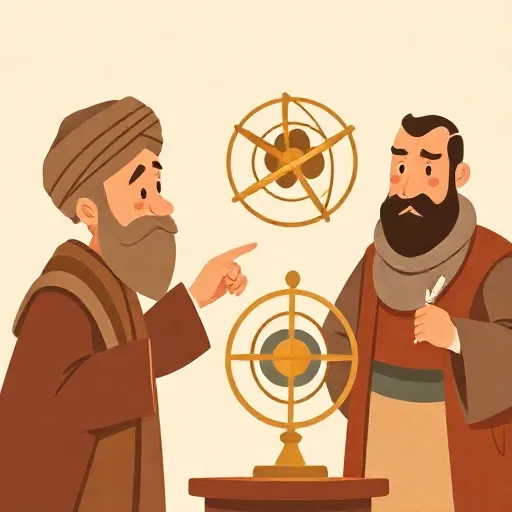
Decades before his crisis, al-Ghazālī had already thrown himself into a heated debate. A movement called falsafa (the Arabic name for philosophy) had brought the ideas of Aristotle and other Greek thinkers into the Islamic world. Its champions, the falāsifa, included brilliant Muslims like al-Fārābī (c. 872–950) and Avicenna (Ibn Sīnā, 980–1037). They offered a grand system of thought that explained everything — from the motion of the stars to the nature of the human soul — using logic and reason alone.
Some of their teachings, however, flatly contradicted central beliefs of Islam. They argued that the world had no beginning in the past, that God’s knowledge did not include the tiny details of individual lives, and that after death human souls would never return to physical bodies. For a devout Muslim like al-Ghazālī, those claims were not just mistakes — they were dangerous. If people believed them, he feared, they might abandon the religious law altogether.
So al-Ghazālī did something few would dare. He spent years studying the works of the falāsifa so deeply that he could argue from inside their own system. Then he wrote a book with a pointed title: The Incoherence of the Philosophers. His goal was not to dismiss philosophy wholesale; it was to show that the falāsifa had broken their own most important rule. They claimed their positions were demonstrations (burhān) — airtight proofs that no reasonable person could deny. Al-Ghazālī set out to prove they were nothing of the sort. Their arguments, he said, rested on unproven assumptions that only other philosophers accepted. He accused them of simply repeating the founders of their movement, not truly examining the evidence. And at the end of his book, he drew a bold line: three of their teachings were so wrong that anyone who publicly taught them was, in his view, an apostate from Islam.
When Reason and Revelation Seem to Collide
But al-Ghazālī was no simple enemy of reason. In fact, he insisted that a sound rational proof could never truly contradict what God had revealed. Both reason and revelation, after all, came from the same source. So he proposed a rule to handle apparent conflicts.
If a philosopher could present a genuine demonstration — a proof so solid that no rational person could reject it — and that proof clashed with the obvious, literal meaning of a verse in the Qur’an, then the Muslim scholar must do something bold: interpret the verse as a symbol. For example, the Qur’an describes God as having a “hand” or sitting on a “throne.” Reason, al-Ghazālī argued, proves that God is not a body and does not take up physical space. So those passages must be read symbolically. This method of reading sacred text beyond its literal surface is called allegorical interpretation (taʾwīl). But he warned that allegory is not a playground: you can only use it when a real demonstrative proof forces you to. Without that, you must stick to the plain meaning of the words.
This rule sparked debate for centuries. A later thinker, Averroes (Ibn Rushd, 1126–1198), accepted the rule but disagreed on the facts. Averroes believed Aristotle had already demonstrated that the world is eternal, so that teaching should become a religious doctrine, not a heresy. Al-Ghazālī thought no such demonstration existed. The argument was about which truths reason could actually lock down — and which ones still required trust in scripture.
Training Your Soul Like a Horse: Ethics After the Crisis

When al-Ghazālī left Baghdad, he didn’t just argue with philosophers — he transformed his own way of living. He began writing his massive guidebook, The Revival of the Religious Sciences, a forty‑book roadmap for ethical life. In it, he scolded fellow scholars who, he said, cared more about worldly reputation than about their souls. His message was stark: on the Day of Judgment, it won’t be your fine beliefs that save you, but the good habits you built in life.
In building this ethics, al-Ghazālī quietly borrowed from the very philosophers he had criticized. He adopted the idea that moral health comes from developing character traits (akhlāq). Like Aristotle, he thought virtues are acquired by repeated practice. A person who forces herself to be generous until it becomes second nature becomes genuinely generous. He compared the human soul to a young horse: you shouldn’t try to destroy its natural drives like anger or desire, but you must train and guide them with your rationality.
He even adapted the philosophers’ psychology to explain prophecy. Avicenna had described prophecy as an especially powerful combination of mental faculties that exist, in a small way, in every person — like the ability to understand something in a flash, or to have a vivid dream that comes true. Al-Ghazālī used this model to explain how Sufi saints and prophets receive higher knowledge, placing them above what unaided reason can ever reach.
Do Fire and Cotton Have to Go Together?

In one of the most famous parts of The Incoherence of the Philosophers, al-Ghazālī took a match to something we take for granted: cause and effect. When you touch fire to a ball of cotton, it burns. Why? The philosophers said it burns because fire possesses a nature that necessarily produces burning — the connection is forced, unbreakable. Al-Ghazālī disagreed. Observation only tells us that the two events — fire touching, cotton burning — happen side by side. It does not prove that fire makes the cotton burn, or that nothing else could be involved.
He argued that God is the only true agent in the universe. Cotton burns not because fire forces it, but because God creates the burning at the moment fire touches it, following a steady custom (sunna). The Qur’an insists that God’s custom never changes. The world runs on unvarying habits, so it looks exactly like a world of necessary causes. But those habits could have been different — we can imagine a world where fire leaves cotton unharmed — and God freely chose this one.
Al-Ghazālī never insisted that God must create every event directly. He left two possibilities wide open. God might use a chain of intermediate causes (like a celestial angel passing along creative power), or He might create each flame and each thought from scratch. Both possibilities, he said, are consistent with reason and scripture. What he refused to accept was the idea that the causal order is an unthinking machine, compelled by its own nature. The world is held in being moment by moment by a conscious, choosing Creator.
Why This Still Matters: Choosing What to Believe

Al-Ghazālī’s story isn’t just a medieval curiosity — it’s a mirror for anyone who has ever felt torn between what they can prove and what they believe. He was a brilliant logician who still thought that the deepest truths about life, God, and the human soul might come through revelation and the purified heart, not through argument alone. Yet he refused to turn off his brain. He wanted both reason and faith to be at the table, each keeping the other honest.
His rule about allegorical interpretation still echoes whenever a new scientific discovery seems to challenge a religious teaching. Should we reinterpret scripture? Should we question the science? Al-Ghazālī would say: first, check whether the scientific claim is really a demonstration. If it is, then we may need to read the sacred text differently. If it’s only a strong guess, the literal sense might still stand. And his stubborn belief that God’s habits are uniform but not automatic leaves a window open for miracles — understood not as God breaking the rules, but as rare events already woven into the fabric of creation from the beginning.
Most of all, his personal crisis reminds us that the search for truth can be uncomfortable. It might lead you to leave behind what is safe and familiar, to ask whether the way you’re living matches what you actually believe. For al-Ghazālī, that was worth everything.
Think about it
- If you saw an event that broke every known pattern of nature, how would you decide whether it was a genuine miracle, a trick, or just something science hasn’t explained yet?
- Imagine a future discovery proves beyond any doubt that the universe had no beginning in time, directly contradicting a creation story you grew up with. What would al-Ghazālī’s rule suggest you should do, and what would you actually do?
- Al-Ghazālī believed that God determines everything that happens, including all your choices, yet you still feel completely free when you pick what to eat for lunch. Could both be true at the same time? If your choices are predetermined, can praise or punishment ever really be fair?