What to Do When Everyone Around You Is Wrong?
A Vizier Who Asked Big Questions
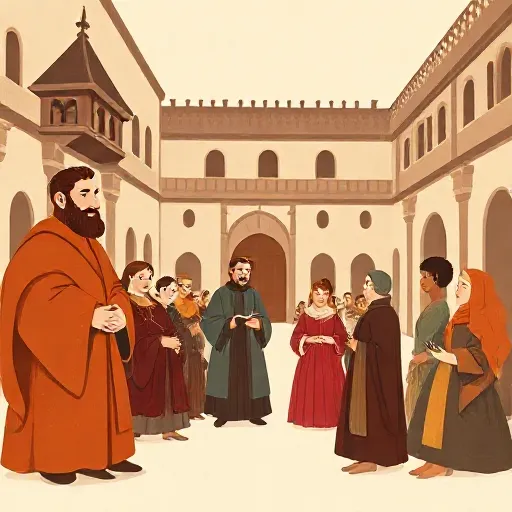
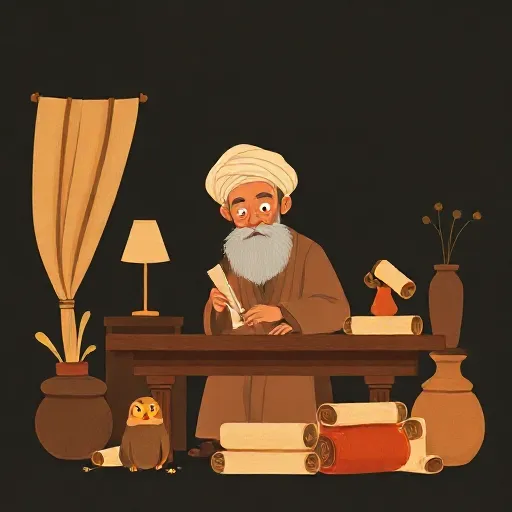
In the early 1100s the Muslim kingdom of Saragossa, in what is now Spain, was a hothouse of art and science. One of its brightest stars was Ibn Bajja (c. 1085–1139), a man who wrote poetry, played the lute, studied astronomy and medicine — and became a trusted vizier (a high‑ranking adviser) to the governor Abu Bakr ibn Tifilwit. The two spent afternoons in a fortified palace, enjoying music, wine and conversation. Ibn Bajja even composed moving elegies when the governor died in battle. But behind the courtly life, Ibn Bajja was quietly building a philosophical system that would ask: how can a person find real happiness when the society around them is blind to the truth?
His life was never safe. After Saragossa fell to Christian armies in 1118, Ibn Bajja moved between courts, was imprisoned more than once, and made fierce enemies — one rival physician hated him so intensely that, years later, gossip whispered Ibn Bajja was poisoned with an aubergine. Even so, he kept writing. Latin scholars later called him Avempace, and his most original ideas would influence thinkers across Europe and the Islamic world.
Building Knowledge from the Ground Up

Before you can argue about big questions, Ibn Bajja believed, you have to understand how any science works. He borrowed a framework from the earlier philosopher Alfarabi (d. ca. 950): every piece of knowledge begins with two acts of the mind — conceptualization and assent. Conceptualization is simply grasping the meaning of a term. When you learn the word “triangle,” you form a mental picture of a three‑sided shape. Assent is the moment you accept that a statement about that concept is true — for example, “every triangle has three angles.”
Ibn Bajja complained that many people fail to notice how many grades of assent exist. You might accept something because an authority said it, because it’s generally admitted in your community, or because you grasp it directly with your intellect. The highest grade — certain science — comes only through demonstration, the kind of rigorous proof that uses syllogisms (step‑by‑step chains of reasoning). That’s why Ibn Bajja thought logic was both a tool and a part of philosophy itself. A person who really knows something isn’t just repeating words by heart; they can trace the steps that make it undeniable.
This careful order gave Ibn Bajja a map of all the sciences: mathematics deals with objects stripped of matter but still having measure and number; physics studies natural bodies that exist whether we will them or not; metaphysics aims at the ultimate causes that are neither a body nor in a body. And above them all stands the human task of using reason to climb toward truths that never change.
The Ladder of Spiritual Forms

To explain that climb, Ibn Bajja developed a doctrine of forms. A form is not just a shape; it is the whatness of a thing — the quality that makes a horse a horse, or a flower a flower. Natural bodies are made of matter and form, but the most important forms are spiritual forms — they exist in the soul without being weighed down by matter.
Ibn Bajja arranged spiritual forms in a rising hierarchy. At the bottom are the images you get from your senses and common sense, like the memory of a particular mountain. Higher up are the abstract intelligibles — universal concepts such as “horse” or “justice,” which your rational faculty can grasp. Still higher is the active intellect, a completely immaterial substance that illuminates the mind the way the sun lights up the world. A person who trains their intellect can eventually unite with this active intellect in what Ibn Bajja called conjunction — and that, he argued, is the peak of human happiness and true freedom from mortal limits.
He was not talking about a fuzzy mystical feeling. Ibn Bajja warned that some Sufi practitioners mistook vivid particular spiritual forms for the universal intelligibles, and so mistook the lantern for the sun. The genuine summit of knowledge, he insisted, is wordless yet secure: you become one with the intelligences that Aristotle described in the Metaphysics.
The Solitary Sage in a Corrupt World
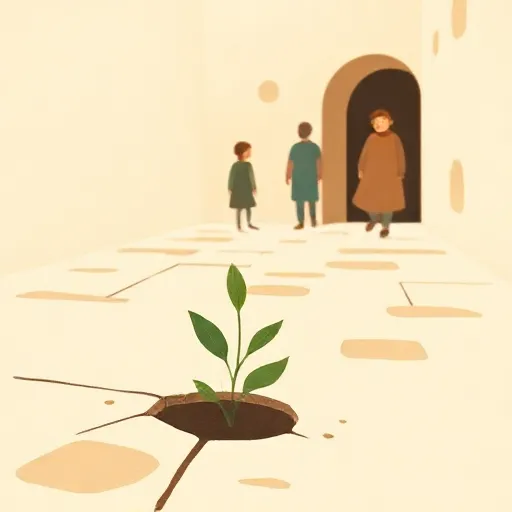
But what do you do if you live in a city full of false opinions? Ibn Bajja followed Plato in dividing societies into perfect and corrupt types. The perfect city would need no judges or doctors, because every habit would be healthy and every belief true. Ibn Bajja looked around 12th‑century al‑Andalus and saw no such place. So where did that leave a person who stumbled upon real truth?
He borrowed an agricultural image from Alfarabi: such a person is a weed (in Arabic, nawabit), a plant that springs up where it was not sown. In a perfect city there would be no weeds. In imperfect cities, the weed is alone, surrounded by people who hold wrong or contradictory beliefs. Ibn Bajja’s most famous work, the Rule of the Solitary, is written like a doctor’s manual for preserving spiritual health. It lays out how a philosopher should manage bodily needs, particular spiritual forms, and the highest universal intelligibles. He admitted that a solitary person still has to eat, dress honourably, and live among others — but their real care is the life of the intellect. By choosing the best part of every kind of activity, the solitary becomes “divine and virtuous” while remaining an outsider.
Later in the Epistle of Conjunction of Intellect with Man, Ibn Bajja described three levels of people. The common people see only shadows, like prisoners in Plato’s cave. Natural scientists see the spiritual forms that light things up. But the blessed — the true solitaries — reach absolute intelligibles and become light themselves. He acknowledged that this final step might be a divine gift, and his younger contemporary Averroes (Ibn Rushd, d. 1198) would later question whether it was a natural achievement at all. Still, Ibn Bajja offered a road map for anyone who suspects that their community’s loudest certainties might be wrong.
Thinking for Yourself, 900 Years Later

You have probably felt like a weed yourself — the only person in the room who thinks a popular opinion is unfair, or the one who wants to ask a question everyone else is ignoring. Ibn Bajja doesn’t promise that standing apart will be easy. He knew firsthand how court life, imprisonment, and fierce rivalries could squeeze a person. Yet his philosophy insists that the mind has its own dignity, and that thinking clearly about what is really true is the deepest form of health.
He also shows us that the medieval Islamic world was not a monolith. In the same century that Gothic cathedrals were rising in Europe, a vizier in al‑Andalus was analysing the speed of falling stones, explaining the Milky Way as the refracted light of countless stars, and writing a handbook of spiritual independence. His system still invites you to ask: what do I actually know, and how certain can I be? Is there a ladder of understanding I haven‘t climbed yet? Those questions belong to nobody’s city — they belong to any person who stops, steps back, and thinks alone.
Think about it
- If you believe something that almost no one around you accepts, does it take courage to keep believing it, or can evidence be enough?
- Is it possible to be truly happy while remaining an outsider in your own community, or does happiness require some amount of belonging?
- Ibn Bajja thought the highest pleasure comes from knowing eternal truths. Do you think the most lasting satisfaction comes from knowledge, from relationships, or from something else?