
Is Being Gay a Natural Kind or a Social Invention?
A Time Traveler’s Confusion
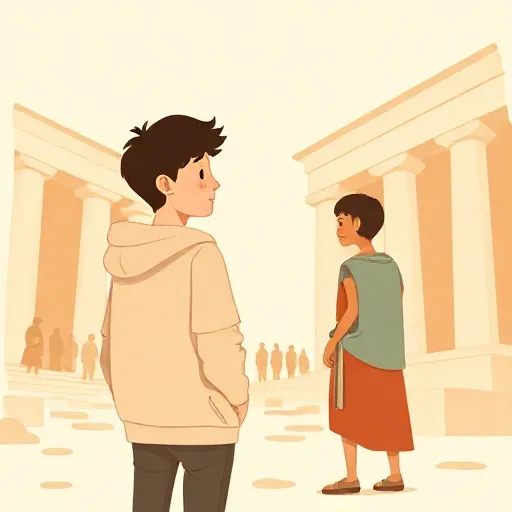
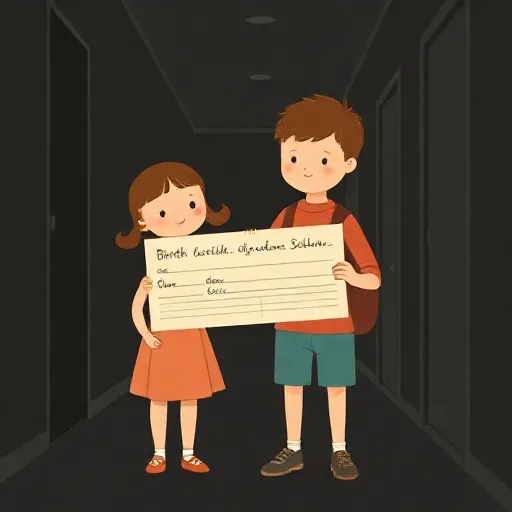
Imagine you travel back to Athens in 400 BCE. You spot a young soldier about your age. “Hey,” you ask, “are you gay or straight?” He stares at you blankly, then smiles at an older man walking towards him. “I am an eromenos,” he says, “and that is my erastes.” You have no idea what those words mean. And you’ve just stumbled onto a massive philosophical puzzle: the categories we use to think about attraction are not natural facts—they have a history.
In ancient Greece, nobody divided the world into heterosexual and homosexual. What mattered was whether you took the active (insertive) role or the passive (penetrated) role in sex. Free male citizens were expected to be active. The passive role was considered fine only for women, enslaved people, or boys who were not yet citizens. A typical same-sex relationship was between an older man, the erastes, and a teenage boy, the eromenos. There were rules: the erastes had to show he cared about the boy’s character, not just his body; the boy should not give in too easily; the relationship was supposed to end when the boy reached adulthood. This was pederasty, a cultural practice, not an identity. Most men who had same-sex relationships also married women. The idea that you could be a “type of person” defined by whom you were attracted to simply did not exist.
How the “Homosexual” Was Born
Fast-forward to medieval Europe. Christian theologians had a very different framework. They didn’t ask about your inner desires; they looked at acts. The key term was sodomite—someone who committed sodomy, which meant any non-procreative sex act, whether with a person of the same sex or the opposite sex. If a married couple engaged in oral sex, they were committing sodomy. If you had same-sex desires but never acted on them, you were not a sodomite. And if you repented and vowed never to do it again, you stopped being a sodomite. Identity was fluid; it depended on what you did, not what you felt.
That all changed dramatically in the 1800s. As science and medicine gained prestige, doctors began to study human desire as a biological or psychological condition. They argued that some people were innately attracted to their own sex—a deep, unchangeable condition that existed whether or not the person ever acted on it. Suddenly, a new character appeared in the Western world: the homosexual. The word itself was invented in 1869. Now you could be a “latent homosexual”—a person with the orientation but no visible behavior. The medieval view would have found that idea ridiculous. This shift had huge consequences. It made it harder to justify punishing people for something they didn’t choose, but it also created a new kind of medical “problem” that doctors and psychiatrists tried to cure.
Soon, this new category felt so natural that people assumed it must have always existed. But historians noticed something strange: the ancient Greeks, the medievals, and the moderns seemed to be living in completely different sexual worlds. Could it be that the thing we call “homosexuality” is not a timeless biological fact, but a socially constructed concept?
Two Camps: Natural Kind or Cultural Artifact?
Philosophers and historians broke into two rough camps. The first, essentialism, says that sexual orientation is a real, universal feature of human nature. Sure, the names and social rules differ from culture to culture, they argue, but the underlying pattern is the same. People have always had a stable, deep-down attraction to one sex or the other, even if they didn’t have the word “homosexual.” John Boswell (1947–1994), a historian, argued that gay people have existed throughout history and can be found if you know how to look. Louis Crompton (1925–2009) wrote massive studies showing that same-sex desire appears across centuries and continents. Many LGBT activists found this view empowering: if you were “born this way,” discrimination is as unjust as racism.
The opposite camp, social constructionism (sometimes called historicism), insists that sexual categories are not discovered but made. Thinkers like Michel Foucault (1926–1984) and David Halperin (1952–) argued that the very idea of “a homosexual person” is a specifically modern invention, crafted by 19th-century medicine, law, and social pressure. They point to ancient Greece: the whole setup there revolved around status and the active/passive divide, not around the gender of your partner. Men who loved men were not a separate species. So calling them “homosexual” distorts the past. According to constructionists, sexuality is irreducibly tied to time and place; there is no transhistorical essence waiting to be labeled.
The political stakes are high. Essentialists worry that if you give up the idea of a natural orientation, you weaken the moral force of the demand for equal rights. Constructionists counter that accepting the straight/gay binary as natural only reinforces heterosexuality as the norm and locks people into boxes. If categories are historically invented, then maybe we can invent better ones.
Queer Theory: Identity Without an Essence

Building on constructionism, a movement called queer theory emerged in the late 1980s. It began with a deliberate choice of language. Instead of “gay and lesbian,” which seemed to imply a fixed essence, scholars used the term queer—a word that once meant strange or bent out of shape. For queer theorists, that’s exactly the point. David Halperin wrote that “queer” refers to nothing in particular; it is simply whatever is at odds with the normal, the legitimate, and the dominant. It is an identity without an essence.
This move allows queer theory to attack the very idea that any sexual category is natural. Judith Butler (1956–) argued that even our basic sense of “male” and “female” is produced and reinforced by everyday actions—things we do without thinking, like the way we walk or talk. The categories we think are rock-solid (heterosexual, homosexual, bisexual) are actually held up by a social script, and that script privileges heterosexuality. Queer theorists look at how language and silence—the “closet” and the “out” self—structure our whole culture. Their goal is not just to win rights for a fixed group, but to crack open the whole system and free everyone from rigid labels.
Queer theory has been hugely influential in universities, especially in literary studies and feminist thought. But it has also faced fierce criticism.
Why This Fight Matters
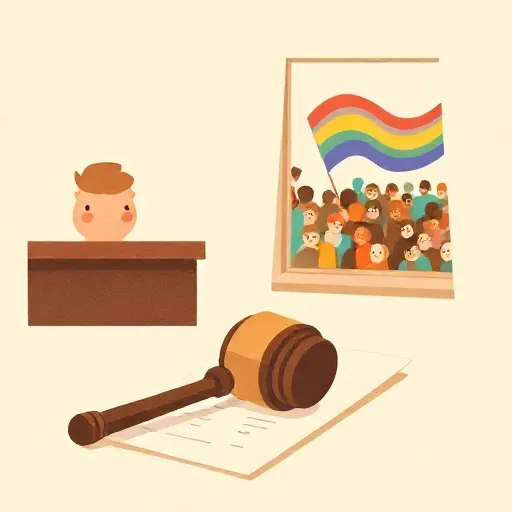
The debate between essentialists, constructionists, and queer theorists is not just an academic game. It shapes laws, families, and how you understand yourself. If homosexuality is a natural kind, then it makes legal sense to protect it like other inborn traits. If it is a social construction, then the whole framework might need rethinking—and people who feel they don’t fit neat labels might finally get to breathe.
Centrist defenders of LGBT equality, like writer Andrew Sullivan (1963–), have criticized queer theory for being too radical. They argue that using a word like “queer,” which still sounds like an insult, only reinforces prejudice. Queer theory’s refusal to define limits also raises tough questions: if “queer” is whatever challenges the norm, then what about forms of sexuality that most people find harmful? Can the theory draw any lines?
Meanwhile, essentialists are attacked by queer theorists for buying into the very system that marginalizes them. If you insist you were “born this way,” you are still accepting the idea that heterosexuality is the baseline from which you deviate. For a constructionist, the real prize is to show that all of these categories—including “heterosexual”—are cultural inventions, and therefore open to change.
So the next time you hear someone say “I’m just this way,” you are listening to a piece of a centuries-long argument. Are we born into our identities? Do we build them out of the cultural tools our history gives us? Or are both of those ideas too simple? Philosophers are still fighting it out, and the answer is anything but settled.
Think about it
- If you grew up in a culture that had no word for “left-handed” and assumed everyone should use their right hand, would being left-handed feel like a deep identity or just a weird habit?
- The idea of a “teenager” didn’t exist before the 20th century—it was invented by changes in education, work, and culture. Does that make being a teenager any less real? How is that similar to or different from sexual identity?
- Who gets to decide which labels count: scientists, your community, or you? What if those groups disagree?