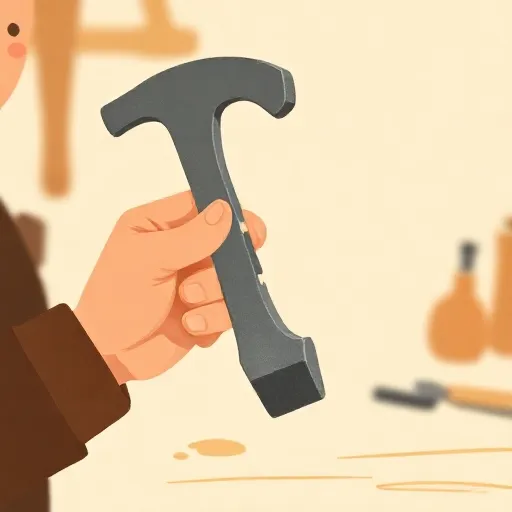

What Does It Mean to Be? Heidegger’s Hammer
A Hammer That Vanishes

You are hammering a nail. The weight of the hammer feels like an extension of your arm. You don’t think about the tool — you just hammer. The hammer withdraws, almost invisible, while you focus on the task.
Everything changes the moment the hammer breaks. Suddenly you stop and stare at it. The cracked head, the splintered handle, the cold iron — all become obvious. You are no longer smoothly coping; you are examining a object with properties, like a scientist in a lab.
This ordinary moment was the starting point for Martin Heidegger (1889–1976). He believed that one simple question had been forgotten by centuries of philosophy: What does it mean for something to be? When the hammer works, it is in a special way — not a lifeless thing, but something that solicits you, that invites you to act. By paying attention to that difference, Heidegger tried to wake us up to the deepest puzzle of existence.
Three Ways Things Can Be
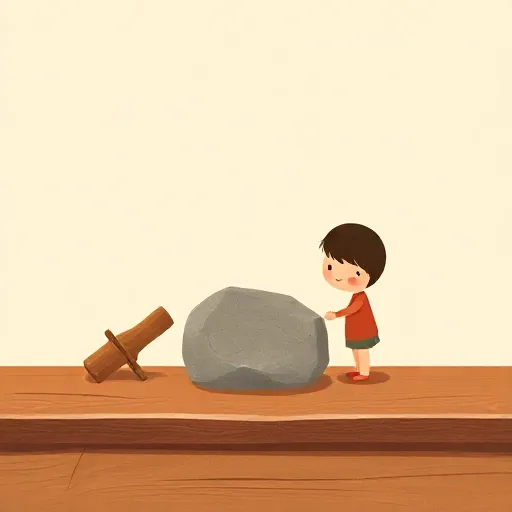
Heidegger thought things don’t all exist in the same way. He described three basic kinds of being, each with its own structure.
The ready-to-hand (or “available”) is the kind of being that tools and equipment have when they are usable. A hammer that feels right in your grip, a path that invites you to walk on it, the sun that warms your face — all show up first as something that affords an action. Ready-to-hand things belong to whole networks: the hammer points to nails, nails to boards, boards to a house, the house to shelter. You do not first notice isolated objects; you notice a world of practical invitations.
The present-at-hand (or “occurrent”) is the kind of being we discover when we step back and just look. A scientist measuring a rock’s weight or a philosopher defining matter thinks about things as substances with properties, existing independently of any human project. Even a hammer can become present-at-hand when it breaks and you examine it like a foreign object. But Heidegger insisted that the ready-to-hand comes first in everyday life — we are continually absorbed in doing, not theorizing.
The third way to be is existence, and that’s you. Heidegger used the word Dasein (a German term for “being-there”) instead of “human” to focus on what truly matters: we are the beings that can ask what it means to be. A Dasein is never fixed like a rock. You are always a “who,” not a “what” — a parent, a friend, a student, or something yet to be decided. Your being is always at stake because you can choose, change, or even stop being who you are.
Living in a Shared World

To exist as Dasein is to be being-in-the-world — not like a pea in a pod, but as a unified whole. The world is not outer space; it is the meaningful network of rooms, streets, tools, and purposes that you navigate every day. Your world shapes what shows up as relevant.
Heidegger argued that you never are a lonely “I” first. You are always being-with others. The playground, the classroom, the dinner table are all structured by what others expect and do. Even when you are alone, the possibilities you sense — what you could do, what would be weird, what feels natural — come from a shared social sense. Heidegger called this impersonal “one” the anyone (das Man): the voice that says “this is how one behaves.”
Your familiarity with the world also depends on your moods. A sunny day invites play; a tense room makes you cautious. Moods are not private feelings pasted onto a neutral world — they tune you into what matters. Fear makes threats stand out; boredom makes everything feel flat. Beneath all moods, Heidegger thought, is a fundamental understanding: a practical know-how, like knowing how to ride a bike, that lets you project yourself into possibilities.
Everyday life mostly runs on the anyone-self. You do what one does, and that is not a failure — it’s how you first make sense of things. But it also means you can drift, letting “one” decide for you.
Can You Own Your Life?

Heidegger thought that drifting with the crowd has a cost: you lose hold of yourself. He named the challenge authenticity: owning your own existence instead of letting it be lived by the anyone.
What could wake you up? Death. Not the event of dying — what he called “demise” — but the ever-present possibility that all your possibilities could end. Your death is the one thing no one else can do for you. When you genuinely face that, the crowd’s rules lose their grip. You see that your life is yours alone, and that every choice matters because your time is finite.
This encounter is terrifying. In the mood of anxiety, the everyday world suddenly seems weightless; nothing feels like the “right” thing to do. But from that collapse, a chance emerges: you can choose yourself. Heidegger called that choice resoluteness — not stubbornness, but taking responsibility for who you are, even though you can never fully justify it. You were thrown into a particular family, culture, and body you did not pick. Yet you still respond. Authentic existence means acting in light of that finitude, owning your guilt (the lack of any final excuse) and committing to a direction you know is limited.
Technology and the Danger of Stock

In his later work, Heidegger turned his attention to the modern world. He saw that technology was not just a collection of gadgets — it was a new way of revealing what things are. In the technological age, everything shows up as something that must be ordered, optimized, and made available on demand.
He called this gathered way of revealing enframing (Gestell). A forest becomes a lumber supply; a river becomes a source of hydropower; even people become “resources” to be managed. Things lose their own weight and significance; they become stock — replaceable pieces in an inventory. Boredom becomes the background mood because nothing truly calls to you; everything is just another option to distract you.
The danger, Heidegger warned, is that this style of being could drive out all others. If everything is just a resource, then friendship becomes networking, nature becomes a power plant, and the idea of something sacred — something that makes a claim on you, that you must respect for its own sake — disappears. He did not believe we could just decide to stop technology, but he hoped that by recognizing the danger we might begin to recover a more poetic dwelling: a life where we let a place shape us, where things shine as more than tools.
Why This Matters
Heidegger’s life casts a long shadow. In 1933 he joined the Nazi Party and, as a university rector, helped align the institution with Hitler’s aims. He later resigned but never publicly confronted his actions or the horror they supported. Philosophers still argue fiercely about whether his thought is tainted by his politics. That uncomfortable fact does not make his questions go away; it makes them sharper — we must ask who a thinker is and whether we can separate ideas from the life that produced them.
His central question remains urgent. Every time you scroll through endless options and feel bored, you are living the world he described — everything available, nothing truly mattering. Every time you lose yourself in a project and the world feels rich, you touch the other side. Heidegger didn’t give neat answers. He gave us a language to wonder about what it means to be, to belong, and to own our finite lives.
Think about it
- If you could live forever, would any choice still feel important? Why or why not?
- Think of an object you use every day without noticing it. What would you learn if it suddenly broke and you had to examine it like a scientist?
- Can you appreciate a forest while also knowing it could be cut down for paper? Does seeing it as a “resource” change how it actually exists for you?