Why Do You Owe More to a Baby Than to a Goldfish?
A Fire at the Rescue Center

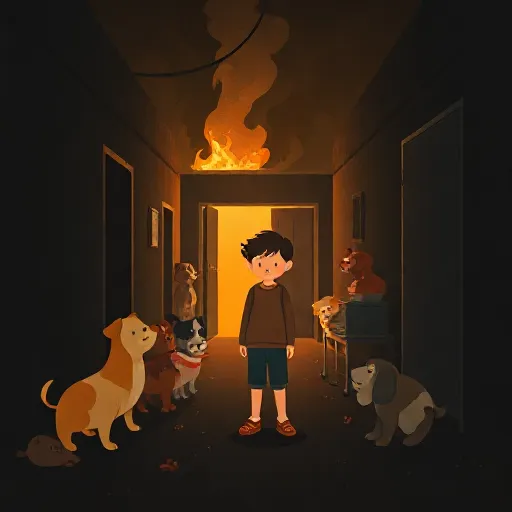
Imagine you are walking past an animal shelter when a fire breaks out. A volunteer shoves a baby, a dog, a goldfish, and a potted fern into your arms and shouts, “You can only save one!” Almost everyone would save the baby first, the dog second, the fish before the plant. Even if you love your pet, the baby somehow seems to matter more.
That feeling points to a big philosophical idea. Most of us think different beings have different moral status — a measure of how much a being’s interests count when we make decisions about what is right or wrong. A being with a high moral status gets strong protection against being killed, harmed, or used as a mere tool. The top tier is called full moral status (FMS) . But what exactly earns a being that highest rank? And why do we feel so sure a human baby has it while a goldfish does not? The answers turn out to be harder than you might think.
Full Moral Status: The Ultimate “Do Not Disturb” Sign

If someone has full moral status, it is as if they carry a sign that says, “Do not destroy, harm, or interfere with me, except for the gravest reasons.” Philosophers spell this out in a few ways. First, there is a stringent presumption against interfering — a very strong rule that forbids killing or experimenting on a being with FMS, even if doing so would bring a lot of pleasure or help others. You might bend this rule if millions of lives are at stake, but even then, a moral stain remains.
Second, beings with FMS generate a strong reason to aid — if you see one drowning, you should jump in. That reason is stronger than the reason to rescue a being with lower moral status. Third, all beings with FMS matter equally: you must treat their needs fairly, dividing up goods or lifesaving help without playing favorites.
Here is the tricky part. The “commonsense view” says all human beings — even newborn infants and people with severe brain injuries — have FMS. At the same time, it says most animals have some moral status but not FMS. A dog’s life matters, but not in the same locked-down way a human life does. The question is whether there is a single simple rule that gets all of this right. So far, every candidate rule has either left out some humans we want to include, or accidentally let in animals we want to keep at a lower status.
Four (and a Half) Ways to Explain Moral Status — and Their Troubles
Philosophers have proposed several features that could ground moral status. Each tries to separate beings who deserve FMS from beings who don’t. Each hits a painful speed bump.
1. Sophisticated thinking. The German thinker Immanuel Kant (1724–1804) argued that what makes you a moral person is autonomy — the ability to set goals using reason. More recent versions point to self-awareness, the ability to value things, or the skill of planning for the future. A being who can do these things has FMS. The problem? Infants and people with severe permanent cognitive disabilities don’t have these capacities yet (or ever). On this view, they would lack FMS and be in the same moral boat as a rabbit — clashing with the commonsense view.
2. Potential to think. The American philosopher Don Marquis (1935–2022) argued that what makes killing wrong is that it steals a “future like ours.” Even a baby has that future, so it gets FMS. This neatly covers infants, but it still leaves out humans who are born with such deep impairments that they never had the potential to develop sophisticated thought. Their moral status remains in the attic, unaccounted for.
3. Being able to feel (sentience). Lower the bar: all you need is the capacity to feel pleasure or pain. Infants and impaired humans now count. But so do dogs, cows, birds, and even fish. That means a pig and a human with the same mental life would have equal moral weight. The Australian philosopher Peter Singer (b. 1946) famously defends equal consideration for all sentient beings, but many people find it hard to accept that a severely brain-damaged infant and a sheep have exactly the same status.
4. Being human. Perhaps simply belonging to our species is enough. But why should biology matter? Imagine a spaceship lands and the aliens are super-smart but not human. Do they lack FMS? That seems unfair. Worse, imagine using gene therapy to make chimpanzees “superchimps” with human-level intelligence. On the species-membership view, a regular chimp could gain FMS just because its species’ average intelligence went up — even if its own brain stayed exactly the same. That feels arbitrary to many philosophers.
4½. Special relationships. Some thinkers claim moral status comes from being in a relationship, like the bond between a parent and child or membership in a community. Human beings might have FMS toward one another because we share a society, while a stray dog does not. The problem: if a friendly Martian landed, it wouldn’t be in that special relationship, so it would have no duty to rescue your baby sister. But moral status is supposed to be impartial — it should bind all moral agents, not just members of your club.
A Newer Idea: Learning-in-Progress

Two contemporary philosophers, Agnieszka Jaworska and Julie Tannenbaum, have offered a creative fix. They notice that when a baby plays games like “I-smile-then-you-smile” with a caregiver, the baby isn’t just acting randomly. With the adult guiding things, the baby is incompletely realizing a sophisticated activity — the start of rule‑following and practical reasoning. The baby has an incompletely realized sophisticated capacity . The same can happen when a caregiver practices interactions with a severely cognitively impaired person: the impaired person participates, however minimally, in a process aimed at developing cognitive sophistication.
Because this “learning-in-progress” is closely related to the thinking abilities many philosophers value, the account can explain why infants and many impaired humans have a higher moral status than most animals. A dog, by contrast, would never be in a similar process toward cognitive sophistication; it can flourish perfectly well without it. The idea is fresh and avoids the under‑inclusion and over‑inclusion traps of earlier views. Still, it doesn’t promise that this status is as full as FMS — it may only buy a seat just below the top tier. The search continues.
Why This Mess Matters in Real Life

You may never have to sort humans from animals in a fire, but moral‑status questions show up all around you. Debates about abortion and embryo research depend on whether a very early fetus has FMS. Arguments about raising pigs on factory farms turn on whether a pig’s sentience gives it moral weight and, if so, how much. Decisions in hospitals — like who gets the last ventilator — can become agonizing when a human with no consciousness and a cognitively gifted chimpanzee both need the same resource.
Philosophers are still arguing because every answer has consequences that make us uncomfortable. If you give FMS only to reasoning adults, you leave infants in the cold. If you give it to all sentient creatures, you demote humans to animal‑level value. That doesn’t mean the question is hopeless; it means it’s worth thinking hard about before you need to act.
Think about it
- If scientists created a chimpanzee with human-level intelligence, would it be wrong to keep it in a zoo? What would convince you one way or the other?
- A self-driving car must choose between hitting an 80-year-old person and a 10-year-old child. Does the theory of moral status you lean toward make a difference to which crash is worse? Why?
- Suppose a new medicine could prevent severe cognitive disabilities before birth. Would using it show that we think people with those disabilities have less moral status than others? Is there a way to answer that without saying either yes or no?