Can Math Prove All Truths? Kurt Gödel's Surprising Answer
The Quiet Student Who Shook the Foundations

In a crowded Viennese café in the late 1920s, a circle of philosophers argued passionately. They believed that all knowledge could be captured by precise logical rules. Among them sat Kurt Gödel (1906–1978), a slender, soft‑spoken student with thick glasses. He rarely spoke, but he was about to change everything.
Gödel was born in Brno (now in the Czech Republic). As a boy he excelled at math and languages. He went to the University of Vienna and fell in with the Vienna Circle, a group of thinkers who wanted to rebuild all of human knowledge on a foundation of logic and evidence. Their dream was a complete system — a set of rules that could prove every true statement and never lead to a contradiction.
In 1929 Gödel seemed to hand them a huge victory. His doctoral dissertation proved the completeness theorem for first‑order logic. For that simple logical grammar, every true sentence could be proved step by step. The dream looked real. But Gödel was already sensing a hidden wall.
The First Triumph: When Logic Seemed Complete
Gödel’s completeness theorem meant something striking. Take a statement like “If all humans are mortal, and Socrates is human, then Socrates is mortal.” No matter what model you imagine — a collection of objects where the words refer to something real — that statement holds true. And from just a few axioms, you can prove it. No truth of this simple logical shape ever slips through the net.
That was a big step. It showed that at the lowest level of mathematical grammar, everything true is reachable by a proof. But the logic he handled couldn’t talk about real arithmetic — adding, multiplying, or even counting all the natural numbers. As soon as mathematicians wanted to work inside a system strong enough to talk about ordinary number theory, they needed Peano arithmetic, a richer language with its own axioms.
Gödel next set out to show that arithmetic was both consistent (no contradictions) and complete (every true statement about numbers provable). Instead, he uncovered a permanent blind spot.
The Shocking Discovery: Math’s Permanent Blind Spot
In 1931, Gödel published his incompleteness theorems. They showed that any formal system strong enough to do basic arithmetic will always contain true statements that cannot be proved inside that system. And you can’t escape by adding more axioms — the incompleteness just shows up again.
He pulled this off with a clever trick called Gödel numbering. He assigned a unique number to every symbol, formula, and sequence of formulas. So a statement like “0 = 0” became a number. Then he could talk about proofs using arithmetic itself. He built a sentence that, through this coding, said about itself: “This sentence is not provable in the system.”
Think of the old liar’s paradox: “This sentence is false.” If it’s true, it’s false; if it’s false, it’s true. Gödel swapped “false” for “not provable.” If the system could prove the sentence, it would be proving something that says it isn’t provable — which would mean the system is inconsistent. If the system cannot prove it, then the sentence is true but unprovable. So any consistent system must contain true, unprovable statements. This is the First Incompleteness Theorem.
He also proved the Second Incompleteness Theorem: a system cannot prove its own consistency. You can’t use math to guarantee that math itself will never produce a contradiction.
The dream of a complete, rock‑solid foundation for all of mathematics crumbled.
A World of Ideas: Gödel’s Belief in a Mathematical Universe

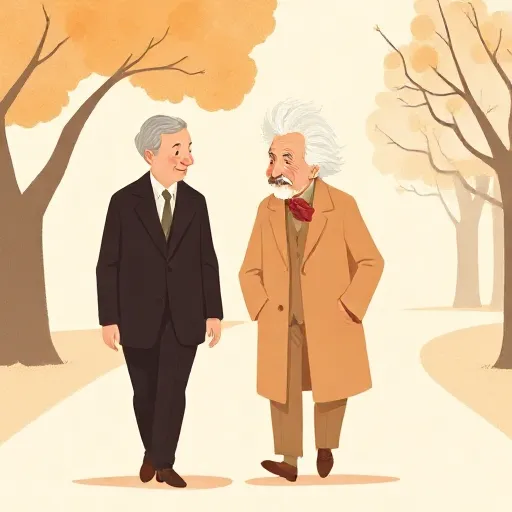
By the 1930s, Austria had fallen under Nazi rule. Gödel, who had many Jewish friends and was himself at risk, left Vienna in 1940 with his wife Adele. They settled in Princeton, where he joined the Institute for Advanced Study. There he found a lifelong friend: Albert Einstein. Every day they walked together, talking about time, space, and truth.
Gödel’s philosophical views deepened. He was a mathematical Platonist: he believed that numbers, sets, and other mathematical objects really exist — not in the physical world, but in an abstract realm we discover, not invent. The incompleteness theorems, he thought, supported this. If math were just a game of rules we made up, how could there be truths that outrun any possible set of rules? The fact that we can recognize a true but unprovable sentence, Gödel argued, suggests our minds touch something real.
He even argued the human mind is not a machine. A machine can only follow fixed rules, so its mathematical knowledge is limited to what those rules can prove. But we can see truths that no fixed formal system can prove. So, Gödel reasoned, either our minds surpass all machines, or there are unsolvable mathematical problems we will never know. Both options are dizzying. This remains a hot debate in philosophy of mind and artificial intelligence.
Gödel also worked on set theory’s Continuum Hypothesis — the puzzle of how many real numbers exist between the whole numbers and the full continuum. He showed it could be added to standard set theory without causing contradictions. But he suspected it was false and believed new, self‑evident axioms would one day settle it. He spent his later years seeking a method of conceptual analysis that could solve deep philosophical problems with the same rigor as mathematics.
Why Limits Matter for You

Gödel’s theorems are not just about dusty formulas. They carry a clear message: no set of rules can capture all truth. In our digital world, where computers run on precise programs, his work reminds us that every formal system has blind spots. An algorithm can solve many problems, but it can never solve all mathematical problems.
That doesn’t mean the unprovable truths are unknowable. You can still grasp some of them with your own mind. But it raises a thorny question: if your brain is a physical machine obeying laws, how can you ever see beyond its built‑in limits? Or maybe the feeling that you understand truths no computer could compute is just an illusion. These are the kinds of puzzles Gödel chased — and they are still wide open.
Next time you face a question that feels impossible, remember: even in the perfect world of numbers, some doors stay locked forever. The mystery of what you can know and what stays beyond reach is one of philosophy’s oldest stories. Kurt Gödel gave it a starring role.
Think about it
- If a computer could solve any math problem you fed it, would that make it smarter than you? What does “smarter” even mean here?
- Think of something you are deeply certain is true but could never prove to someone else. Should you still count it as knowledge? Why or why not?
- Gödel claimed that seeing unprovable truths shows the mind is not a machine. What would a machine have to do before you believed it truly “understands” something, not just runs a program?