
Is Space Made of Tiny Pixels?
The Pixel World: Could Space Be Made of Tiny Bits?

Picture the smoothest surface you know: a frozen lake, a polished tabletop, the screen of your phone when an image is perfectly sharp. Now imagine zooming in — way in, farther than any microscope can go — until you reach the smallest possible piece of space. What would you see?
One answer, the one you learned in math class, is that space is continuous: you can always zoom deeper, forever, with no smallest dot. The other answer is that space is discrete: like a digital photograph, it breaks down into tiny, indivisible chunks. A discrete geometry says the universe is built of these smallest bits of space, which some thinkers call hodons (after the Greek word for “path”). Time, too, might come in tiny ticks called chronons.
This idea isn’t just a video-game fantasy. For over a century, mathematicians, physicists, and philosophers have taken it seriously. If they are right, everything you see — every curve, every circle, every “smooth” edge — is actually a clever arrangement of ultra-tiny building blocks, like a mosaic so fine you never notice the seams. But turning that dream into a working picture of geometry turns out to be really, really hard.
A Stubborn Puzzle: The Diagonal That Refuses to Be Longer

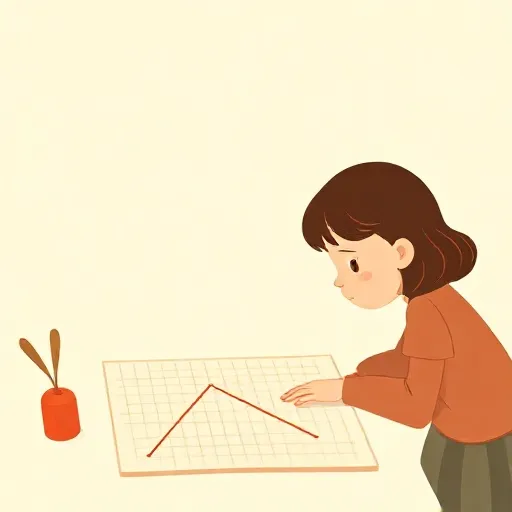
The biggest headache for any discrete geometry is measuring distance. To see why, lay out a checkerboard. The shortest path from one corner to the opposite corner along the squares isn’t a slanted straight line — you’d have to zigzag, stepping from square to square. But if you measure by counting squares, something weird happens.
The mathematician Hermann Weyl (1885–1955) pointed this out in 1949. Suppose you build a square from tiny miniature tiles. Count the tiles along one side, say eight. Now count the tiles along the diagonal: they also number eight, even though your eyes tell you the diagonal should be longer. If space were truly made of tiny indivisible bits, Weyl argued, then the diagonal of a square would have to be exactly as long as its side — an obvious violation of the Pythagorean theorem you know from class. That’s the distance function problem.
If you can’t tell the difference between a side and a diagonal, you don’t really have geometry anymore — just a strange, flattened world where shape and distance lose their meaning. Many people thought this puzzle killed any hope for a discrete geometry. They were wrong, but the fix required some big, creative leaps.
Thick Lines and Clever Counting: How to Save the Diagonal
A handful of thinkers in the late twentieth century refused to give up. They realized you could rescue the Pythagorean theorem if you stopped imagining points and lines as infinitely skinny. After all, a real pencil line has thickness. Maybe discrete lines do, too.
One solution, proposed by the philosopher Jean Paul Van Bendegem (working in the 1980s and 1990s), says that every line in a discrete space has a fixed width — a certain number of tiny hodons across. If you measure distance by counting squares but then divide by that width, the numbers start to behave. A diagonal line at an angle spreads its thickness over more grid columns, so its effective “length” can become longer than the side, just as Euclidean geometry expects. At the extreme, when the width is a single square, you’re back to Weyl’s puzzle; make the line thick enough, and familiar geometry re-emerges almost perfectly.
Other philosophers, like Peter Forrest (born mid‑20th century), took a different route. Instead of a regular grid of squares, they imagined space as a network of points where “adjacency” depends on a scale factor — a kind of zoom setting. Two points are neighbours if they are close enough according to a built-in rule. When the scale is huge, the distance you measure by hopping between adjacent points gets very close to the smooth distances of ordinary geometry. The Weyl puzzle only arises when you insist on a strictly square grid with no such flexibility.
These fixes are ingenious, but they also show something important: a discrete geometry doesn’t look exactly like a scaled-down version of the smooth world. It has its own strange features — like lines that must have thickness, or directions that aren’t all equal. That leads some thinkers to ask whether such a world could be the real one.
Hodons and Chronons: When Physics Gets Pixelated

If space is discrete, time probably is too. As early as the 1930s, the physicist Ludwik Silberstein (1872–1948) worked out a miniature universe where both space and time come in whole-number steps. He imagined that the smallest distance, one hodon, is the tiniest hop anything can make. The smallest tick of time, one chronon, is the briefest moment that can pass. In that world, the speed of light becomes simply one hodon per chronon — a single, neat ratio.
Silberstein even plugged this discrete scaffolding into Einstein’s special relativity and found that extra rules popped up, rules that aren’t needed in the continuous version. For example, the mathematics now demands that certain combinations of space and time steps must equal exactly one — a condition that appears only because the numbers are integers, not smooth decimals. It was as if discreteness forced hidden patterns onto the physics.
Of course, if chronons are fantastically tiny (Silberstein guessed they might be linked to the Planck time, around 10⁻⁴³ seconds), we would never notice the jumps in everyday life. But if we could design an incredibly precise experiment, might we catch a glimpse of them? That question remains open, and a few philosophers have even sketched what such an experiment would need to look for, like subtle chaotic wobbles that wouldn’t appear in a smooth, continuous world.
What’s Really Down There, and Why It Matters

The tug-of-war between smooth and pixelated space isn’t just a math game. It sits at the heart of one of physics’ biggest quests: a “theory of everything” that unites the physics of the very large (gravity, described by smooth curved spacetime) with the physics of the very small (quantum mechanics, which often deals with discrete jumps). If space and time are themselves made of discrete bits at the deepest level, that could be the bridge. That’s why modern physicists study causal sets, loop quantum gravity, and lattice models — all attempts to build spacetime from simpler, discrete ingredients.
Yet the debate also matters right now for a simple reason: it forces you to ask what it means for a description of the world to be “true”. When you draw a circle on graph paper with a thick marker, is the circle real, or is it just an arrangement of rough blocks that looks smooth from far away? If the smoothest thing you can touch is secretly pixelated, does that change how you think about distance, shape, or even what is real?
These are not questions with final answers in a textbook. They are live, unsettled puzzles that tug at the edges of what we know. The next time you zoom into a digital photo and see the little squares appear, you might wonder: is the universe doing the same thing, just at a scale we can’t yet see?
Think about it
- If space were made of tiny pixels, would a circle ever be perfectly round, or would it always be a bit jagged? Would that matter if you could never notice?
- Imagine you could move only in whole steps on a grid, like a rook in chess. How would that change the way distances feel — and could you still trust a ruler?
- Suppose a future experiment proves that space is pixelated, not smooth. Would that make you see the world differently, even if your everyday life stayed exactly the same?