Do You Really Learn Through Your Senses? Gassendi's Stubborn Answer
A priest who chased comets, not certainty
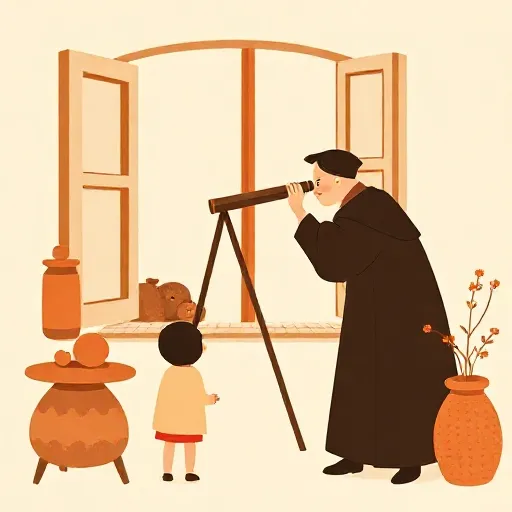
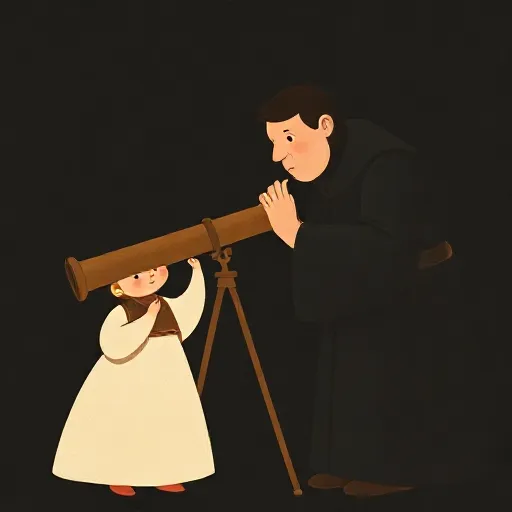
Pierre Gassendi (1592–1655) grew up in a quiet Provençal town, but his restless mind outran any village. By sixteen he was studying in Aix; by his twenties he was a professor and a Catholic priest. Instead of staying safely behind a lectern, he pointed telescopes at the sun, timing Mercury as it crossed the golden disc. He fired cannons to clock the speed of sound. He dropped stones from a moving ship to show the Earth could move without flinging everything into chaos. None of this looked like armchair philosophy — and that was the point.
Gassendi was convinced that knowledge starts with what your eyes, ears, and fingers tell you. If Aristotle or Descartes said something that didn’t match experience, he thought they were just guessing prettily. He spent his career rebuilding ancient atomism — the idea that the world is made of tiny, solid particles moving in empty space — and using it to explain everything from crystals to courage. Most of all, he argued that being a little unsure about what you know isn’t a disaster. It’s the beginning of honest science.
Your senses are all you’ve got
In the early 1600s, two big teams dominated philosophy. The followers of Aristotle said you could discover real essences — the hidden “what-it-is-to-be” of things — by pure thinking. Descartes (1596–1650), the new star, claimed that some ideas are so clear and distinct you just know they’re true, like the fact that you exist because you think. Gassendi pushed back hard on both sides. He insisted the only raw material for knowledge is sensory information. Not your mind’s built-in clarity. Not essences nobody can see.
He backed this up with a simple skeptical worry: honey tastes sweet to you, but bitter to someone else. A fire feels hot to us, but not to an insect that lives near the flames. If our feelings contradict each other, how can either one reveal the “essence” of honey or fire? According to Gassendi, we don’t know essences at all. We know appearances — how things strike our particular senses. That’s it. Reason can help sort appearances, but it can’t magically leap beyond them.
This doesn’t mean the senses give you solid certainty. They give you warrant — a good reason to believe — but never a perfect guarantee. Gassendi called this probabilism: knowledge is a matter of having strong evidence, not absolute proof. You can be confident, but you should stay humble.
The quarrel with Descartes: why “clear and distinct” isn’t enough

In 1641 Descartes published his Meditations and invited scholars to pick holes in it. Gassendi’s objections were so sharp that the two philosophers found it hard to understand each other. The heart of the fight was Descartes’ rule: if an idea is clear and distinct, it’s true. Gassendi thought this rule collapsed under its own weight.
He gave several reasons. First, you can have a perfectly clear and distinct idea of a blue sky, but two people might not agree on what “blue” looks like. Clarity doesn’t settle it. Second, when we build ideas by chaining reasoning together, those ideas are less direct than seeing or touching. They become murky. Third, if a clear-and-distinct idea ever turns out wrong, you need another rule to tell the good ones from the bad. That starts an endless ladder of rules — not a solid foundation.
His most famous objection landed on Descartes’ “I think, therefore I am.” Gassendi pointed out that noticing thinking is happening doesn’t automatically prove that a particular you is doing it. The leap from “there is thinking going on” to “I exist as the thinker” smuggles in the very thing Descartes was trying to prove.
Descartes also offered a proof for God that said existence is part of the definition of a perfect being — like having three angles is part of the definition of a triangle. Gassendi replied that a definition can’t make something exist. You can define a winged horse, but that doesn’t make one appear. Existence isn’t a property you can add to the list; it’s the state of being that lets things have properties at all.
Atoms: the building blocks of everything

If the senses are your only doorway to the world, what do you conclude about the stuff you can’t see? Gassendi turned to an idea from the ancient Greek thinker Epicurus: atoms. These were the smallest, indivisible particles — solid, weighty, shaped differently, and always in motion. Between them lay void, empty space.
The atomist hypothesis offered a mechanical story for how things happen. Hardness? Atoms packed tightly with little void. Softness? More empty space. Crystals forming? Atoms arranging themselves in regular patterns. Gassendi used this picture to explain chemistry, light, sound, even memory. When you forgot something, he suggested, the folds in your brain holding that memory had decayed from lack of nourishment.
He knew he couldn’t see atoms directly. But he believed in indicative signs — surface-level clues that point to hidden realities. If you see a crystal’s edges and watch it dissolve, the best explanation is that it’s made of smaller building blocks. Today we call this inference to the best explanation. Gassendi didn’t claim atoms were proven fact; he called them the most likely hypothesis, the one that made sense of the most data. That modern-seeming move puzzled his critics and delighted later scientists.
Half monk, half rebel: the middle path

Some readers have suspected Gassendi of hiding atheist leanings because he revived a materialist philosophy and hung around a circle of free-thinking Parisians called the libertins érudits. But he genuinely was a person of faith. He simply believed the Book of Scripture and the Book of Nature were written by the same Author and didn’t contradict each other when properly understood. He accepted Copernican astronomy in principle but publicly endorsed Tycho Brahe’s model because it didn’t challenge Church teaching on a moving Earth.
In ethics, he blended Epicurus and Christianity. He thought pleasure and pain guide our choices — but the deepest pleasures aren’t bodily. They are ataraxia, a tranquil mind free from fear, and the love of God and neighbor. Unlike Hobbes, who saw human beings as purely mechanical, Gassendi insisted on an immaterial soul that could freely choose the good. Free will wasn’t a physical chain; it was a rational act of the animus — the understanding part of the soul.
His middle way showed that you could be an empiricist without being a full-blown skeptic, and a priest without rejecting the new science. It was a tightrope, but he walked it deliberately.
Why Gassendi’s fight still matters

Gassendi didn’t win his era’s celebrity contest. Descartes became the household name. But Gassendi’s ideas seeped into the thinking of John Locke, Robert Boyle, and Isaac Newton. Locke’s argument against innate ideas, Newton’s talk of absolute space and time, and the general modern assumption that good science starts with observation — all carry his fingerprints. Even David Hume’s careful doubts about induction echo Gassendi’s warning that we can never check every instance of a law.
Today, when someone argues that you should believe something because it’s “obvious” or “self-evident,” Gassendi’s ghost asks: obvious to whose senses? evident on what evidence? He gave twelve-year-olds everywhere a durable question: not “Are my senses perfect?” but “Are they reliable enough, and how would I find out?”
Think about it
- If two people honestly see the same thing differently — one says the dress is blue, the other says gold — can either one claim to know the truth? Why or why not?
- Suppose a scientist can’t see atoms but says they’re the best explanation for experiments. When is it okay to believe something you can’t observe directly?
- Gassendi thought free will belonged to an immaterial soul. If you someday build a robot that learns from its sensors exactly like you do, would it need a soul to make choices, or could it be just atoms in motion?