Is There a Bottom Layer to Everything? Or Does It Go On Forever?
A Child’s Question: What’s Underneath Everything?

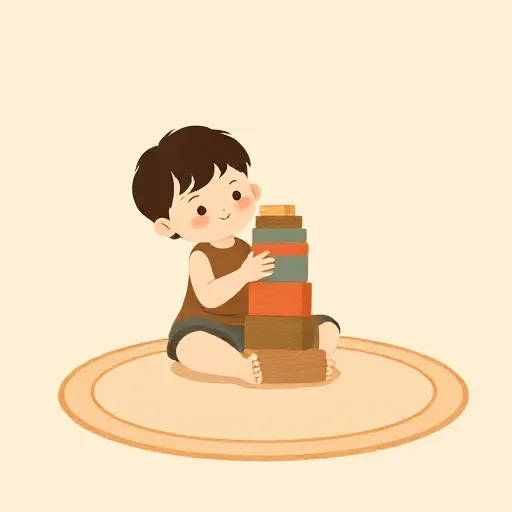
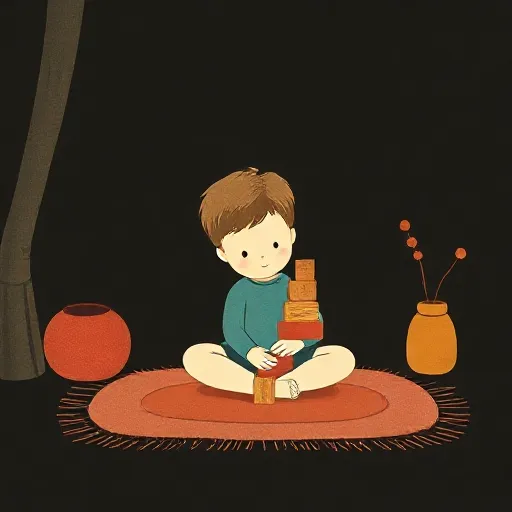
You are sitting on the floor, stacking blocks. You place one on top of another, then another. But your little sister asks the kind of question that can make your brain buzz: “What is holding up the bottom block?” You might say the floor. Then she asks, “And what holds up the floor?” The ground. “And the ground?” The earth. “And the earth?” And so on.
The same puzzle appears when you look inside ordinary things. A piece of wood is made of fibers, which are made of cells, which are made of molecules, which are made of atoms. Atoms are made of protons, neutrons, and electrons. Protons and neutrons are made of quarks. And then your sister’s voice whispers in your ear: “And what are quarks made of?”
Philosophers love this kind of why-chain. It leads to a huge question: does the chain ever end? Is there a fundamental layer — something that everything else depends on but that itself depends on nothing? Or does reality go downward forever, with no final floor? This is the problem of fundamentality, and it may be the deepest puzzle about what the world is made of.
The Independence Test: Does It Need Something Else?
One way to catch something fundamental is to ask: does it depend on anything else? If it doesn’t, then it is absolutely independent. But this turns out to be much too strict. Almost everything we can think of depends on something in some way. Even numbers, if they exist, depend on each other. (If the number 2 exists, then the number 3 must exist too, and the other way around. They come as a package.) So if “independent” means zero dependence of any kind, probably nothing in the universe would count — maybe only the whole universe itself, or a creator, but certainly not ordinary things like particles.
That’s why most philosophers use a weaker idea: restricted independence. You pick one specific way of depending, and you check whether a thing depends on anything in that way. The most common example is mereological dependence — dependence on your parts. A table depends on its legs and top; a molecule depends on its atoms. So a thing is mereologically fundamental if it has no smaller parts. Ancient atomists like Leucippus and Democritus thought there were tiny, indivisible bits — atoms — that were the bottom layer in this sense. Today, we still talk about elementary particles, but we aren’t sure if they have parts or not.
Another important kind of dependence is grounding. Grounding is not about parts; it’s about what makes something true or real. Think of how an act is wrong because it causes harm. The harm is the ground of the wrongness. A fact is grounded if something else explains why it is true. A fundamental fact, on this view, would be completely ungrounded — it doesn’t get its truth from anything deeper. Many contemporary philosophers believe that the most useful way to define fundamentality is through grounding. A fundamental entity is simply an ungrounded one.
The Complete Building Kit: A Minimal Basis of Reality
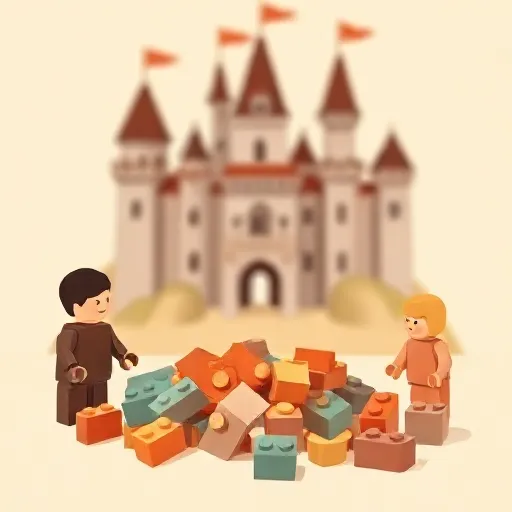
There is a different way to think about fundamentality. Instead of finding things that need no support, you look for the smallest set of things that together can build everything else. This is the idea of a complete minimal basis. Like the smallest box of LEGO bricks from which you could still build all the other creations. If you can write a list of these special bricks — maybe certain particles, forces, or properties — and the list is short but still enough to determine the whole world, then those bricks are the fundamental things.
This approach does not require each brick to be utterly independent. It only requires that the whole set works like a recipe. If you had them, everything else would follow. Some philosophers think this is exactly what a creator would need to do: create only the minimal basis, and then everything else would unfold. That picture is vivid because it suggests that reality has an instruction manual written at the bottom level.
But keep in mind: even with a complete minimal basis, there may be more than one set that could do the job. And if the world were perfectly flat — nothing depending on anything — then everything would be fundamental in this sense, which sounds strange. So this definition is useful mainly when the world is layered.
Foundations or Forever: The Great Debate
Now we reach the big split. Does reality actually have a foundation? The view that it does — that there is a fundamental level — is called metaphysical foundationalism. The opposite view, metaphysical infinitism, says the chain of dependence never stops.
Foundationalists worry that without a bottom, the whole tower would collapse. A famous line says that without a foundation, being is “infinitely deferred, never achieved.” It’s like trying to pay a debt by borrowing from someone else, who borrows from another, and so on forever. No one ever truly pays. So foundationalists insist that somewhere, there must be ungrounded things that finally settle the accounts.
But infinitists reply that this worry is too dramatic. They point out that grounding is more like a mathematical relationship than a physical chain that might break. In math, you can have an infinite series that still adds up to a definite number. Maybe dependence can work the same way: it just needs to be structured right.
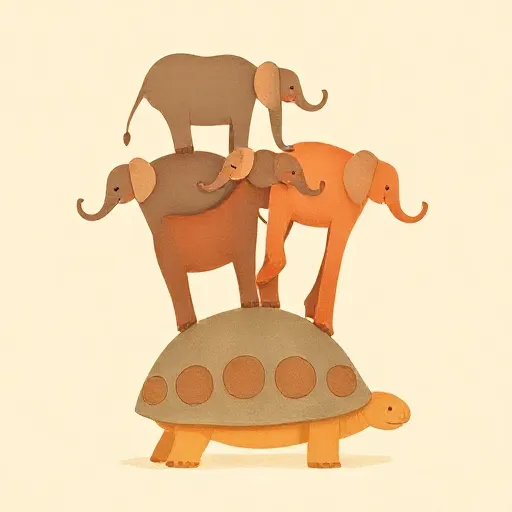
There are different kinds of infinite descent. One is boring infinite descent, where the pattern repeats. Imagine the world is supported by four elephants, the elephants stand on a turtle, the turtle stands on two camels, the camels stand on four elephants — and the whole loop repeats again and again. We could fully describe this universe with just four elephants, one turtle, and two camels, plus the instruction “continue as before.” Such a world might seem weird, but it doesn’t obviously collapse.
A more radical version is infinite complexity, where each level introduces brand new kinds of things, forever. That would mean the explanation never simplifies — you keep finding novel ingredients with no end. Many philosophers find that hard to swallow, but the possibility is still on the table.
Interestingly, some views, like ontic structural realism, suggest that the world is made of relations rather than things, and those relations can be mutual. On that picture, there might be loops of dependence all the way down, and even the idea of a bottom level would disappear. The debate is very much alive.
Why It Matters: Are You Standing on a Turtle?
Back to the child stacking blocks. If the bottom block sits on nothing — or on an infinite stack — what does that mean for you? It’s easy to feel dizzy. We like firm ground. But the philosophical lesson might be that reality doesn’t owe us a simple bottom. The search for elementary particles, the laws of physics, a “theory of everything” — these great human quests are shaped by the idea that there is a final floor. What if there isn’t? Then maybe explanation never stops, and that’s okay.
Thinking about fundamentality also changes how we see ordinary things. A table isn’t just a table; it is a pattern held up by deeper patterns. We are part of that chain too. Your thoughts rest on brain states, which rest on cells, which rest on molecules, and further down. Does that mean your choices have an anchor, or are they just floating in an endless sea? That question leads to deep debates about free will, which are another story.
The old puzzle of the bottom layer hasn’t been solved — and maybe it never will be. But it keeps philosophers and scientists asking, and it reminds us that the world is stranger than any block tower.
Think about it
- If you found out that the universe has no bottom level — just layers forever — would that make your life feel different? Why or why not?
- Can you imagine a world where everything depends on something else, with no starting point? What, if anything, would be missing from such a world?
- Some scientists hope to find a “theory of everything” that explains all of physics. Do you think a final explanation is possible, or will there always be another deeper layer? What might it mean if the search never ends?