
Can One Planet Be Two Stars? The Puzzle That Changed Philosophy
A Letter That Broke a System

On a June day in 1902, Gottlob Frege (1848–1925) sat proofreading the final pages of his second volume of Grundgesetze der Arithmetik (The Basic Laws of Arithmetic). He had spent over a decade perfecting a logical system that would, he believed, show that all of mathematics—from simple counting to calculus—was nothing but logic. Then a letter arrived from a young English philosopher, Bertrand Russell (1872–1970). Russell had spotted a contradiction hidden at the system’s core. Frege’s grand project had a fatal crack.
The problem involved classes that don’t contain themselves. Imagine a village barber who shaves everyone who does not shave themselves. If he shaves himself, then by the rule he shouldn’t. If he doesn’t, then he must. Russell’s paradox was similar but about sets: the set of all sets that are not members of themselves both is and is not a member of itself. Frege had built his logic around extensions—collections defined by concepts—and this paradox showed that his way of forming extensions led straight to a contradiction. Frege hastily wrote an appendix trying to fix it, but he never succeeded.
Though the collapse crushed his dream, the tools Frege had forged—and the questions they raised about language—would transform philosophy.
From Sentences to Functions: Frege’s New Logic
For over 2,000 years, logicians analyzed sentences into a subject (“what you’re talking about”) and a predicate (“what you say about it”). In that old logic, “John loves Mary” had John as the subject and “loves Mary” as the predicate. The rule for inferring “Something loves Mary” was different from the rule for “John loves something.” They seemed unrelated.
Frege saw a deeper unity. He borrowed the idea of a function from mathematics. A mathematical function like (x^2) takes a number and returns its square. Frege extended this: the verb “loves” is a function that takes two arguments—the lover and the loved—and returns The True or The False. So “John loves Mary” becomes (L(j, m)), which equals The True if John indeed loves Mary. A concept, like “is happy,” is just a special function that maps every object to a truth-value. An object falls under a concept if the function maps it to The True.
This trick let Frege handle “every” and “some” with a single rule. He used a variable, such as (x), and a quantifier: (\forall x, Mx) for “everything is mortal,” and (\exists x, Ljx) for “John loves someone.” Now the inference from “John loves Mary” to “someone loves Mary” and to “John loves someone” both follow from the same logical axiom. Logic became a flexible machine for representing any kind of reasoning.
Frege also insisted that a proper definition be eliminable (you can always swap the new term for its definition) and conservative (it shouldn’t let you prove new things about old terms). These standards are now basic to mathematics.
What Is a Number, Then?
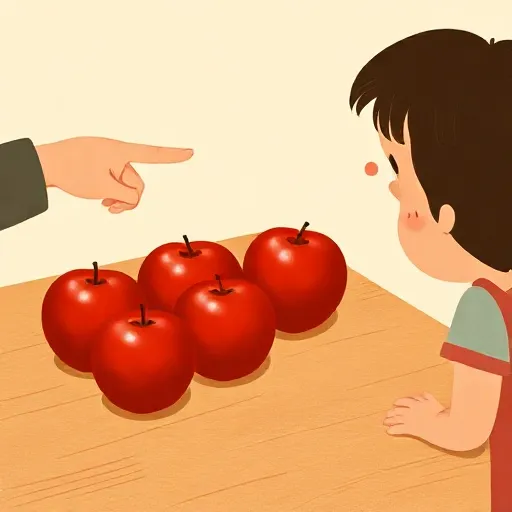
Frege next turned to the question: what kind of thing is a number? He noticed that the same physical collection can be counted in different ways depending on the concept you choose. Picture a battlefield: you might count 1 army, 5 divisions, or 20 regiments. The number changes with the concept. So Frege said numbers are second-level concepts: they tell you how many objects fall under a first-level concept.
He then defined what it means for two concepts to be equinumerous: there is a one-to-one matching between the objects falling under them. The number of a concept (F) is the extension of all concepts equinumerous with (F). For zero, he used the concept “not identical to itself”—nothing falls under it, so its number is the extension of all empty concepts. He called this 0. Next he defined the successor relation: one number precedes another if the larger belongs to a concept that has exactly one more object. Finally, to reach all natural numbers, Frege used the ancestral of the predecessor relation—a way of chaining immediate steps. This let him say that 0 precedes 2 even though they aren’t neighbors, because you can travel the chain 0→1→2.
Frege’s view that math is reducible to logic is called logicism. He derived many theorems using a principle now called Hume’s Principle: the number of (F)s equals the number of (G)s exactly when there is a one-to-one correspondence between the (F)s and the (G)s. Remarkably, modern philosophers have shown that Hume’s Principle is consistent and can derive the basic axioms of arithmetic. Frege’s core insight, stripped of the contradictory part, still works.
The Morning Star and the Evening Star

While building his mathematical logic, Frege stumbled into a puzzle about ordinary language. Consider:
- The morning star is the morning star.
- The morning star is the evening star.
Both are true. The object referred to—the morning star and the evening star—is the same: the planet Venus. But the first sentence is boring; you can see it’s true just by looking at it. The second is a discovery. Ancient astronomers did not know the two lights were one planet. How can two true sentences about the same object have different cognitive significance?
Frege’s answer: a name or description has both a reference (the object it picks out) and a sense (the way the object is presented). “The morning star” and “the evening star” share a reference but differ in sense. One presents Venus as the brilliant object in the dawn, the other as the object in the dusk. The whole sentence expresses a different thought—the sense of a sentence—even though its reference is always a truth-value.
This distinction solved another puzzle about propositional attitude reports—sentences like “John believes that Mark Twain wrote Huckleberry Finn.” If you substitute “Samuel Clemens” for “Mark Twain,” the truth of the report can change, because John might not know they are the same person. Frege argued that inside such contexts, words shift their reference to what is usually their sense. So “Mark Twain” no longer refers to the man himself but to the way John thinks of him. Substitution fails, and our intuition that John can hold one belief without the other is preserved.
Frege’s sense/reference distinction became one of the most influential ideas in the philosophy of language, shaping everything from translation theory to how computers process meaning.
Why Does Any of This Matter Today?

Frege’s attempt to ground math in logic collapsed, but the wreckage was fertile. His formal language is the ancestor of every modern logic textbook and every programming language that uses Boolean operators. Computer scientists and linguists still use his function-argument analysis to model grammar and meaning. His standards for definitions—eliminable and conservative—are silent guardrails in every precise field.
The paradox Russell uncovered forced mathematicians to rebuild the foundations of set theory, leading to systems like Zermelo–Fraenkel set theory that avoid the contradiction while still providing a solid base for mathematics. And Frege’s sense/reference puzzle lives on: when your phone translates “morning star” into another language, it is grappling with the very issue Frege identified—that meaning is more than just pointing to an object.
So next time you use a calculator, wonder whether two different-looking fractions like (\frac{1}{2}) and (\frac{2}{4}) express the same number, or notice that a friend can believe something true about “Clark Kent” while denying it about “Superman,” you are walking on ground Frege first cleared.
Think about it
- If you learned that your favorite story character was actually the same person as another character with a completely different name, would your feelings about the story change? Why or why not?
- Could a computer that correctly matches “the morning star” and “the evening star” to Venus ever truly understand them the way you do, or is something still missing? What would “understanding” require?
- Frege tried to prove that math is pure logic, but a paradox stopped him. If someone discovered a hidden contradiction in the way we teach simple arithmetic, would you still trust that 2+2=4? What kind of proof would restore your confidence?