Why Is It So Hard for a Robot to Make a Cup of Tea?
A Robot in the Kitchen, Frozen by a Teacup
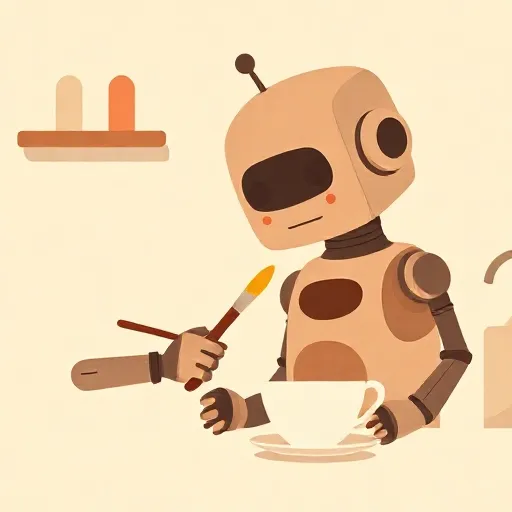
Imagine a robot named R1 in a 1980s artificial intelligence lab. Its one job today is to make a cup of tea. It knows the blue cup lives in the cupboard, the kettle is on the counter, and today is a Wednesday. R1 opens the cupboard, grabs the cup, and then stops cold.
The cup’s location has changed — that much is obvious. But what about the color of the walls? The date? The temperature of the tea leaves? R1 has a database of thousands of facts about the world, and it cannot take a single step without checking whether each one still holds. It stays frozen, stuck in an endless update loop.
This is the frame problem. It was first named and studied in 1969 by the computer scientists John McCarthy and Patrick Hayes. At heart, it’s a question about change: when something happens, how do you figure out what stays the same — without checking absolutely everything you know? For a logic-based robot, even a simple action like picking up a cup becomes a nightmare of bookkeeping.
Why Saying “Most Things Don’t Change” Wasn’t Enough
To see why, imagine a really simple world with only two actions: Paint an object a new color, and Move an object to a new spot. You might write two laws:
- After Paint(x, color), the object x has that new color.
- After Move(x, spot), the object x has that new spot.
Now suppose a red cup is on the table. You paint it blue, then move it to the garden. Intuitively, the cup is now blue and in the garden. But using only the two laws above, the logic is missing something. The Move action might, for all the computer knows, have turned the cup green. The rules only tell you what does change; they are silent about everything else.
To fix this, you need extra sentences called frame axioms — rules that explicitly say what an action does not change. For our tiny world, you would write:
- After Move(x, spot), the color of x stays whatever it was before.
- After Paint(x, color), the position of x stays whatever it was before.
That’s just two extra rules. But real life has millions of properties. If you have M actions and N properties, you would need roughly M × N frame axioms — an impossible mountain of “don’t change” statements. McCarthy and Hayes wanted to find a way to capture the common-sense idea that, unless you have evidence otherwise, things usually stay the same. They called this the common sense law of inertia.
The trouble is that classical logic is monotonic: adding new facts never cancels old conclusions. But the law of inertia needs to say, “Assume nothing changes — unless we later discover an exception.” If you later learn that moving a cup into a paint bucket does change its color, you want to override your earlier assumption. That’s impossible in straight classical logic.
To escape this, researchers developed non-monotonic reasoning — logics where new evidence can withdraw old guesses. One famous technique is called circumscription. Yet early attempts ran into bizarre snags, like the Yale shooting problem. In that scenario, a naive program concluded that a loaded gun would mysteriously become unloaded after a short wait, simply from sitting still. It took years of refinement to make non-monotonic systems deliver the right answers. Despite those struggles, most AI researchers now agree that the narrow, technical frame problem — the one about writing efficient logic — is largely solved. But for philosophers, a deeper riddle was just getting started.
The Philosopher’s Robot: Hamlet with a Teacup
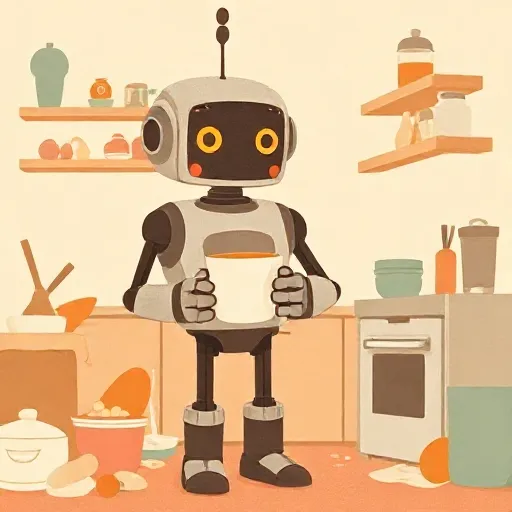
In the late 1970s and 1980s, philosophers like Daniel Dennett (1942–2024) and Jerry Fodor (1935–2017) looked at the frame problem and saw a puzzle not just for logic, but for any mind. Dennett asked: how does a creature with many beliefs keep those beliefs roughly true after it acts? Fodor put it this way: think of a robot that stores facts in sentence-like chunks. It picks up a teacup. It knows the cup’s location must change. But which other sentences in its giant memory should it re-examine? The ambient temperature hasn’t changed. The location of the teapot hasn’t changed. But if a spoon was sitting in the cup, the spoon’s location has changed — and the robot needs to realize that.
The simple, brute-force solution is to re-check every belief one by one. For a robot with human-level intelligence and a colossal database, that would take forever. That’s the computational frame problem. In practice, programmers often use a “let sleeping dogs lie” strategy: only update what you know must change, and leave the rest alone. In the tea example, the robot would fix the cup’s location and the cupboard’s contents, but it would not bother thinking about every possible spoon that might have been on the cup, unless its goal directly involves that spoon.
Yet the philosophical frame problem doesn’t end there. The truly tough question is: how could the robot ever be sure it has updated all and only the relevant facts? Only then could it safely apply the common-sense law of inertia and assume the rest of the world is untouched. Fodor called this “Hamlet’s problem: when to stop thinking.”
One natural answer is to appeal to relevance: only certain properties of a situation matter for a given action. If you’re cleaning a cupboard, the newly exposed shelf is relevant; if you’re making tea, the fact that the cup can be filled from a pot is relevant. But then you face a new difficulty: determining what is and isn’t relevant depends on context — and contexts can shift endlessly. As the philosopher Hubert Dreyfus (1929–2017) argued, “if each context can be recognized only in terms of features selected as relevant and interpreted in a broader context, the AI worker is faced with a regress of contexts.” You could end up needing to know every possible background situation just to take one step.
Fodor pushed this worry even further. Once you admit that anything could be relevant to the consequences of an action — just as anything could be relevant in scientific theory — you’re forced to conclude that central human thinking is informationally unencapsulated. That is, there is no fixed list of what facts your mind can draw on. No matter how clever your computer indexing, the real puzzle is how a thinker ever realizes that two seemingly unrelated things (say, bananas and mandolins) are relevant to solving a problem in the first place.
Fridgeons and the Riddle of What Counts as “Changed”
Fodor noticed one more deep snag. The common-sense law of inertia is supposed to be justified by the observation that most things don’t change when an action happens. But what does “most things” mean? Consider a very special property: something is a fridgeon at a given moment if and only if Fodor’s fridge is switched on at that moment. Now, the simple act of turning Fodor’s fridge on or off instantly changes trillions of particles — each one now flips from being a non‑fridgeon to being a fridgeon. An action that seems tiny suddenly has world‑shattering effects, provided you are willing to count properties like fridgeonhood.
The problem isn’t logical; you could easily write a rule to handle fridgeons. The problem is metaphysical. The law of inertia only works if we use the “right” set of objects and predicates — the right ontology. But what principle tells us to rule out fridgeons and keep things like colors and positions? Fodor’s point is that without a principled way to choose which properties count, the law of inertia loses its justification.
This challenge echoes a famous riddle from the philosopher Nelson Goodman (1906–1998), called the “grue” paradox. Goodman asked you to imagine a new word, grue: an object is grue if it is green before a certain future time and blue after that time. Every emerald you have seen so far is both green and grue. So why does science infer that all emeralds are green, but not that all emeralds are grue? The only answer is that the predicate “grue” is an unnatural, gerrymandered property. Induction — and common-sense inertia — only work if we stick to the “right” kinds of things in our thinking. The frame problem thus ties together logic, change, relevance, and the very furniture of the world.
Why Your Own Mind Is the Hardest Case of All
Today, the logical side of the frame problem is largely solved. Researchers working within traditional, symbol‑based artificial intelligence have a variety of workable tools. Yet the wider philosophical puzzles are very much alive. Fodor maintained that human thought is deeply holistic: when you fix your beliefs after an event — or creatively solve a problem — anything you know might become relevant. This phenomenon, sometimes called isotropy, makes it hard to explain how the mind works using only step‑by‑step rules over sentence‑like thoughts.
Some philosophers, including Dreyfus and Michael Wheeler, argue that classical AI and its emphasis on internal representations are the wrong tools entirely. They look to situated robotics and the dynamics of the brain itself, where relevance might arise in a distributed, non‑representational way — not from a list of “if‑then” rules, but from a flexible system that has absorbed thousands of past experiences. Others propose that the brain’s global workspace integrates signals from many specialist processes, letting relevance bubble up from the bottom rather than being dictated from the top.
The frame problem has left a lasting legacy: it reminds us that common sense is an astonishingly deep ability. Every time you pick up your backpack and automatically ignore a thousand nearby facts that didn’t change, you are doing something that no computer program has fully replicated. The problem started with a robot and a teacup, but it ends with a question about your own mind — and that question is still open.
Think about it
- If you had to program a robot to tidy your room, how would you decide which parts of the room are “relevant” after each small action? Where would you start, and what might you end up forgetting?
- Can you think of a time when you suddenly realized that something you had always ignored — a detail, a memory, an object — became important in a new situation? How did your brain make that leap?
- A chess computer can beat a grandmaster, yet it cannot make a reliable cup of tea. What does that gap tell us about the difference between human and machine intelligence?