
When Should You Change Your Mind? The Math of Belief
A Thermometer Tells a Confusing Story

Sophia checked the thermometer on the kitchen wall: 85° Fahrenheit. She decided it was warm enough to eat in the garden. But then her little brother said he had moved the thermometer next to the boiling pasta pot. Suddenly Sophia wasn’t sure about her conclusion. She still believed the thermometer had read 85°, but she no longer believed it was pleasant outside. Her mind had to update—she had to give up an old belief without tossing out everything she knew.
This everyday moment raises a huge question: when new information contradicts what you already believe, how should you sort out what to keep and what to throw away? Could there be rules—something like the rules of a game—that always lead you to change your mind in a reasonable way?
Philosophers and mathematicians have spent decades trying to answer exactly that. They’ve built formal systems that treat beliefs almost like numbers in an equation. This article follows their story, from strict all‑or‑nothing logic to the squishy world of degrees of belief, and into the puzzles that still keep them up at night.
The Dream of a Logic for Beliefs

Long before computers, the mathematician Gottfried Wilhelm Leibniz (1646–1716) dreamed of a characteristica universalis—a perfect language in which every idea could be written like a formula. Disagreements would be solved not by shouting, but by calculating. That dream was too big, but it inspired later thinkers to try to capture the rules of good reasoning with mathematical precision.
To build those rules, you first need a clear picture of what a belief is about. Many formal theories treat the objects of belief as propositions. A proposition is a statement that can be true or false: “Vienna is sunny tomorrow.” You can also think of a possible world as a full, detailed description of one way things could be. The set of all possible worlds that make a proposition true is that proposition’s truth set.
If you believe a proposition, you are certain that the actual world is inside its truth set. When two propositions are logically connected—for example, “it is sunny” follows from “it is sunny and warm”—their truth sets nest inside each other. That gives us a neat way to talk about deductive consequence: if proposition A logically forces proposition B, then the truth set of A is contained in the truth set of B.
But real life reasoning often goes beyond deductive logic. You don’t just combine certainties; you make leaps. If you see 100 black ravens, you might conclude “all ravens are black.” That’s ampliative reasoning—it goes beyond your evidence. Philosophers wanted a logic that could handle such leaps and, crucially, tell you when to take them back.
Belief as All‑or‑Nothing: The AGM Theory

In the 1980s, Carlos Alchourrón (1931–1996), Peter Gärdenfors, and David Makinson developed a theory of belief change known as AGM theory (from their initials). They imagined an agent whose beliefs are like a tidy box of sentences—every belief is either fully accepted or fully rejected. That’s an all‑or‑nothing view of belief.
The central puzzle is belief revision. Suppose your belief box is logically consistent and closed under deduction (if you believe A and A entails B, you also believe B). Then you learn a new piece of evidence E that contradicts some of your old beliefs. You cannot simply add E without creating a mess—so you must contract your old beliefs in a way that makes room for E while changing as little as possible.
AGM theory proposes several principles that any rational revision should obey. Two of the most famous are:
- Inclusion: After revising by E, your new beliefs should be no more than what you would get by just adding E to your old beliefs and closing under deduction (that is, you don’t invent brand‑new conclusions out of thin air).
- Preservation: If E is logically consistent with your old beliefs, then you should not throw away any of your old beliefs at all—you simply add E and see what follows.
Together, these principles sound very conservative: don’t make unnecessary changes. But many philosophers think Preservation is too strict. Imagine you believe “Either Bizet and Verdi are compatriots, or Satie is French” on the basis of some evidence. You then learn that Bizet and Satie are compatriots. Preservation would force you to keep believing Satie is French, even though the new information might undercut your original reason. The philosopher John Pollock (1940–2012) called this a problem of undercutting defeaters: sometimes new evidence destroys the support for a belief without directly contradicting it.
This debate shows that even the most elegant rules for all‑or‑nothing belief bump into real‑life complications. And that’s before we even consider that beliefs sometimes come in shades of gray.
Degrees of Belief: The Probabilistic Picture
What if belief isn’t all‑or‑nothing? The mathematician Frank Ramsey (1903–1930) and the statistician Bruno de Finetti (1906–1985) argued that our confidence comes in degrees. You might be 99% sure that Vienna is the capital of Austria, but only 60% sure it will be sunny tomorrow. These credences behave like probabilities: they are numbers between 0 and 1, and they obey the standard rules of the probability calculus.
When you learn new evidence, you use Bayesian conditioning. If you become certain of some proposition E, your new degree of belief in any hypothesis H becomes your old conditional probability of H given E. This rule is precise and widely used in science and artificial intelligence.
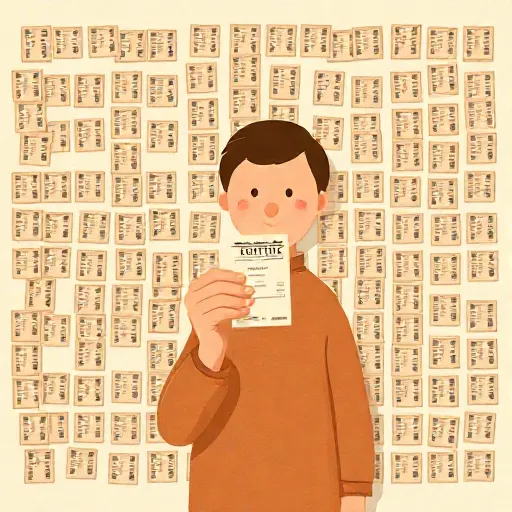
But here’s a puzzle. If full belief is just having a very high probability, say above some threshold like 0.9, then you can run straight into the Lottery Paradox. Imagine a fair lottery with 1,000,000 tickets. Your probability that any particular ticket will lose is extremely high—far above 0.9. So by the threshold rule, you fully believe “ticket 1 will lose,” “ticket 2 will lose,” and so on for every ticket. Since you believe each one, and belief should be closed under conjunction, you also believe “all tickets will lose.” But you also believe that one ticket will win. Your beliefs become inconsistent. The philosopher Henry Kyburg, Jr. (1928–2007) showed that no single threshold can avoid this trouble while keeping beliefs logically closed.
So the probabilistic picture seems to clash with the tidy all‑or‑nothing picture. How can you have both graded confidence and stable full beliefs?
Bridging the Gap: Stability and Tracking

Several modern thinkers have tried to rescue a rational connection between full and partial belief. Hannes Leitgeb (born 1972) proposed the Stability Theory (sometimes called the Humean Thesis). The idea is that a full belief should be stable: even after you learn new information that is compatible with what you currently believe, your degree of belief in that proposition should stay above 50%. This avoids the lottery paradox—you cannot stably believe “ticket 1 will lose” because learning “either ticket 1 or ticket 2 wins” could drop your confidence to exactly 50%. But stability comes at a cost: in some situations, like a doctor forming an opinion about how long a patient will survive, the theory forces you to have almost no non‑trivial full beliefs at all. That seems too skeptical for everyday life.
Another team, Hanti Lin and Kevin T. Kelly, proposed a Tracking Theory. They imagine that your mind runs two systems: a slow, precise probability system for big decisions, and a fast, qualitative system for ordinary planning. The qualitative system should track the probabilistic one: updating your qualitative beliefs on new evidence should give the same result as first updating your probabilities and then translating them into all‑or‑nothing beliefs. Lin and Kelly designed a rule based on plausibility orders (ranking possible worlds from most to least plausible) that achieves this tracking without falling into the lottery paradox. Their rule, however, does not satisfy the AGM principle of Preservation—a trade‑off many find acceptable.
Both approaches show that the problem of connecting full and partial belief is alive and unresolved. The right bridge might depend on what you want your beliefs to do for you.
Why It Matters: From AI to Your Own Mind

You might wonder why anyone cares about such abstract rules. But formal belief revision is everywhere under the hood. Every time your phone’s virtual assistant learns a new fact about you, it must update its “beliefs” without forgetting everything else. Self‑driving cars use probabilistic models to decide when to brake. Even medical researchers who need to remove patient‑identifying information from a database perform a careful kind of belief contraction—they want to keep as much useful data as possible while “forgetting” just the sensitive parts.
And the questions are deeply personal. When a friend tells you something that contradicts what you thought, do you hold on stubbornly or flip completely? Some philosophers think rationality demands that you follow rules like Bayesian conditioning; others argue that gut feelings and the structure of your reasons matter just as much as numbers. The lottery paradox reminds us that being rational isn’t simply about having high confidence—it’s about how your beliefs hang together.
So next time you change your mind, ask yourself: did you follow a rule? Was it a good one? You’re doing the very thing that Leibniz dreamed of calculating.
Think about it
- If a scientist could predict every choice you’ll ever make with perfect accuracy, would it still make sense to say you “decided” to change your mind?
- Imagine you have 99% confidence that your football team will win the championship. Does that mean you fully believe they’ll win, or is there a meaningful difference between believing and being almost sure?
- Suppose you and a friend hear the same surprising news. You revise your beliefs quickly, while your friend refuses to budge. Can both of you be rational, or is one of you making a mistake?