The Secret Rule That Tells You When to Change Your Mind
The Eclipse That Shook Physics
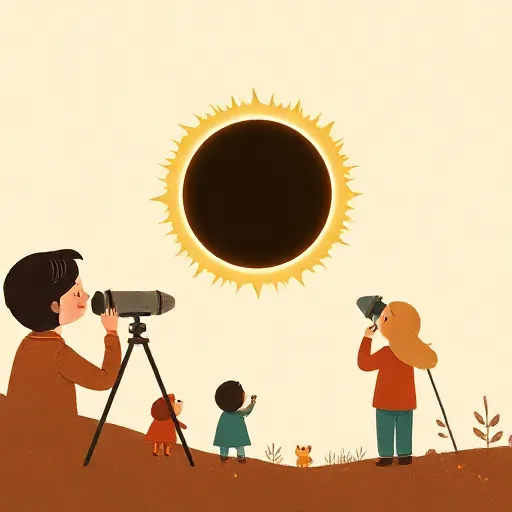
In May 1919, two teams of scientists traveled to remote spots on Earth to watch a total solar eclipse. They weren’t just sky-gazing. They wanted to test a bold new idea from Albert Einstein: general relativity. Einstein had predicted that light from distant stars would bend as it passed the sun. If he was right, the stars near the eclipsed sun would appear in slightly different positions. The scientists measured those positions and found exactly what Einstein predicted.
Before the expedition, many physicists were skeptical. After seeing the data, they became much more confident. Their degrees of belief shifted. That shift is what Bayesian epistemology studies — the rules for how your confidence in an idea should change when you get new evidence. At its heart is a simple notion: we don’t just believe things or disbelieve them; we hold them with numbers between 0 and 1. A credence of 0 means you’re sure it’s false, 1 means you’re sure it’s true, and 0.5 means you’re evenly torn.
The Two Rules That Keep Your Thinking Tidy
Bayesian epistemology centres on two core norms. The first is Probabilism: your credences must be non-negative and add up to exactly 1. If you think there’s a 0.7 chance it will rain tomorrow, you must also think there’s a 0.3 chance it won’t. And your confidence in a combined event is just the sum of its parts — if two outcomes can’t happen together, their credences add.
The second norm is the Principle of Conditionalization. It tells you how to update your credences when you learn a new piece of evidence. Here’s how it works. First, you list all the possibilities, some of which fit the evidence and some of which don’t. When you learn that a particular bit of evidence is true, you set the credence of any possibility that contradicts it down to zero. Then you rescale the remaining possibilities so their credences still add up to 1, keeping their ratios the same.
Return to the eclipse. Suppose before the expedition you thought there was only a 20 percent chance Einstein’s theory was right. After the expedition, the light-bending evidence became certain. That evidence is incompatible with a world where Einstein was wrong and no bending happened, so you cancel that world. The remaining possibilities — Einstein right, or Einstein wrong but bending happens for some other reason — get scaled up. Your credence in the theory jumps, exactly as the scientists’ judgements did. And if the prediction had been extremely surprising, the jump would be even bigger — just as our intuition says surprising evidence confirms a hypothesis strongly.
Where Do Your Starting Beliefs Come From?

The two rules tell you how to move from one set of credences to another. But they don’t say what your prior credences should be — the ones you hold before you see any evidence at all. This is the problem of the priors, and it divides Bayesians into two main camps.
Suppose someone hands you a coin you’ve never seen. What credence should you have that it will land heads? A subjective Bayesian says that as long as your credences obey Probabilism, any prior is permitted. You could start with 0.5 because you have no reason to favour one side, but you could also start with 0.2 if your background hunches say the coin might be weighted. The only requirement is coherence.
An objective Bayesian disagrees. They argue that good reasoning demands freedom from bias. If you have no evidence one way or the other, you ought to assign equal credence to each possibility. This idea, called the Principle of Indifference, would force a 0.5 credence in heads. But indifference has its own troubles. In a famous puzzle known as Bertrand’s paradox, applying indifference to a square’s side length versus its area gives two different answers — even though they describe the same situation. So objective Bayesians must be very careful about what counts as “no reason to favour”.
Subjective Bayesians reply that even though we start with different priors, we will eventually converge. If two people who start far apart keep updating on the same stream of evidence, their opinions merge closer and closer — a result known as merging-of-opinions. Over the very long run, shared evidence can wash away the differences, so the lack of a single correct prior may not be as dangerous as it first appears.
The Problem of Old Evidence: Einstein’s Other Clue

Time-travel back to 1915. Einstein, while developing general relativity, turned his attention to a puzzle that had nagged astronomers for over fifty years: the orbit of Mercury. Mercury’s closest point to the Sun, its perihelion, shifted slightly in a way that Newtonian physics could not fully explain. Einstein’s calculations showed that his new theory predicted exactly that shift. He became much more confident in his theory — yet he had collected no new astronomical data. The evidence was already old.
Here’s the trouble. The Principle of Conditionalization seems to say that only genuinely new evidence can change your credences. Old evidence, which you already fully believe, doesn’t rule out any new possibilities, so conditionalization leaves your credences untouched. So how could Einstein rationally raise his confidence? Some Bayesians reply that Einstein learned a new logical fact: that his theory entailed the old data. That logical fact was new to him, so conditionalization on it still works. But this raises a follow-up worry: if a physics student first hears about relativity and already knows the old Mercury data, how can her confidence in the old Newtonian theory drop? She hasn’t learned any new evidence, not even a logical fact. This riddle, the problem of new theory, pushes Bayesians to refine their diachronic norm — perhaps allowing that only plans for belief change need follow conditionalization, or that the set of possibilities under consideration can grow over time.
Why Perfect Rules for Imperfect Minds?
You’ve probably noticed that the Bayesian norms demand a lot. Probabilism requires your credences to be sharp real numbers, precise to infinitely many digits, and to fit together perfectly. It also seems to demand that you know every logical truth — an ability no human has. This is the problem of idealization. If “ought” implies “can”, then norms we can’t possibly follow can’t really be norms for us.
Bayesians respond in several ways. One is to say the norms are ideals to strive for, like a physicist’s frictionless plane. We can de-idealize them step by step to get norms that fit real, limited minds. Another strategy points out that when scientists use Bayesian statistics on computers, they deliberately simulate perfectly rational agents. The idealization isn’t a bug; it’s what makes the tool so powerful. And even in everyday life, you already approximate these rules — you don’t calculate numbers, but your confidence in rain rises when you see dark clouds, and you act accordingly.
Why You Already Think Like a Bayesian

Every time you change your mind because of something you see or hear, you are walking the Bayesian path. Maybe you thought a new restaurant would be just okay, but after a friend raves about it, your confidence that it’s excellent jumps. You didn’t solve an equation, but your brain followed the same logic: new evidence ruled out some possibilities and boosted others.
This way of thinking powers much more than dinner choices. Bayesian methods drive machine learning, help doctors interpret medical tests, and even run the weather app on your phone. Yet the fight over priors remains deeply relevant. An algorithm that starts with biased data — a bad prior — can produce unfair results. So the philosophical debate about where your starting beliefs come from is not just an old puzzle; it shapes the technology that increasingly surrounds you. Bayesian epistemology gives you a way to ask: when is a change of mind truly rational, and when is it just a leap?
Think about it
- If you have no idea whether a new restaurant is good, should you start by being equally confident that it’s great, okay, or terrible? Why or why not?
- Imagine you and a friend start with very different opinions about who will win a race, but you both watch the same races all season. Do you think your opinions will eventually match? Could you ever be sure?
- Is it ever rational to be 100% certain about something? What if you later find out you were wrong?