What Does It Mean to Fight for Women? The Philosophy of Feminism
A Brand-New Battle Cry
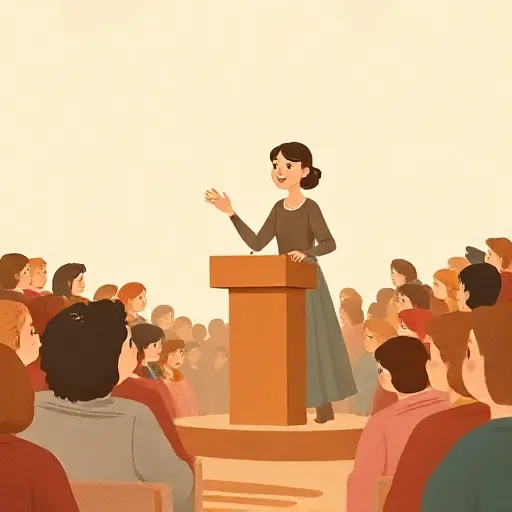
It was May 1892. Hundreds of women — and a few men — from across Europe and the United States gathered in a Paris meeting hall. They had come for the first International Women’s Conference. They talked about rights, work, and what it meant to be treated equally. But one detail would stick: the word féministe kept appearing in discussions. Until then, “feminism” in English had simply meant “the qualities of females.” Now it was becoming something much bigger: a belief in equal rights for women, and a demand that the world change.
That moment captures the double nature of what we now call feminism. It is a political movement — people organizing to end injustice — and it is also an intellectual project. Feminists don’t just protest; they ask hard philosophical questions. They examine how norms (social rules about what is “normal”) have been used to push some people to the edges and shut them out, simply because of their gender. They study patriarchal societies — societies that are structured in ways that give power and privilege to men over women. And they try to imagine what a truly just world would look like.
For many, feminism starts with a simple observation: in nearly every place and time in history, something unfair has been going on. Something that treats women as less than men.
More Than a Protest Sign
If feminism is a response to injustice, what kind of injustice? The obvious answer is legal: for centuries, women could not vote, own property, or go to university. Winning those political rights was an early focus. But feminist philosophers soon realized that the problem runs deeper. Even when laws are equal, unfairness can live inside everyday habits, language, and the way we think.
A key idea is gender, which feminists distinguish from biological sex. Gender refers to the roles, behaviors, and identities that a culture labels “masculine” or “feminine.” Feminist thinkers say that these labels are not simply natural — they are shaped, often without our noticing, to fit a patriarchal system. For example, imagine a video game where one team always starts with less equipment, shorter time limits, and harsher judges. The game’s rules look neutral, but they are rigged. Feminism tries to expose how real-world norms can work the same way, steering people into different life paths based on their gender.
That is why feminism is not only a movement about getting rights. It is also a way of examining everything — science, art, language, even philosophy itself — to see whose experience is being centered, and whose is being ignored.
Waves of Change (and What the Waves Left Out)
If you have heard of “first-wave feminism” or “third-wave feminism,” you have met the wave model. This is a way of telling feminism’s story in the United States and Europe as a series of surges of energy. The first wave (roughly from the mid‑1800s to 1920) fought for basic political rights — above all, the right to vote. Think of Mary Wollstonecraft (1759–1797), who argued for women’s education in 1792, or the suffragists who marched in the early 1900s. The second wave (the 1960s and 1970s) pushed for equality across the board: in the workplace, in schools, and inside the home. The third wave, which began in the 1990s, criticized earlier feminists for paying too little attention to differences among women — such as race, class, and sexual orientation — and made questions of identity central.
The wave model is handy, but philosophers warn that it can also mislead. It can make it seem as if feminism vanished between 1920 and 1960, or that only white, middle-class women fought against male domination. In reality, women of color and working-class women never stopped organizing, writing, and resisting. The model also misses thinkers like Simone de Beauvoir (1908–1986), whose groundbreaking book The Second Sex appeared in 1949, right between the supposed “waves.” Because of these blind spots, many scholars use the wave story only lightly, or not at all.
Who Counts as a “Woman”?

If feminism is about ending injustice against women, who exactly is a “woman”? That question might sound strange. But the more feminists have examined it, the trickier it becomes.
For a long time, many feminists assumed that the typical subject of feminism was a white, middle-class, heterosexual woman. That assumption left out huge numbers of people — women of color, poor women, nonbinary and trans people — whose experiences of gender were different. Today, many feminists argue that gender cannot be understood all by itself; it is always tangled up with race, class, ability, and other parts of identity.
Some philosophers go even further. Judith Butler (born 1956) has argued that any attempt to define “woman” is also an attempt to draw a line that will exclude some people. The moment you say “a woman is X,” you risk telling someone else she doesn’t count. For Butler, gender is not a fixed thing inside you; it is something you do, something that is created again and again through your actions and the way society responds to you. That view makes the category “woman” permanently open and contestable.
These debates can feel uncomfortable, but many feminists see them as a sign that the philosophy is alive. Feminism’s strength, they suggest, is not that it has a single answer, but that it keeps asking the question.
What Feminism Does to Philosophy
When feminist philosophers look at the history of philosophy, they see a long habit of claiming a universal point of view while actually writing from a very specific one — usually, the perspective of educated men. The “neutral” thinker was often anything but neutral.
Feminists have shown, for instance, that great philosophical systems sometimes treated women as incomplete or less rational, while insisting they were speaking about “all humans.” In response, feminist work tends to be more historicized (paying attention to specific times and places), more contextual, and more focused on lived experience than mainstream philosophy. Instead of asking what a person is in the abstract, a feminist might ask how real people live, who takes care of whom, and whose labor is invisible.
Today, this critical energy changes every corner of philosophy — from ethics and political theory to philosophy of science and language. Feminist thinkers uncover biases in supposedly objective research, ask how language shapes our perception of gender, and argue that understanding the world well means listening to people on the margins.
For a 12-year-old, all of this might sound distant. But it isn’t. Every time someone says “boys don’t cry” or “that’s not ladylike,” a tiny piece of a patriarchal script is being acted out. Noticing those scripts — and asking whether they are fair — is exactly what feminist thinking, in its oldest sense, invites you to do. The philosophy that started in a Paris hall in 1892 is still asking you to look at the world and wonder.
Think about it
- Think of a time you heard someone say that a certain hobby, toy, or feeling was “for boys” or “for girls.” What would it take to know whether that rule is fair, or just a habit?
- If every person in a society agreed to treat everyone equally under the law, would that be enough to end gender injustice? What might still be unfair?
- Imagine you could travel back to the 1892 conference and ask a question. What is one question about gender and justice you would want those activists to think about?