Did You Know Tree-Hugging Started as a Feminist Protest?
The Women Who Hugged Trees
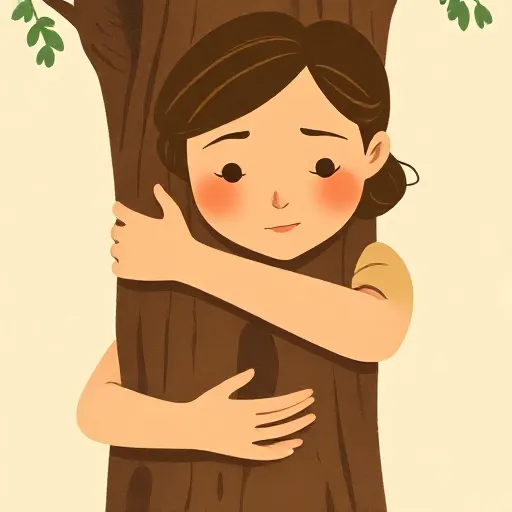
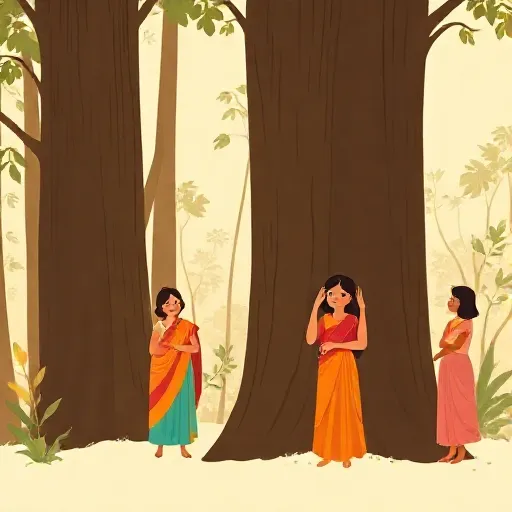
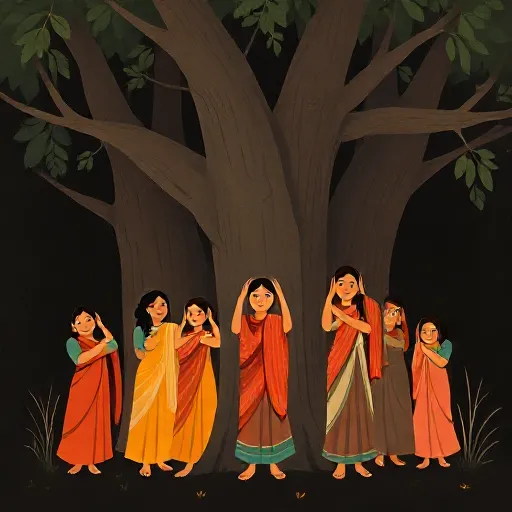
In 1974, twenty-seven women from the village of Reni in northern India took a stand. A logging company had arrived to cut down the forest—a forest the women depended on for firewood, food, and medicine. As the loggers raised their axes, the women rushed forward, wrapped their arms around the tree trunks, and refused to let go. They said the loggers would have to cut the women first. The protest worked. The loggers left, and the women saved 12,000 square kilometers of fragile Himalayan watershed.
This event became famous as the Chipko movement (“chipko” means “to hug” in Hindi). It’s often celebrated as an early environmental victory. But if you look closer, Chipko was also a feminist protest. The women weren’t just defending trees. They were defending their own livelihoods, their knowledge, and their power. They stood up to a system that treated both women and nature as things to be controlled. That insight—that the domination of women and the domination of nature are intertwined—is the starting point of a rich area of philosophy called ecofeminist philosophy.
Ecofeminist philosophy explores the connections between the unjustified domination of women and the domination of nature. It critiques the old, male-biased ideas that often justify that domination, and it tries to build fairer, more caring alternatives. To see why these ideas are so powerful, we need to understand the invisible ladder that western philosophy has long used to sort the world.
A Ladder of Power: Why Do We Think “Up” Is Better?

Philosopher Karen Warren, a key ecofeminist thinker, argues that many problems common to women and nature come from living inside an oppressive conceptual framework. A conceptual framework is a set of basic assumptions, beliefs, and values that shapes how we see the world—like the lenses in a pair of invisible glasses. When a conceptual framework is oppressive, it helps powerful groups keep less powerful groups in a lower position, and it makes that arrangement seem natural or even right.
Warren identifies five features of an oppressive conceptual framework, but three are especially important here.
First, value-hierarchical thinking: the habit of putting everything on a ladder where the “higher” rungs get more value and respect. In much of western history, men have been placed up high, along with culture, reason, and the mind. Women, emotions, the body, and nature have been placed down low.
Second, oppositional value dualisms: these are pairs of opposites that aren’t just different—they are ranked. Reason is good, emotion is suspect. Culture is refined, nature is wild. Male is strong, female is weak. The dualisms don’t allow for a middle ground, and they always give the top half to men and the bottom half to women or nature.
Third, and most crucial, is the logic of domination. This is the moral claim that superiority justifies control. Because men are “higher” (rational, strong, cultured), it seems acceptable—even natural—for them to dominate women, animals, and the land. The logic of domination turns a simple difference into an excuse for ruling.
These three features wired together explain why, to the loggers in Reni, the forest was just a resource waiting to be harvested. They saw themselves as civilized men bringing progress, standing above the “backward” women who clung to the trees. The women’s knowledge of the forest didn’t count, because knowledge linked to emotion and daily life was placed below the “objective” science of the foresters.
But the framework also works through something more hidden: the everyday words we use.
Words That Trap: Animalizing Women, Feminizing Nature

Pay attention to the language you hear. Women are called “silly geese,” “catty,” “cows,” “chicks,” or “bird-brained.” Notice the pattern? Women are animalized—described with animal terms—in a culture that already sees animals as beneath humans. The message is subtle but powerful: women are closer to beasts, so it’s more acceptable to treat them as less-than-fully human.
The reverse happens with nature. We speak of “Mother Nature,” not “Father Nature.” We “conquer” mountains, “master” the wilderness, and “mine the earth’s womb.” Forests are “virgin timber” waiting to be taken. These phrases feminize nature—they paint the natural world as female, passive, and there for the taking. In a patriarchal world, what is feminine is also seen as weaker and meant to be controlled.
Ecofeminist philosopher Carol Adams has shown that this two-way verbal traffic doesn’t just reflect unfair attitudes—it reinforces them. When you constantly hear women compared to animals and nature compared to women, the exploitations begin to seem like part of the same story. The Chipko loggers didn’t need to think of the trees as “female” to cut them down. But the wider culture had already taught them that both women and nature were “lower” and could therefore be used. Language, in this way, helps keep the ladder standing.
But ecofeminist philosophy is not just about exposing hidden ladders. It also proposes a different ladder altogether—or rather, no ladder at all.
Caring for More Than Just Yourself: Ecofeminist Ethics
If the old framework tells us that the best moral thinkers are rational, detached, and follow abstract rules, ecofeminist ethics flips the picture. It emphasizes care-focused ethics: an approach that sees empathy, compassion, and relationships—not just rights and duties—as the core of morality.
There is scientific backing for this. Psychologist Daniel Goleman found that “the intellect (rational mind) simply cannot work effectively without emotional intelligence.” Brain studies show that people who lose the ability to feel empathy (through damage to a part of the brain called the amygdala) can’t engage in ethical reasoning at all. Caring isn’t a soft extra; it’s necessary for being a decent person.
Ecofeminist Val Plumwood argued that a healthy self is both individual and ecological. You are a unique person with your own desires, but you are also a relational self: you exist in webs of relationship—with parents, friends, soil, water, and other species. If you are fundamentally connected to the living world, then caring for a forest is also caring for yourself. The Chipko women didn’t protect the trees out of a cold calculation; they acted from love for their community and their home.
This sort of ethic doesn’t pretend to be perfectly impartial or gender-neutral. It starts from the real experiences of people—especially women—who have been left out of traditional moral theories. And it pays attention to a kind of knowledge that those theories ignore.
Why It Still Matters: Climate, Gender, and You
Vandana Shiva, an Indian ecofeminist and scientist, describes the modern push to replace diverse, local forests with single-crop plantations as maldevelopment. These projects often force women out of subsistence economies—where they grew food for their families—and push men into cash-based work for export. The result is what Shiva calls the “feminization of poverty”: women lose their independence, and the rich, multispecies forest is destroyed. The Chipko protest was an early fight against exactly this kind of development.
The same patterns repeat across the globe. Studies from Sierra Leone show that local women can name 32 different uses for trees—food, dye, medicine, basketry—while men typically name only 8. Yet when official foresters plan projects, they often look only at timber value. Women’s indigenous technical knowledge becomes invisible, because the planners’ ladder places “scientific” expertise far above lived, daily know-how.
So why should a twelve-year-old in the twenty-first century care about ecofeminism? Because you still hear the old language: humans “conquer” disease, “master” climate, “tame” rivers. Because the environmental problems your generation will face—heat waves, floods, species loss—hit girls and women hardest, especially when they are poor. And because the Chipko women taught us a lasting lesson: the people closest to the land often know it best, and the courage to hug a tree can start a revolution in ideas.
Ecofeminist philosophy invites you to question the invisible ladders inside your own thinking. It asks you to notice when words link women with animals or nature with weakness, and to imagine a world where care, not control, is the highest value. That world is still being built—and you get to help decide what it looks like.
Think about it
- Think of a time you heard someone describe Earth as “Mother Nature” or talk about “virgin forest.” What does that language suggest about how we treat the planet? Can you imagine different words that might change our attitude?
- If a company wants to build a dam that will flood a forest, and local women use that forest for food and medicine while the government’s study only values the timber, whose knowledge should count more? How would you decide?
- Is it ever okay to dominate something or someone “for their own good”? Where do you draw the line between protecting and controlling?