
Can a Picture Prove a Math Theorem?
The Dots That Don’t Quite Prove It

You are sitting at your desk, staring at a pattern drawn on the board. Six rows of dots: one dot at the top, two in the next row, then three, four, five, six. A triangle of dots. Next to it, your teacher draws the same triangle flipped over, so together they make a neat rectangle with six rows of seven dots. The total number of dots must be half of 6 × 7, which is 21. You think: 1 + 2 + 3 + 4 + 5 + 6 = 21. But does this picture prove that for any number n, the sum 1 + 2 + … + n equals n × (n + 1) / 2? A thrill of understanding hits you. Then a doubt creeps in: the picture only shows n = 6. What about 100? What about 1? Can you ever trust a picture to prove a mathematical truth meant for all numbers?
This is the puzzle at the heart of visual thinking in mathematics—using diagrams, sketches, or mental images to do math. For centuries, mathematicians have argued about whether such thinking can belong in a genuine proof, the gold standard of certainty.
Why Pictures Make Mathematicians Nervous
Imagine you try to prove that every triangle’s inside angles sum to 180 degrees. You draw a triangle, tear off its corners, and arrange them into a straight line. It looks convincing. But does that prove the theorem for every possible triangle—skinny, fat, right-angled? Your drawing is just one case. A diagram always comes with extra details that the general idea doesn’t demand. The triangle you drew might have all acute angles, but the theorem must hold for obtuse ones too. If you unknowingly rely on a feature only your drawing has, you over-generalize—you assume something is true for all cases when it’s only true for the pictured one.
A famous historical trap is the “proof” that all triangles are isosceles. The diagram shows an angle bisector and a perpendicular bisector meeting inside the triangle. In many triangles, that meeting point actually falls outside. Because the picture is misleading, the argument collapses. In the 19th century, after many such errors, mathematicians like Moritz Pasch (1843–1930) and David Hilbert (1862–1943) insisted that a proof must be “independent of the figure.” Bertrand Russell (1872–1970) went further: in the best books, he claimed, there are no diagrams at all. The fear was simple: if your reasoning depends on how a drawing looks, you might be building on an illusion.
Can a Picture Carry the Weight of a Proof?
Does that mean pictures are always just decoration? Not so fast, say some philosophers. Jon Barwise and John Etchemendy (both late 20th century) argued that valid reasoning is simply the reliable extraction of information you already have. Why can’t that information be stored in a diagram, just as it is in words? Suppose we create a formal system where the rules of inference are moves on diagrams. In such a system, you could prove a theorem by stepping from one diagram to the next according to strict rules. Miller (2001) built a diagrammatic system for a piece of geometry, and you can watch a proof unfold entirely in pictures. Because the system is proven sound, the diagram-based thinking is not just a hint—it’s an essential part of the proof.
Even outside such formal systems, a picture can carry logical weight. Look at knot theory. A knot is a closed loop of string that doesn’t intersect itself. Two knots are equivalent if you can smoothly twist, stretch, and wiggle one into the other without cutting the string. A major task is to tell whether a knot is secretly the unknot—a simple circle. The trefoil knot, with its three crossings, looks definitely knotted. But how can you prove it’s not just a twisted unknot?
Enter colourability, a visual property. Take a knot diagram and try to color each arc (the stretch between crossings) with one of three colors, obeying two rules: (1) use at least two colors, and (2) at each crossing, the three meeting arcs must be all the same color or all different. The trefoil can be colored so that all three colors appear at each crossing. But a diagram of an unknot—a circle with no crossings—has only one arc, so you can’t use two colors. Since any diagram of an unknot will lack a proper three-coloring, and since colourability is an invariant (it doesn’t change when you wiggle the knot), the trefoil cannot be equivalent to the unknot. The proof hinges on seeing the colors on the diagram. You can’t replace that visual check with pure algebra without changing the proof itself. Here, a picture proves a deep truth.
When Pictures Meet Infinity: The Limits of Visual Proof
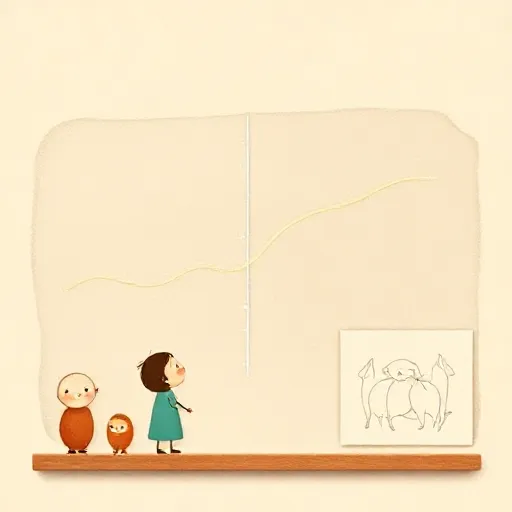
Yet not all math is knot theory. In analysis, the branch dealing with limits and infinite processes, pictures can be treacherous. Consider the Intermediate Value Theorem (IVT): if a continuous function on a closed interval goes from a negative value to a positive one, it must cross the x‑axis somewhere. Glance at a wavy curve crossing the axis, and you’ll probably nod. Philosopher James Robert Brown famously claimed that “using the picture alone, we can be certain of this result.”
But wait. Philosopher Marcus Giaquinto (born 1953) pointed out a problem. The curve in the picture assumes the function is visually continuous—you can draw it without lifting your pencil. Yet some continuous functions are so wildly oscillating that they cannot be drawn (imagine a graph that looks like a blur). Even when a function has a drawable curve, the picture can trick you. Consider the function x² – 2, but only on the rational numbers between 0 and 2. The curve would look exactly like the real-number curve, crossing the x‑axis. However, there is no rational number x such that x² = 2, so the zero does not exist. The picture hides that fact. The visual argument secretly assumes a deep property of the real numbers that the rationals lack (completeness). So a picture alone is not reliable in analysis. The debate remains open: maybe visual proving could work for a restricted class of “nice” functions, but no consensus has been reached.
So: visual routes can be powerful in geometry and topology, but when infinity enters, a picture may whisper lies.
How Pictures Help You Discover Math (Even When They Don’t Prove)
Even when a picture fails as a rigorous proof, it can spark discovery. Visual thinking helps mathematicians stumble upon truths, find proof strategies, and invent whole new mathematical kinds.
Truth discovery. Suppose you want to compare the arithmetic mean (a + b) / 2 with the geometric mean √(ab) of two positive numbers. You sketch two touching circles with diameters a and b, draw a right triangle connecting their centers, and notice a shorter segment representing √(ab). By imagining the smaller circle shrinking and growing, you see that √(ab) never exceeds (a + b) / 2. This journey doesn’t count as a formal proof, because you can’t be certain your mental image covers all cases. But it gives you a reliable inkling—often the first step toward a solid argument.
Discovering new realms. In the 1980s, mathematician Mikhail Gromov (born 1943) used a visual trick to revolutionize group theory. A group is an algebraic structure, but you can picture it as a Cayley graph: a network of dots (group elements) joined by colored edges that show multiplication by a generator. By “zooming out” in your imagination, the discrete graph blurs into a soft geometric object. Gromov realized you could then apply the geometry of curved spaces to study groups. This gave birth to geometric group theory, where notions like hyperbolicity—inspired by visual models of hyperbolic space—capture deep algebraic properties. Visual thinking about graphs and zooming out was essential to building the whole field.
Mental arithmetic. Even basic calculation can involve visual imagery. Expert users of the Japanese soroban (abacus) often perform lightning mental math by visualizing a soroban and moving the beads in their mind’s eye. Brain studies confirm that these mental abacus operators use visuospatial working memory, not just verbal processing. So visual thinking isn’t only for advanced geometry; it can live inside your head while you add numbers.
What This Means for Your Own Thinking
You have probably doodled a diagram to crack a tough problem, or imagined a shape to see what’s going on. The history of math shows that those moments echo the very processes that led to brilliant discoveries. The debate about whether visual thinking can be part of a genuine proof isn’t fully settled. Some uses are reliable, others are deceptive. But one thing is clear: visual thinking is a powerful tool for understanding, discovering, and checking ideas. As mathematician Hermann Weyl (1885–1955) put it, we don’t want to traverse a proof “blindly, link by link, feeling our way by touch.” We want to see the big picture—and sometimes, that big picture is literally a picture.
So next time you find yourself sketching a triangle of dots, a knot, or a wavy line, remember: you’re joining a long tradition. Just keep a sharp eye, and check your pictures with logic.
Think about it
- If a picture convinces you of a math fact, but you later find a case where the picture misleads, should you still trust future pictures? How would you decide when a diagram is safe to reason from?
- Imagine you discover a new mathematical truth using only a mental image. Would that count as knowing it, even if you can’t write a formal proof? Why or why not?
- Think of a time you solved a problem by drawing something. Did the drawing serve as evidence, or did it just help you see what you already knew? What role did it play?