Can Selfishness Actually Help Everyone? Adam Smith’s Surprising Answer
The Professor Who Saw the Whole Market as a Machine
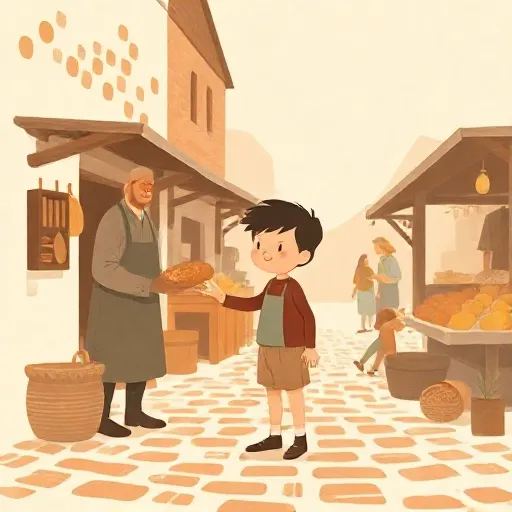
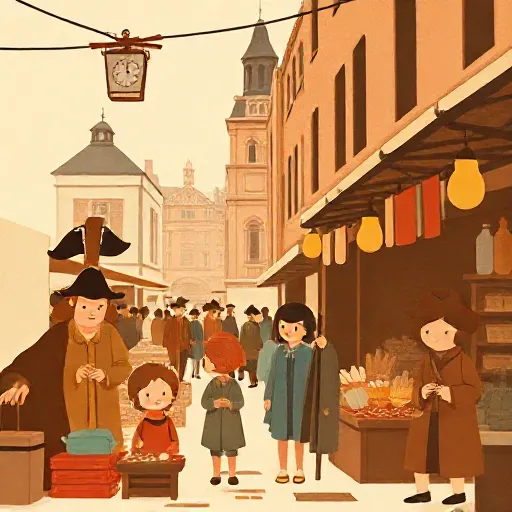
It is 1776. You are standing in a crowded London street market. People shout, coins clink, a baker hands over a loaf for a shilling. You wonder: why does all this work? No one is in charge, yet everyone gets what they need. That very question obsessed a Scottish professor named Adam Smith (1723–1790).
Smith had already written a book about human feelings called The Theory of Moral Sentiments (1759). In it, he argued that we desperately crave other people’s approval. That hunger, he said, drives us to earn money and own nice things. Then, in 1776, he published an even bigger doorstop: An Inquiry into the Nature and Causes of the Wealth of Nations. There he described how markets actually run.
Smith noticed something almost magical. When each person chases their own goals, the whole economy seems to follow an invisible hand—a pattern no one planned. He once visited a pin factory and saw workers splitting tasks: one drew the wire, another cut it, a third sharpened the point. By dividing the work, they made thousands of pins a day instead of a handful. He called this the division of labor, and it became a cornerstone of economics. In Smith’s picture, self-interest—doing what’s best for yourself—isn’t pure greed. When you trade with others, you both win, and the whole world can slowly grow richer.
Money: From Sinful Metal to the Oil of Trade

Long before Smith’s time, many thinkers believed that chasing profit was dangerous. The ancient Greek philosopher Aristotle (384–322 BCE) argued that commerce twists our values: we treat money as the goal instead of a tool. Medieval scholars like Thomas Aquinas (1225–1274) built on that idea. They said that cheating customers, price gouging, and charging interest on loans (called usury) were morally wrong. A just price, they taught, should recover costs but stay fair to the community.
Then, between the 1600s and 1700s, a new idea spread. Philosophers started calling trade doux commerce—French for “gentle commerce.” The more people traded, the more they had to play fair, keep promises, and treat strangers with respect. The French thinker Montesquieu (1689–1755) claimed that where there is commerce, there are gentle manners. The Scottish philosopher David Hume (1711–1776) added that towns and markets made people more sociable and humane.
But Smith was not entirely swept up by this cheerful picture. He knew that merchants often collude to keep wages low and “have an interest to deceive and even to oppress the public.” A nation where the majority lives in misery, he insisted, cannot truly be called happy. During this period, the desire for wealth still walked a tightrope between virtue and vice.
The Magic of Money: Why Coins Flow Like Water

In the sixteenth century, a Polish astronomer named Nicolaus Copernicus (1473–1543) was asked to solve a puzzle. Spain was flooding Europe with silver from the Americas, yet prices kept rising and coins felt unreliable. Copernicus realized a simple but powerful law: the more money there is, the less each coin can buy. That insight grew into the quantity theory of money—the idea that the general price level moves up and down with the money supply.
Hume turned this into a set of clever thought experiments. Imagine, he said, that overnight every coin in your country doubled. You wake up richer, but soon all the shopkeepers raise their prices to match. In the end, nothing real has changed. Money, he argued, is neutral in the long run: extra cash doesn’t make a country genuinely wealthier, only more inflated. He also observed that if one nation piles up gold, prices there climb, imports become cheaper from abroad, and the specie leaks out again like water seeking its own level. That process is known as the specie-flow mechanism.
Smith remained cautious. He thought paper banknotes were useful but dangerous—like a wagon lunging through the air on wings of wax. Banks that printed too many notes risked crashing, as he’d seen in the financial panic of 1772. For both thinkers, money was a refined tool, but it couldn’t be bottled up, and it certainly wasn’t real treasure.
The Poor Man’s Son and the Winter Storm

Smith understood something unsettling about why we hustle. He wrote a famous parable about a poor man’s son who works his whole life to become rich. He toils, flatters people he despises, and sacrifices his peace of mind. Finally, at the end of his days, he realizes that “wealth and greatness are mere trinkets.” The beggar in the gutter, Smith added, often sleeps better than the king.
What drives the chase is not comfort but approbation—the desperate need to be admired. We imagine ourselves in the polished carriage of a wealthy lady and feel a thrill, even though the carriage doesn’t make her any happier. Smith called this the “parade of riches,” and he believed it tricks us into a restless cycle. We are never quite satisfied, always in a hurry to better our condition.
Even so, Smith did not want to abolish trade. He thought rising wages and the spread of schools could soften the worst edges of capitalism. He worried that factory work might turn people into human machines who repeat one simple motion all day, “as stupid and ignorant as it is possible for a human creature to become.” His solution was neither revolution nor greed — it was a kind of ancient wisdom: prepare for the winter storm, because wealth can keep off a summer shower, but not the real hardships of life.
Why This Old Debate Still Lives in Your Pocket

Every time you save up for a video game or trade snacks in the lunchroom, you are stepping into the world Smith studied. The puzzles haven’t vanished. Does your desire to show off a new phone really make you happy, or just hungry for the next upgrade? Can a system built on self-interest ever be fair to everyone?
Smith himself never gave a tidy answer. His work sits right in the middle of a tug-of-war between two ideas: that trade makes us decent and that the craving for wealth can corrupt us. Modern economists still argue about whether inequality is a natural byproduct of growth or a sign that markets need mending. And parents and teachers still remind you that friends matter more than stuff—a lesson Smith would have cheered.
So next time you watch a marketplace hum, or swipe a card at a shop, remember the 18th-century professor who saw both the power and the danger of your everyday choices. The invisible hand might be clever, but it doesn’t have a heart.
Think about it
- If working hard for your own goals ends up making other people’s lives better too, does that make your self-interest a good thing, or is it still just luck?
- Can a society be called fair if some people struggle to afford lunch while others own private islands — so long as nobody stops anyone from trading?
- When you dream of having the coolest shoes or the shiniest gadget, do you care more about the object itself or about what other people will think of you?