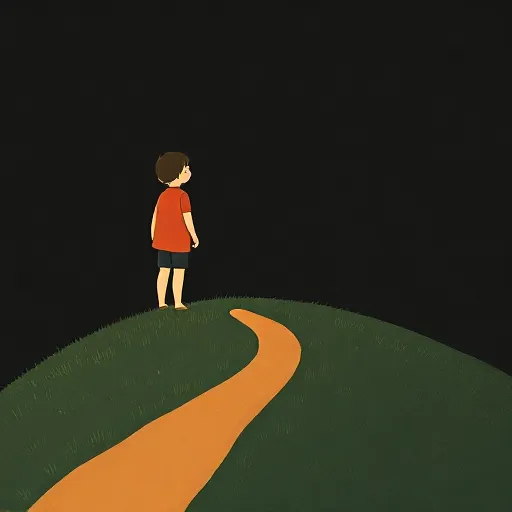
Why Do Smart Choices Sometimes Build a Trap?
Maya’s Bike: How One Small Treat at a Time Stole Her Dream

Maya saves five dollars every week. She has taped a picture of a shiny blue bike above her desk. But each Friday after school she passes a bakery, and the smell of warm chocolate chip cookies makes her pause. A cookie costs two dollars. Maya tells herself she will skip it this time, but the pleasure feels so close and the bike still feels so far. She buys the cookie. Every week she plans to be stronger next week, and every week the same thing happens. Months roll by. The bike never arrives.
Maya is caught in a dynamic choice problem. A dynamic choice problem happens when a series of sensible-looking choices leads to an outcome you never wanted. Each single choice — eating one cookie, spending two dollars — seems fine in the moment. But the pattern of choices over time steals the bigger goal.
Why does Maya keep reversing her plan? Because of present-biased preferences. Humans naturally value a reward more the nearer it is. Imagine a graph that tracks how much you desire a future treat as time approaches. That graph is called a discount curve. A small, immediate reward like a cookie has a discount curve that shoots up steeply right before you can grab it. A larger, later reward like the bike has a flatter curve. At first, the bike looks more appealing. But when Friday afternoon arrives, the cookie’s curve spikes and crosses above the bike’s curve. Maya’s preferences flip: now the cookie feels bigger than the bike. After she eats it, the moment passes and she regrets the choice, but next week the curves cross again. That is a preference reversal, and it is a perfectly normal trick of human psychology, not a sign of weakness.
Philosophers who study choice over time, such as John Broome (b. 1947), point out that these reversals explain why people struggle to save for retirement, why someone who desperately wants to be healthy still smokes cigarette after cigarette, and why Maya’s bike stays a picture on the wall. Each step down the cookie path feels smart in the minute, yet the long-term result is a life Maya never chose.
Kay’s Beach vs. Her Paintbrush: When Nothing Is Simply Better

Not all dynamic choice problems come from changing preferences. Some arise because the options themselves refuse to be ranked. Think about Kay: she must choose between a six-day beach vacation with her children and a two-month oil-painting course. Neither option is clearly better than the other. But are they equally good? If they were equally good, then a slightly improved version of one — say, a seven-day beach trip — would definitely be better than the painting course. Yet for Kay, the seven-day trip still isn’t better than the painting course. That means the two options are incommensurable. Two alternatives are incommensurable if neither is better, nor are they equally good. Philosophers Joseph Raz (1939–2022) and John Broome helped popularize this idea.
Incommensurable options create a special kind of drift. Broome imagines the biblical story of Abraham. God tells Abraham to take his son Isaac to a mountain and sacrifice him. Abraham must decide. Suppose submitting to God and saving Isaac are incommensurable values, like Kay’s beach and painting. Abraham can rationally set out for the mountain. But once he reaches the foot of the mountain, he can turn back. Turning back saves Isaac, but trust between father and son is already badly damaged; it’s worse than never having left home. Still, turning back might be incommensurable with going ahead — neither is better, and they aren’t equal. So Abraham could switch his plan at the last moment, ending up with an outcome worse than if he had simply refused from the start. Each separate decision was understandable, but the chain of choices left him in a deeper hole.
When your options are incommensurable, you can wobble between plans without ever landing in a clearly right place. That wobbling can carry you somewhere you never meant to be.
The Self-Torturer and the Secret Loop in Your Preferences
Preferences can be stable and still lead you into a trap if they contain a hidden loop. Normally, preferences are transitive: if you like A over B and B over C, you also like A over C. But sometimes people’s preferences form a circle instead. Jay, for example, is choosing between three jobs. Job A is very stimulating but pays little. Job B is somewhat stimulating and pays decently. Job C is dull but pays a lot. Jay prefers A over B because the pay jump isn’t worth losing stimulation. He prefers B over C for the same reason. Yet he prefers C over A because the huge pay gap now feels worth giving up even a very stimulating job. His preferences loop: A beats B, B beats C, C beats A. These are intransitive preferences, and they make it impossible to rank the jobs from best to worst.
The philosopher Warren Quinn (1940–1992) invented a famous puzzle to show how dangerous intransitive preferences can be. A person — Quinn calls him the self-torturer — has a device attached to him with 1001 settings, from 0 to 1000. Each week he can move up one setting. The increase in electric current is so tiny he feels no difference. Each advance gives him $10,000, and he can never go back. Because no two neighboring settings feel any different, the self-torturer prefers setting 1 over 0, 2 over 1, and so on. But he absolutely does not prefer 1000 over 0. That contradiction creates a preference loop. By following his preferences one week at a time, he climbs to a setting that causes agony — an outcome he loathes.
This is not just a strange thought experiment. The money pump argument, developed by Donald Davidson (1917–2003) and others, shows that intransitive preferences can be exploited. Imagine Alex prefers computer type A over B, B over C, and C over A. He starts with a type C computer. Offered a trade of his C plus one dollar for a B, he accepts. Then trade B plus a dollar for an A, he accepts. Then trade A plus a dollar for a C. He ends up with the same computer he started with but has lost three dollars. The loop can pump money out of him indefinitely, even if he sees it coming.
The Million-Dollar Promise You Can’t Make: Kavka’s Toxin Puzzle

Some dynamic choice problems pit your present self against your future self in an even stranger way. Gregory Kavka (1947–1994) imagined a billionaire who makes you a curious offer. At midnight tonight, if you genuinely intend to drink a vial of toxin tomorrow afternoon, he will deposit one million dollars in your bank account by morning. The toxin will make you painfully sick for a day but causes no lasting harm. The twist: you don’t actually have to drink the toxin to keep the money. The cash arrives hours before you would need to swallow it. So tomorrow afternoon, you already have the million. Drinking the poison would bring only misery with no added reward. Because you know this, you cannot honestly form the intention tonight. You are confident your future self will refuse. Without the intention, you never get the million.
This is an autonomous benefit case: you would benefit from forming an intention, not from carrying out the action. The rational, moment-by-moment decision-making that usually serves you well now blocks a great outcome. Your current self wants to cooperate with a plan, but your future self sees no reason to follow through. Together, the two selves miss a treasure that was within reach.
How to Outsmart Your Future Self: Knots, Promises, and Being Stubborn

If your future self is your own worst enemy, how can you ever reach long‑term goals? Philosophers have proposed several strategies, some of which you already use without thinking.
The ancient poet Homer told of a powerful technique called precommitment. Odysseus wanted to hear the Sirens’ deadly song, so he ordered his crew to tie him to the ship’s mast and plug their ears with wax. No matter how much he later begged, the ropes held. In real life, you can precommit by setting up automatic savings that charge a penalty for early withdrawal, or by promising a friend you will practice an instrument each day and stake your reputation on it. The key is to raise the cost of giving in so high that your future self won’t do it.
Another approach, suggested by Robert Nozick (1938–2002), is to invest actions with symbolic utility. You decide that “one more cookie” symbolizes giving up on your bike forever, so the cookie now carries the heavy emotional weight of that failure. The self-torturer could attach the meaning that “one more click” really means choosing a life of agony, and that meaning can stop his hand.
More radically, philosophers Michael Bratman (b. 1945) and David Gauthier (1932–2023) have argued that rationality itself sometimes requires resoluteness — sticking to a plan even when your current preferences nudge you elsewhere. If a general policy of following through on plans leads to a life you overall prefer, then being resolute is not stubborn stupidity; it is part of being a smart chooser who can see beyond the present moment. For the toxin puzzle, Gauthier would say that adopting the plan to drink was good for you, so following through is rational, even though it goes against your immediate wishes.
Why Your Own Life Hides These Traps: Procrastination and Creeping Messes

Dynamic choice problems are not just puzzles for a philosophy class. They show up every time you let “just one more episode” before homework become a nightly habit, or when every extra bite “won’t make a difference” until suddenly it does. Procrastination is a textbook dynamic choice problem. As philosopher Sarah Stroud points out, each delay can seem perfectly reasonable in the moment, yet the total effect is a project left unfinished and a feeling of disappointed regret.
Even giant problems follow the same logic. Philosopher Chrisoula Andreou notes that environmental destruction often creeps. One factory adds an almost invisible puff of smoke. Nobody can feel the difference. But thousands of factories doing the same over years fills the air with poison. The situation is structurally identical to the self‑torturer: many small, individually harmless steps pile into a disaster nobody wanted.
The takeaway for you is simple but powerful. Whenever a goal matters to you — learning an instrument, writing a story, saving for something big — look out for paths where every step feels okay but the end is somewhere you would hate. If you spot such a path, you can set a rule, make a promise, or build a barrier while your motivation is high. Understanding dynamic choice problems won’t make temptation disappear, but it can help you design a life that actually goes where you want.
Think about it
- If someone recognizes they are on a “self‑torturer” path, what could they do besides precommitting? Could a simple decision to stop be enough, or would it almost always fail without a stronger trick?
- Imagine a friend says, “I’ll start my project tomorrow — one more afternoon of games won’t hurt.” Would you call that procrastination or a smart choice? Where do you draw the line?
- Some philosophers argue that drinking the toxin after you already have the million is truly irrational because it’s painful for no gain. Others say it’s rational because it’s part of a beneficial plan. Which side feels more convincing to you, and why?