Is Your Phone Photo Still a Real Photograph?
When Is a Photo Not a Photo?
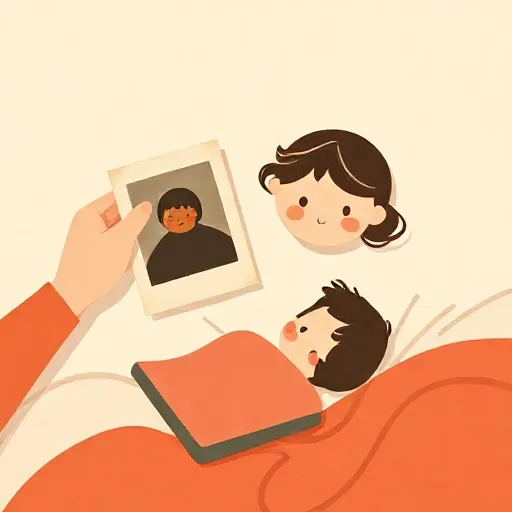
You snap a picture with your phone. Instantly, it appears — sharp, colorful, perfect. But is it the same kind of thing as the crinkled, yellowing photograph your grandmother keeps in a shoebox? At first, they seem alike. Both show a moment frozen in time. Yet a phone picture is stored as a long string of 1s and 0s. The old photograph was made by light hitting a chemical-coated strip of plastic. Does that difference matter? Philosophers who study art have argued about this ever since computers began making images. The central question is whether digital art — art built from numbers and computer code — is fundamentally different from older, analog art, or whether it is just art made with new tools.
The Music of Numbers: What Makes Something Digital?
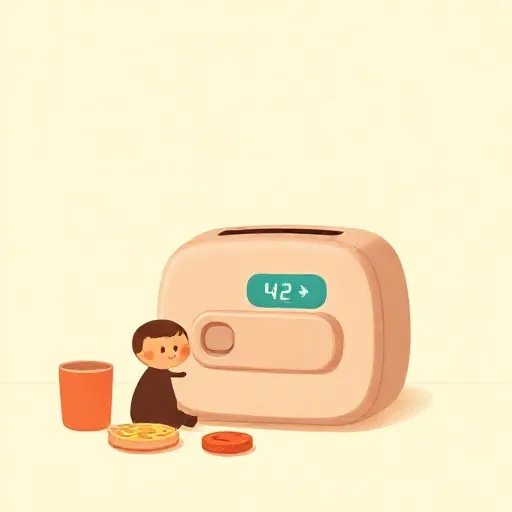
To see why this matters, imagine two devices. One is a toy bank that counts dimes. It has a digital display that shows a whole number, like 42. You can always tell exactly how many coins are inside — the number is 42, not 41 and a half, and not something between 42 and 43. The other device is a traditional liquid thermometer. Hold it in your hands, and the red line rises. But ask yourself: what is the exact temperature? The line could be anywhere along a smooth, unbroken range. No matter how closely you look, there is always another possible position between any two. The dime counter is a digital system. The thermometer is an analog system.
The philosopher Nelson Goodman (1906–1998) explained this using two key ideas. A digital scheme is differentiated: the possible states have clear gaps between them. You never have to guess which state you are in. An analog scheme is dense: between any two states, there is always a third. A digital clock jumps from 3:15 right to 3:16. An analog clock with sweeping hands passes through infinitely many positions; its exact reading is always a little vague. For Goodman, this distinction shapes how we represent the world. A musical score is digital — the notes are discrete and unmistakable. A painting, with its continuously blending colors, is analog. According to Goodman, pictures just are analog by nature. That claim sets up the big fight about digital images.
Inside the Digital Studio: How Computers Make Art
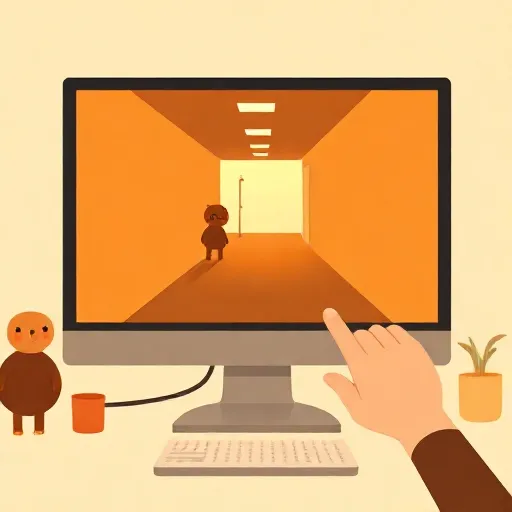
Look at an early digital artwork, Craig Kalpakjian’s video Corridor (1995). It slowly leads you down an empty office hallway with pale walls and opaque windows. The scene looks like a real, filmed space, but it was generated completely by a computer program. Another work, Landscape Study #4 (2002) by Cory Arcangel and Paul B. Davis, took real photographs of Buffalo, New York, scanned them, and then reprogrammed them as a continuously scrolling background for a classic Nintendo game. The artists even melted the chips inside a Super Mario cartridge and replaced them with their own, so the work runs on any Nintendo system.
How does a computer make such things? At its heart, a computer is billions of tiny switches called transistors. Each switch can be either “on” (1) or “off” (0). A sequence of 1s and 0s — called binary code — represents a number. By chaining these numbers, a computer stores images, sounds, and instructions. When you take a digital photo, the camera does not record continuous light. It breaks the scene into a grid of tiny squares, or pixels. For each pixel, it measures the average light intensity and rounds it to the nearest integer from a limited set — a process called sampling and quantization. Invisible to you, many subtle variations in light are dropped. Yet with millions of pixels and billions of possible colors, the result looks smooth. Digital artists can also exploit the blocky look of low-resolution pixels for deliberate effect, as Arcangel and Davis did.
Is the Image Still an Image?
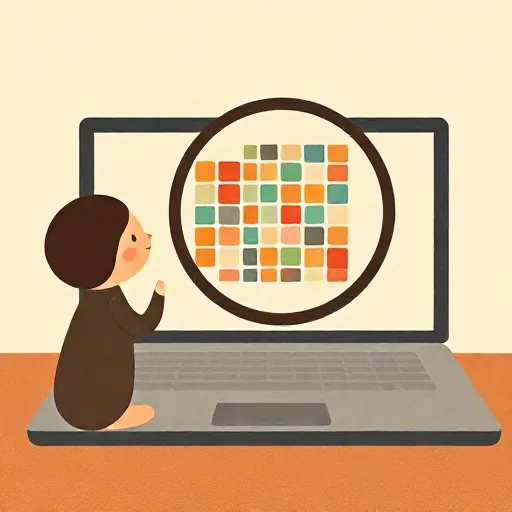
Some media theorists worry that a digital photograph is not a true image at all. An old-fashioned film photograph, they say, is a physical trace — light from the scene literally altered the chemicals on the strip. A digital file is just a data output, a list of numbers that a computer interprets. The link to the world feels more like a code than a trace. Yet, as we saw with the thermometer, pictures are supposed to be analog — dense and continuous. How could something made of a finite grid of numbers be a real picture?
Philosophers point to a clever engineering trick. Modern digital screens can display over 16 million colors. The jumps between neighboring colors are so tiny that your eyes cannot tell them apart. The system is finitely differentiated — it has discrete, separate states — but the differences live below the threshold of human perception. So, for all practical purposes, the image behaves like a truly digital scheme that still looks continuous. This means digital images can be replicated exactly, something an analog photograph can never do. Yet this perfect copyability does not force an artwork to be endlessly copied. Kalpakjian’s Corridor is a single work held by the San Francisco Museum of Modern Art. You cannot freely view it online. Arcangel and Davis’s installation is meant to be shown in a gallery with a specific setup. The artists used their instructions to make the work singular, refusing the medium’s tendency toward multiplicity. Other digital works, like net art, are designed to be accessible to anyone, anywhere, anytime.
Art That Plays Back: Interactivity and You
Many digital artworks do not just sit still — they respond to your actions. An interactive work is one where your movements, clicks, or decisions help generate what you see and hear. The philosopher Dominic Lopes defined this precisely: a work is interactive if it prescribes that a user’s actions help produce its display. In a traditional painting, nothing you do changes the work itself. But in an interactive installation like TeamLab’s Rock where People Gather, a waterfall of virtual particles shifts every time you step on the projection. No two visitors ever see exactly the same flow.
Some interactive works are like watching a garden grow over a season — each visit shows a new, unrepeatable state. Others are repeatable, like most video games, where you can play through again and see a different story unfold. The display can vary so much that a game might end tragically in one playthrough and joyfully in the next. This raises a fresh puzzle: are you a co-creator each time you play? It also changes what it means to appreciate the work. Instead of focusing only on a finished object, you have to pay attention to the actions the work invites and the experiences those actions create. The art is as much in the doing as in the seeing.
Why the Digital Canvas Still Matters
When you choose a filter for your selfie or edit a video clip with a few taps, you are using the same digital foundations that Kalpakjian and Arcangel and Davis used. The ease of making endless tweaks can feel like magic. But easy does not mean simple. Digital tools give you a near-infinite menu of equally possible looks. That very freedom creates a new kind of artistic problem: how to commit to just one version when so many look good. Appreciating a digital film, a game, or even a friend’s photo means recognizing the selection from that vast sea of possibilities. It also means noticing what the maker chose not to let you do — like the missing “play” button in Landscape Study #4.
Understanding what makes something digital is not just a dusty puzzle for museum curators. It changes how you see every glowing screen in your pocket, on your desk, or in a theater. That phone photo really is a different kind of object from the crinkled print in the shoebox. It can be copied, altered, and shared in ways the old photograph cannot. Yet it is still an image, still the product of a human choice about what to frame and how to show it. The fight about whether digital art is a new kind of art is ongoing — and your own everyday flicking and tapping make you a part of it.
Think about it
- If you could make a perfect digital copy of a famous painting that looks and feels identical, should it be displayed in a museum as the original? Why or why not?
- When you choose a filter for your photo, are you acting as an artist, or just using a tool someone else built? Where would you draw the line?
- Suppose a computer program writes a story that you find beautiful and moving. Who is the author — the person who wrote the program, the program itself, or perhaps nobody at all?