
Why You’ll Never Think a Thought Without Your Body
The Blood‑Transfusing Monk
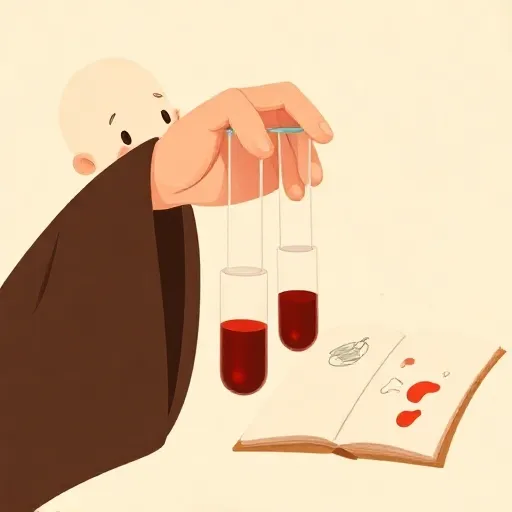
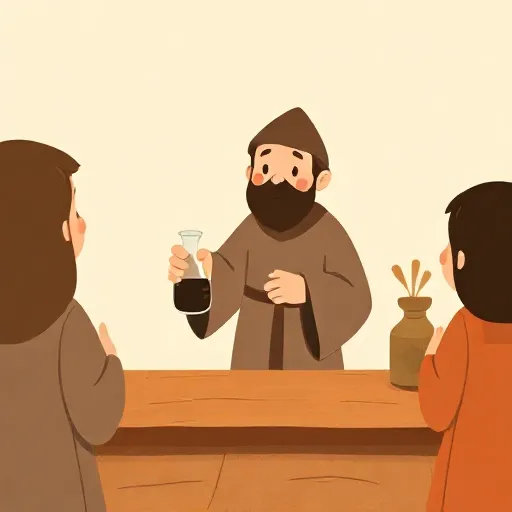
In early 1668, a small pamphlet appeared in Paris that described a startling new medical procedure — a way to move blood from one animal to another. The author was not a famous physician but a quiet Benedictine monk named Robert Desgabets (1610–1678). He had been fascinated by William Harvey’s recent discovery that blood pumps through the body like a machine, circulating according to mechanical laws. For Desgabets, that became more than a medical fact. It was a philosophical lightning bolt.
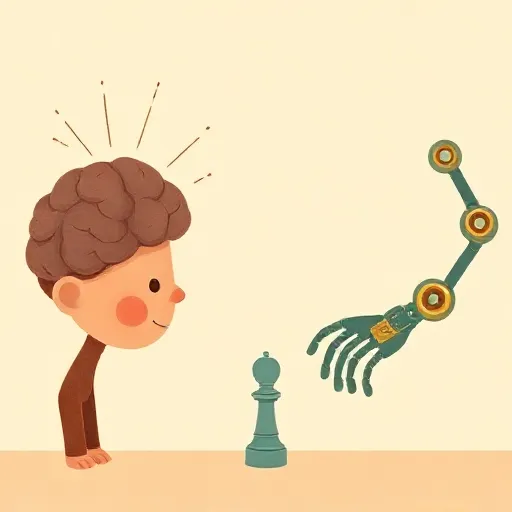
If the body works like an intricate clock, he reasoned, then the human mind — which is united with that body — can never work apart from it. Desgabets spent the rest of his life pushing this idea to its limit, arguing that even our most abstract thoughts ride on the movements of our senses. He adored the new philosophy of René Descartes but believed Descartes had made a colossal mistake. To Desgabets, you cannot think without your body, not even about mathematics, not even about your own soul.
The Mind Can’t Go It Alone

Desgabets was a Cartesian through and through. He accepted that there are two kinds of substance — extended substance (matter, which is just length, width, and depth) and thinking substance (mind, which has thoughts). He agreed that matter and mind are completely distinct and that the physical world runs on mechanical contact, not hidden purposes. But he refused to follow Descartes’s famous claim that the mind can know itself clearly without the help of the body.
For Desgabets, a human being is not an angel trapped in a machine. An angel could have pure thought — a timeless flash with no before or after. Human thoughts, however, always have a beginning, a duration, and an end. They come one after another, like footsteps. That succession, he insisted, is a kind of movement — and movement belongs to the body, not to an immaterial soul. Even the simple act of thinking “I exist” takes time and depends on the brain and the senses.
He used a homely analogy to explain the mind‑body union. Asking why the mind and body can interact, he said, is like asking a carpenter why a convex peg perfectly fills a concave hole. They are made for each other; that’s just how God set up the world. The real task is to understand how, given this union, the body determines the mind — and that is something we learn through experience, not by pure reasoning.
Your First Glance Doesn’t Lie

At the heart of Desgabets’s philosophy was a revolutionary principle he believed Descartes himself had made possible. Descartes discovered that sensible qualities — heat, color, smell, taste — are not actually in objects. When you feel warmth, that sensation is in your mind, not in the fire. The fire has only size, shape, and motion.
From this, Desgabets drew a stunning conclusion: simple conception — the first operation of the mind, before any judgment — is always true. If you simply perceive heat as a feeling, you grasp a real sensation. The trouble begins when you judge that the warmth you feel exists in the fire exactly as you feel it. That judgment is a leap beyond perception, and that’s where error creeps in.
He called this foundational idea the intentionality principle: every idea has a real object. To think is always to think about something. You cannot think of nothing. So long as you merely conceive — without adding “it is like this” or “it resembles that” — your thought grabs reality directly. Take a stick half‑submerged in water. Your simple conception is that you are seeing a bent visual appearance; the error only comes when you judge “the stick itself is bent.” Stick to the raw perception, and you stay in the truth.
This meant the senses are not cloudy windows but the very ground of knowledge. They deliver objects themselves, not just fuzzy copies. The challenge, Desgabets believed, is to learn when you are conceiving and when you are silently judging without realizing it.
No Body, No Thought: Why Descartes Was Wrong About the Cogito

Descartes famously began his philosophy by pushing aside the senses, looking for something the mind could know with absolute certainty all by itself: “I think, therefore I am.” Desgabets thought this was a dangerous misstep. The “I think” is not a pure insight; it is a thought that occurs successively, with a beginning and an end. And succession, he hammered home, depends on motion — which belongs to the body.
He went further. Descartes and his followers claimed we have innate ideas — thoughts like the idea of God or the idea of a perfect triangle, placed in us before any sensory experience. Desgabets flatly rejected this. All our ideas, he argued, originate by the senses (a sensu), not in the senses as a literal picture. When you think of a triangle, you are not remembering a Platonic ghost; your idea is built from the experience of extended bodies — things that stretch out in space — that your senses have encountered since you were a baby. Even the word “thought” cannot be separated from time, and time comes from the moving world.
He was not saying that thinking is material. He was saying that thinking depends on matter in the same way a pole can be measured into ten feet: the division is done by the mind, but the pole is really there. Without a body that moves and senses, your mind would have nothing to work with and no way to work.
God’s Guarantee (and Why Triangles Aren’t Ghosts)

If simple conception always hits a real object, why is that? Desgabets grounded his whole system in what he called the Creation Doctrine. Descartes had suggested that God freely created the eternal truths — truths like “2 + 3 = 5” — by an act of will. Before God created the world, there was no necessity that two plus three equal five; God could have made it otherwise. Once God created the world, those truths became permanent and unchangeable.
Desgabets took this doctrine very seriously. It means there are no plain possibilities floating around in God’s mind or yours, no ghostly triangles that exist even if no physical triangle ever does. An essence exists only in a real, created thing. So when you conceive a triangle, your thought has a real object — not some imaginary nothing, but the actual extended substance that God made. That substance is indefectible: it cannot be destroyed, divided in its essence, or turned into something else. The essence of matter is extension, and extension stays exactly what it is, forever.
This is why Desgabets was certain that physics and geometry belong together. The solid of the mathematician — a magnitude with length, width, and depth — is the very same object as the natural body of the physicist. There is no gap between what your mind grasps and what really exists, because your mind was made to receive the world God actually created.
Why Your Body Refuses to Be Ignored

You may never have heard of Robert Desgabets, but his challenge lands in your own life. When you are tired, hungry, or stung by cold, your thoughts tangle. You cannot “just think” clearly, no matter how hard you try. Desgabets would say that is not a flaw; it is a sign of what you are — a mind that is a union with a body, not a lonely ghost.
Modern science partly echoes him. Researchers now talk about embodied cognition — the idea that thinking is shaped by the whole body, not just a floating brain. And the practical advice he built into his philosophy still works: slow down before you judge. When you feel an emotion, notice the raw sensation before deciding what it means. When you see something surprising, separate the bare perception from the story your mind rushes to tell. Desgabets believed that if you stay with simple conception, you touch reality. Not bad advice for a 17th‑century monk with a vial of blood in his hand.
Think about it
- Close your eyes and try to imagine a taste you have never experienced. Can you? What does that suggest about where your ideas come from?
- If every thought depends on your body, does that mean you cannot have ideas about things that are not physical, like justice or infinity? Why or why not?
- Have you ever been absolutely certain about something at first glance, only to discover later that you were wrong? Does that prove Desgabets was mistaken that simple perception is always true? What might he reply?