Why Does a Flat Picture Show a Whole World?
The Horse on the Page: Is It Just Resemblance?
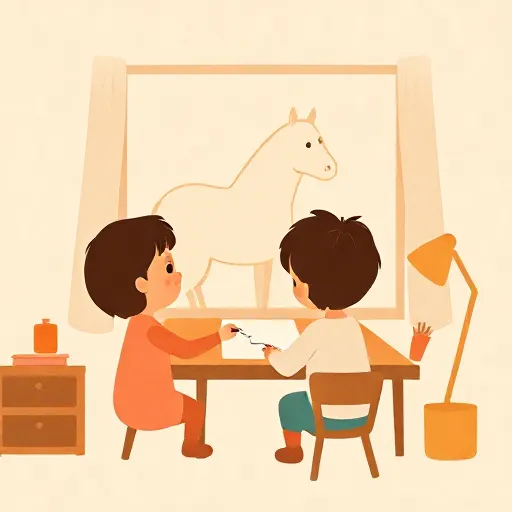
You glance at a few scribbled lines and immediately see a horse — its ears, its mane, its galloping legs. But all you’re really looking at is a flat piece of paper with marks on it. How does that happen? What makes a picture a picture? One of the oldest answers comes from Plato (c. 428–348 BCE). He thought that a painting (or drawing) represents something by imitating its shape and colour. If you trace the outline of a real horse, the result looks like the horse because the shapes and colours on the page resemble the visible parts of the animal itself.
This idea feels right. When you squint at a portrait, you might say, “That really looks like my grandmother.” So a resemblance theory of depiction claims that a picture depicts an object because the marks on the surface resemble that object’s shape and colour in some important way. But as you’ll see, this straightforward idea runs into trouble almost immediately.
The Mirror That Isn’t: Goodman’s Surprising Objections

The philosopher Nelson Goodman (1906–1998) found serious problems with the simplest resemblance theory. First, resemblance is a symmetric relation: if A resembles B, then B resembles A in exactly the same way. But depiction isn’t symmetric. A painting of a horse resembles the horse, yet the horse doesn’t depict the painting. So something more than mere resemblance must be going on.
Second, resemblance isn’t even a guarantee of depiction. Two identical copies of a drawing resemble each other far more closely than either resembles the living person they were copied from. Yet the copies represent that person, not each other. A toy car might look exactly like another toy car, but neither one depicts the other. Goodman concluded that resemblance alone can’t explain what makes a picture work.
Defenders of resemblance theories reply that Goodman attacked only the crudest version. They say resemblance explains what makes a representation pictorial — how a picture presents a view — rather than how it hooks onto a particular object. Still, the problems don’t vanish, and the debate pushed thinkers toward a bold new idea.
Could Pictures Be a Language? Goodman’s Radical Proposal
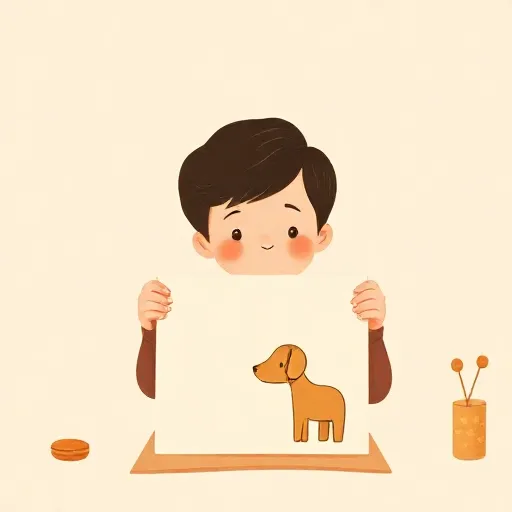
Goodman offered his own answer: pictures are symbols that denote (stand for) things, just as words do. When you read the name “Wellington,” it denotes a particular person. A portrait of the Duke of Wellington, Goodman argued, does the same thing — it denotes him. So what makes a picture different from a written description isn’t resemblance; it’s the kind of symbol system it belongs to. A picture lives in an analog system, where tiny changes in a line’s thickness or a colour’s shade can change what it represents. Words, by contrast, belong to a digital system with a fixed, limited alphabet.
But if pictures are arbitrary symbols, why can you instantly recognize a drawing of a dog — even if you’ve never seen that exact drawing before? The philosopher Flint Schier (20th century) pointed out that picture understanding is naturally generative. Once you can interpret one picture of a cat, you can likely interpret a picture of a dog, even if nobody teaches you a new rule. That’s not how words work: knowing “cat” doesn’t automatically teach you “chien.” So treating pictures as a conventional language faces a serious hurdle.
Goodman also tackled pictures of fictional things — unicorns, Pegasus, made‑up characters. He suggested that when we say “this picture represents a unicorn,” the word “represents” works differently from how it works in a portrait. It doesn’t denote anything real; instead it classifies the picture as belonging to a certain kind of symbol we can interpret, much like the phrase “flying horse.” So the language‑like view can handle fantasies, but not without stretching the ordinary idea of a symbol.
The Window and the Canvas: Seeing‑In and Double Vision
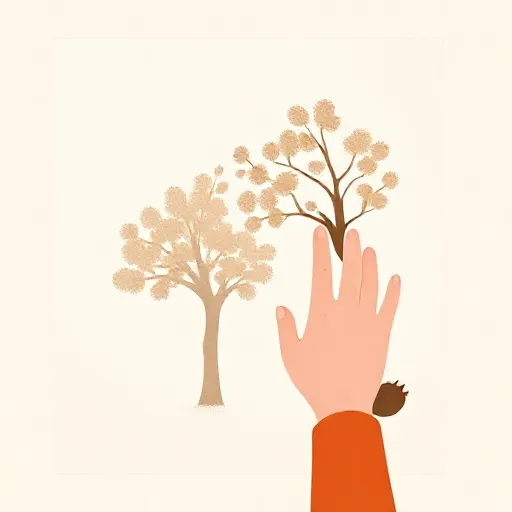
Many philosophers think the key isn’t in the marks alone, but in the special experience you have when looking at a picture. Richard Wollheim (1923–2003) called this experience seeing‑in. When you gaze at a painting of a horse, you’re simultaneously aware of two things: the flat, painted surface and the three‑dimensional scene that seems to stand out from it. Wollheim called this two‑foldness. It’s not an illusion — you don’t believe a real horse is in the room — but you also aren’t just seeing coloured patches. You see a horse in the canvas.
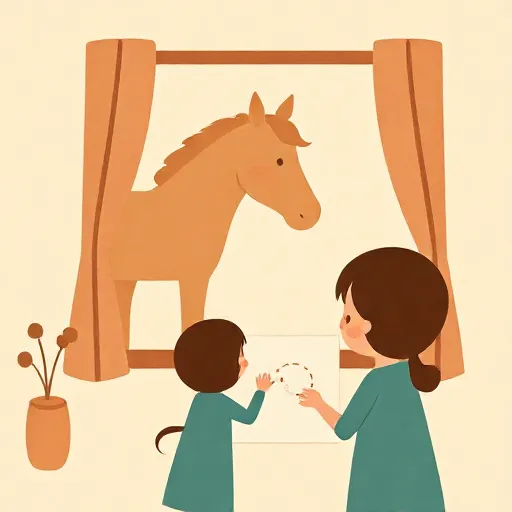
To sharpen this, the philosopher Robert Hopkins argued that seeing‑in is an experience of resemblance in outline shape. An outline shape is the two‑dimensional shape you get if you trace the edge of an object onto a windowpane — it’s the “silhouette” the object makes from your point of view. Hopkins claimed that a picture works because the marks on its surface match the outline shapes of the objects depicted, as seen from an implied viewpoint. So the flat lines on a page aren’t like the three‑dimensional horse, but they are exactly like the horse’s silhouette from one angle.
This brings resemblance back into the story, but in a precise, geometrical way. It also explains why you can see a horse in a drawing without being fooled: you experience a likeness in outline shape while remaining perfectly aware of the real paper in front of you.
Pictures of Unicorns and Other Puzzles
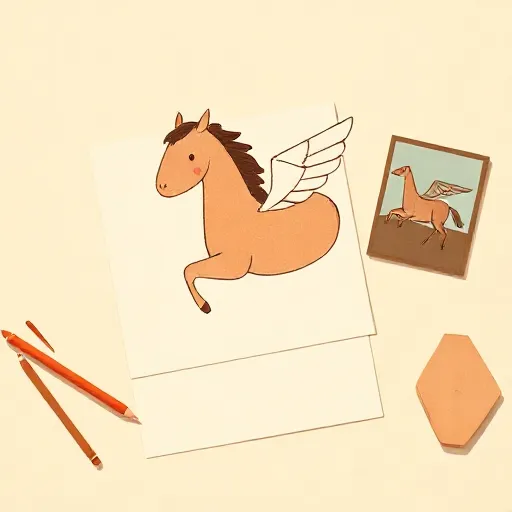
All these theories run into a stubborn problem: pictures of things that don’t exist. You’ve probably seen drawings of dragons, fairies, or made‑up Pokémon. According to a simple resemblance theory, those pictures can’t resemble anything real — so how do they depict anything at all? Some resemblance theorists reply that we can imagine that the picture would resemble a dragon if dragons existed, or that we play a game of make‑believe where we pretend it does. Others claim that fictional characters are abstract, like numbers, and that a picture can still stand in a resemblance‑like relation to them.
Goodman’s approach says the picture doesn’t denote anything, but it still has a meaning within a symbol system we understand — just as the description “gold mountain” has a meaning even though no gold mountain exists. Meanwhile, experiential theories say that when you look at a picture of a unicorn, you have a seeing‑in experience that is just as real as when you look at a portrait; the content of that experience doesn’t require a real object to be out there. Each answer has strengths and weaknesses, and no single theory convinces everyone. The fight over fictional pictures shows how deep the puzzle runs.
Why This Still Matters: Pictures All Around You
You live inside an ocean of images: photos, cartoons, emojis, video‑game graphics, street signs with a running stick figure. The question of what makes a picture represent isn’t locked away in a philosophy library — it’s right under your thumb every time you swipe through your phone. Understanding how depictions work matters for designing clearer symbols, for teaching machines to see, and for grasping why a child’s crayon drawing can feel so alive even though it’s just wax on paper.
The competing stories — resemblance, symbolic convention, a special double experience — are still being debated. Maybe none of them is the whole answer. But next time you look at a picture, you can ask yourself: Am I seeing a resemblance? Reading a symbol? Or experiencing two things at once? That question, asked by a twelve‑year‑old or a professor, is exactly what keeps philosophy alive.
Think about it
- If a picture of a dog is just a symbol like a word, could you ever learn to “read” a completely new style of drawing without being taught, the way you had to learn English? Why or why not?
- You see a photo of your best friend and feel like you’re really seeing them, even though you know it’s just a flat surface. Would you describe that experience as seeing the actual person, or as something else entirely?
- Suppose you invent a creature by combining parts of real animals — a lion’s body with an eagle’s wings — and you draw it. Does your drawing represent something real, something imaginary, or something else? What makes you think so?