The Million-Dollar Box That Might Be Empty
A Mysterious Box and a Perfect Predictor
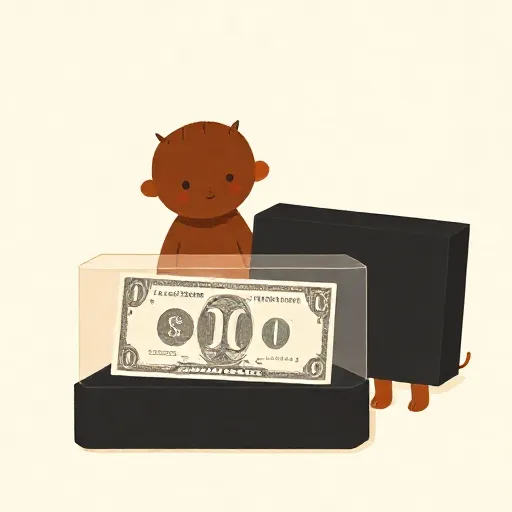
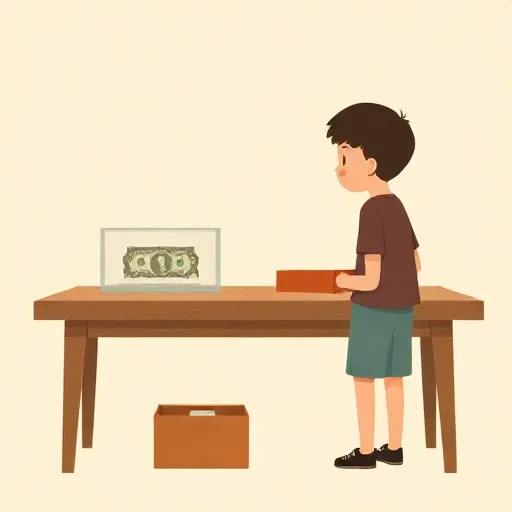
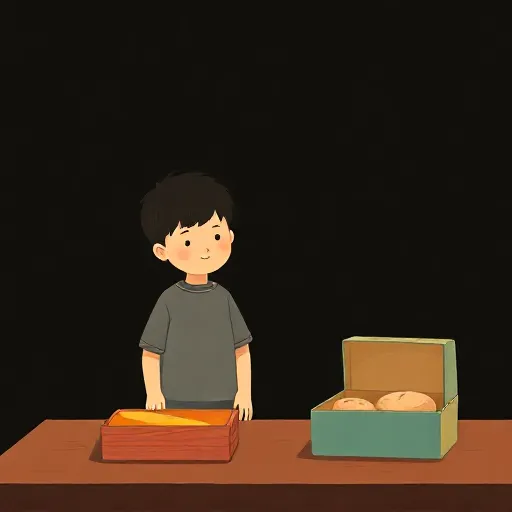
Imagine you are standing in a room with two boxes. One is made of clear glass, and inside you can plainly see a thousand-dollar bill. The other box is completely opaque — you cannot see what is inside. You have been told that the opaque box contains either one million dollars, or nothing at all. The catch? Yesterday, a very good predictor looked into your future and guessed what you would do. If the predictor guessed you would take only the opaque box, then the opaque box is stuffed with a million dollars. If the predictor guessed you would be greedy and take both boxes, the opaque box is empty. The predictor is right about 99 percent of the time.
Here is your choice: you may take only the opaque box, or you may take both boxes. The transparent box’s cash is yours no matter what. What do you do?
This sounds like something out of a science fiction movie, but it is actually a famous thought experiment called Newcomb’s Problem, created by the physicist William Newcomb and introduced to philosophers by Robert Nozick (1938–2002) in 1969. It has been tearing decision theorists apart ever since. The puzzle is not really about money; it is about the very nature of making a choice. Do you follow the evidence, or do you follow cause and effect?
Wise Choices or Lucky Guesses?

Before we dive into the boxes, think about something smaller. You have an exam tomorrow. You reason like this: if I will pass the exam anyway, then studying tonight is wasted effort. If I will fail no matter what, then studying is also wasted effort. So, studying is a waste of effort, and I should not study.
This sounds logical, but it contains a sneaky mistake. Studying does not guarantee passing, and not studying does not guarantee failing, but studying raises the probability that you pass. Good decisions take into account how an action changes the chances of different outcomes, not just what must happen if the outcome is already fixed.
Philosophers who study rational choice use a tool called expected utility to weigh these kinds of decisions. Expected utility is a probability-weighted average. For each possible result, you multiply how good that result would be by how likely it is if you take the action, then add everything together. For studying, you multiply the chance of passing if you study by the value of passing after studying, and add the chance of failing if you study by the value of failing after studying. If that sum is bigger than the expected utility of not studying, then studying is the smarter bet.
But there is another, simpler rule that sometimes seems to shout louder: the principle of dominance. It says that if one option always leads to a better outcome no matter how the world happens to turn out, you should choose that option. If studying always feels like a waste of effort when you will pass and also when you will fail, dominance seems to say “don’t study.” The student’s mistake was ignoring that his action — studying — actually changes the probabilities; it makes the “pass” world more likely.
Now back to the boxes. If you take both boxes, you get the thousand dollars plus whatever is in the opaque box, which could be zero or a million. If you take only one box, you skip the thousand dollars but still get whatever is in the opaque box. The predictor has already acted. If the predictor guessed you would take one box, your taking both boxes cannot make the million vanish retroactively; the money is already there or not. Dominance seems to scream: “Take both boxes! You’ll be richer by a thousand dollars no matter what.” On the other hand, expected utility, using evidence from the predictor’s accuracy, whispers: “Almost everyone who takes both boxes ends up with just a thousand dollars, because the predictor only fills the opaque box when it predicts one-boxing. If you one-box, you probably end up a millionaire.” Which voice do you listen to?
Two Ways to Think About Evidence
To a twelve-year-old who loves statistics, the predictor’s amazing track record makes it obvious: if you one-box, the evidence says you will probably be rich. The tool decision theory uses to capture this is conditional probability — the probability that something happens given that something else happens. If you one-box, the conditional probability that the prediction was one-boxing is very high, and so is the probability that the opaque box contains a million dollars. Expected utility computed with conditional probabilities tells you to one-box.
But philosophers have noticed a problem with using evidence as your only guide. Evidence can point to a good result without your action actually causing it. Imagine you flip a coin of unknown bias one hundred times, and it comes up heads every time. That is strong evidence that the coin is biased toward heads and the next toss will probably be heads. But your act of flipping it the 101st time doesn’t cause the coin to be heads — the coin’s internal weight does. If you could secretly swap the coin for a fair one before the next toss, you would be better off doing that, even though the evidence said heads. A good decision, many argue, aims to make a good outcome happen, not just to gather signs of a good outcome.
This insight gave birth to a split. Evidential decision theory says you should choose the action that gives you the best news — the one that would be evidence of a good result, even if it doesn’t cause that result. It uses ordinary conditional probabilities. Causal decision theory says you should choose the action that would actually bring about the best result. It uses a special kind of probability that tracks causal influence, often expressed through subjunctive conditionals: sentences like “If I were to do A, then S would happen.”
Robert Stalnaker (born 1940) first sketched this fix in a letter to the philosopher David Lewis (1941–2001) in 1972. Allan Gibbard (born 1942) and William Harper (born in the early 1940s) published the detailed version in 1978. Their idea was that in Newcomb’s Problem, the act of one-boxing doesn’t cause the predictor to have predicted one-boxing — the prediction happened before your choice. So the causal probability of the prediction being one-boxing, given that you one-box, is exactly the same as the original probability of the prediction being one-boxing. The evidence changes, but the causal structure does not. Using those causal probabilities, the expected utility of two-boxing comes out higher, in agreement with the dominance principle.
Twins, Prisoners, and the Power of Cause

Another famous example that made the difference between evidence and causation crystal clear is the Prisoner’s Dilemma. Imagine two people, isolated from each other, each given a choice to cooperate or betray. If both cooperate, they each earn a moderate reward. If both betray, they each do poorly. But no matter what the other person does, each person is individually better off betraying. Betrayal dominates cooperation.
Now add a twist: suppose the two players are psychological twins. They think exactly alike, and both know this. If you decide to cooperate, that is excellent evidence that your twin will cooperate too, because you both use the same reasoning. But your cooperation does not cause your twin to cooperate; there is no phone call or magic link. In this setup, evidential decision theory says cooperate (good evidence of a good outcome), while causal decision theory says betray (your action doesn’t actually change the other person’s action). The philosopher David Lewis (1941–2001) showed that this kind of dilemma is, deep down, the same structure as Newcomb’s Problem: an inferior act is correlated with a good state it does not causally produce.
Lewis and others built versions of causal decision theory that don’t even need to talk directly about subjunctive conditionals. Instead, they introduced the idea of a dependency hypothesis — a complete story of how the things you care about causally depend on the acts available to you. You weigh each such story by how likely you think it is, and you choose the act with the highest average payoff across all stories. That still yields two-boxing in Newcomb’s Problem, because the prediction is already settled and your act does not causally influence it.
Why Some Philosophers Still Choose One Box
You might think the case is closed, but the fight is far from over. Many philosophers, including Terry Horgan and Paul Horwich, insist that one-boxing is the only sensible choice — after all, one-boxers walk away millionaires, while two-boxers usually get peanuts. Causal decision theorists reply that the problem is rigged to reward irrationality; just because a bad strategy accidentally pays off doesn’t make it logically sound.
A clever defense of evidential decision theory, called the tickle defense, works like this. Suppose your choice and the predictor’s guess have a common cause — perhaps your own deep-seated personality, which you know by introspection. Once you take that common cause into account, your choice itself provides no extra evidence about the prediction. The conditional probability of a one-box prediction becomes the same whether you take one box or two, and evidential decision theory agrees with causal decision theory: two-boxing is best. But this defense works only if you have full self-knowledge and your reasoning is in perfect order, which is not always true. The debate continues.
What about preparing in advance? Even some causal decision theorists admit it might be rational to train yourself ahead of time to be the kind of person who one-boxes, so that the predictor fills the box. But once you are actually standing in the room, with the money already set, they still say two-boxing is the rational act at that moment. That fine print — the difference between evaluating a whole life and an instant choice — is one reason the puzzle still feels alive.
What This All Means for You
Newcomb’s Problem might seem like an arcade game for philosophy professors, but versions of it appear in ordinary life. When you decide to study for a test, build a friendship, or tell the truth in a tricky situation, you are weighing what your action will cause against what it signals to others — and to yourself. Medical choices often echo this structure: a certain behavior (like drinking coffee) might be correlated with good health not because coffee causes health, but because both are linked to an active, well-rested lifestyle. Without thinking about causation, you might get the wrong advice.
More deeply, the puzzle forces you to ask whether your choices can genuinely affect the future, or whether everything is already settled by chains of cause and effect stretching back before you were born. If a perfect predictor knows your decision in advance, does that mean your will is just another domino in a long line? Philosophers of free will watch this argument closely. Causal decision theory tries to carve out a place for your actions to make a difference, even in a universe of laws and predictions. It says: what matters is not what your choice indicates, but what it does.
So, next time someone says a choice is a no-brainer, remember the million-dollar box. Sometimes the obvious answer and the smart answer are not the same — and figuring out why is what philosophy is for.
Think about it
- If a friend told you, “I know you so well, I can predict everything you’ll do,” would you try to prove them wrong, or would you just behave the same way you always do? Why?
- Imagine you have two buttons that both give you candy, but pressing Button A usually means Button B also gets pressed by someone else later, though your press doesn’t actually cause theirs. Should you care about the pattern, or just focus on what your own finger does?
- Could there be a case where being rational makes you worse off, and being irrational makes you richer or happier? If so, are you still willing to be rational?