Can You Feel History? The Count Who Thought So
The Count in the Hall of Mirrors
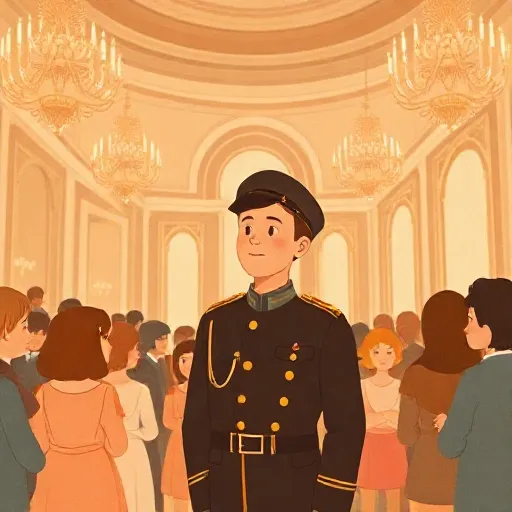
On a cold January day in 1871, Paul Yorck von Wartenburg (1835–1897) stood in the Hall of Mirrors at the Palace of Versailles. Cannons had fallen silent a few weeks earlier, and now a German Empire was being proclaimed right there, among chandeliers and gilded statues. Yorck, a Prussian count and soldier, had fought in the war. He was part of history turning. But he was not the kind of man who thought history was just a catalogue of battles, kings, and dates.
Yorck grew up on a large family estate in Silesia, surrounded by talk of literature, art, and philosophy. His grandfather had been a national hero, a field marshal who dared to sign a treaty against Napoleon without the king’s permission. So Yorck learned early that a single person’s decision could bend the course of an entire people. Later he studied law and philosophy, and in 1871 he met the thinker who would become his closest friend and sharpest critic: Wilhelm Dilthey. The two men began a long, intense correspondence — letters filled with big ideas, gentle corrections, and a shared conviction that philosophy had lost its way.
What bothered Yorck most was the feeling that modern civilisation had turned human beings into observers, not participants. Science and technology had brought tremendous leaps, but people, he believed, had forgotten something crucial. They had forgotten that history is not an object you study from a distance. History, he would argue, is life itself.
Life Doesn’t Just Sit There — It Moves

Yorck drew a sharp line between two ways of being in the world. One he called the ontic — things that are just there, unchanging and static, like a stone, a number, or an abstract rule. Ontic things have no inner life, no growth, no real time inside them. The other he called the historical. A historical reality — a family tradition, a language, the hope of a community — is never the same from one moment to the next. It is alive. It stretches back into the past and reaches forward into the future. As Yorck put it to Dilthey, a human being is not simply something that is, but something that lives. And living means constantly changing, responding, becoming.
This idea, that life and history are the same thing seen from different angles, is at the heart of his philosophy. Yorck called it historicity — the deep, inescapable truth that a person’s whole way of thinking, feeling, and striving has been shaped by everything that came before. You are not a sealed box of private thoughts; you are history walking around.
If you look inside yourself, Yorck said, you will find an entire inheritance. The language you speak, the picture of fairness you carry, even your most personal worries — all have roots that go back longer than any single lifetime. That is why he loved a saying from Goethe: that a person has “lived for at least three thousand years.” It is not a spooky claim about reincarnation. It means that the past is still alive in you, not as a memory you can file away, but as the very pulse of your being.
The Three Motors of History

If history is life writ large, then to understand history you have to understand what it is to be a living human being. Yorck spent his final years working on a fragmentary book that tried to do exactly that. He argued that every person’s inner life has three fundamental comportments, or ways of engaging with the world: feeling, willing, and cognition.
Feeling is the most intimate. When you feel joy, grief, or the quiet ache of missing someone, you are turned inward. Feeling carries no outward picture; it is simply the awareness of being alive in a particular way. It is through feeling that we sense our own mortality and the fact that everything passes away. Because feeling is so deeply interior, Yorck called it the seat of all things personal — where you are most yourself.
Willing reaches outward. It wants to change the world, to grab, achieve, and control. When you decide to win a race or stand up for a friend, your will projects energy into the future.
Cognition, thinking, is also outwardly directed but in a very different way. It steps back and looks. It tries to build a stable picture of things, as if the world were a map you could hold still. Yorck noticed something striking about cognition: it always works through spatiality. Even the most abstract thought, he said, cannot help but picture things placed in some kind of space — near or far, inside or outside. But feeling, by contrast, lives in temporality, in the unrolling sense of time passing, of moments arriving and slipping away.
These three forces are never perfectly balanced. Sometimes one dominates, and that imbalance, Yorck believed, is the motor of history. When a whole culture leans heavily toward cognition, it builds a world of statues, theories, and timeless truths. When it leans toward will, it builds empires and impatient hopes. When feeling becomes the centre, people turn inward and begin to ask what no map or conquest can answer.
Greeks, Romans, and the Secret of the Catacombs
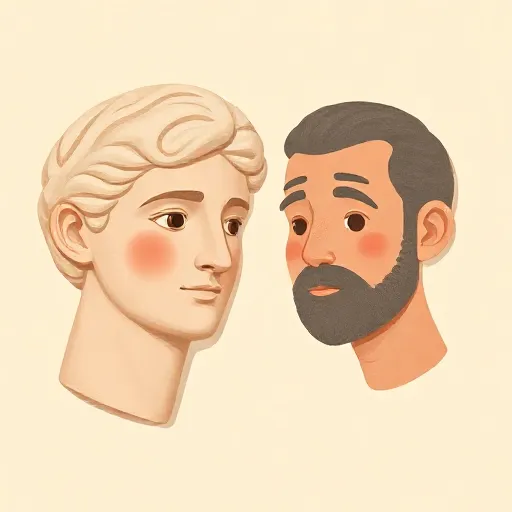
Yorck sketched a story of Western history not as a list of events but as a drama between these three forces. In ancient Greece, he said, the dominant stance was ocularity — pure looking. The Greek mind loved what could be seen, shaped, and held still in its beauty. Philosophy became a search for unchanging forms, for substances that never pass away. That, Yorck thought, was the origin of metaphysics: a flight from temporality, a denial that life actually slips through your fingers. It gave us science and geometry, but it also trained people to treat reality as a museum of eternal objects.
The Romans and the ancient Hebrews, in different ways, gave the will its turn. Rome chased power and made might the only measure of reality; for a Roman, death was almost unthinkable because the city was supposed to be eternal. The Jewish world, by contrast, lived in a state of intense hope — a will aimed not at an object you can see but at a promised future that only God could bring about. Neither the Roman’s empire nor the Hebrew’s messianic expectation sat still; both were driven, restless, a‑cosmic.
Then, Yorck argued, came Christianity, which changed the whole arrangement. Christian consciousness, at its deepest, turned inward to feeling. It was not about contemplating a perfect statue or conquering a distant land. It was about the inner life, about a direct, personal relationship to a God who transcends the world. Yorck saw the scratched crosses that early believers carved on the walls of Roman prisons — small, quiet marks — and contrasted them with the bronze glory of Roman power. Those crosses were signs of transcendence, of a freedom from everything the world could offer. Because feeling is the home of time, Christianity, he believed, was the breakthrough to a fully historical life: a life that knows it is passing away and yet finds meaning precisely in that passing.
Best Friends, Big Disagreement
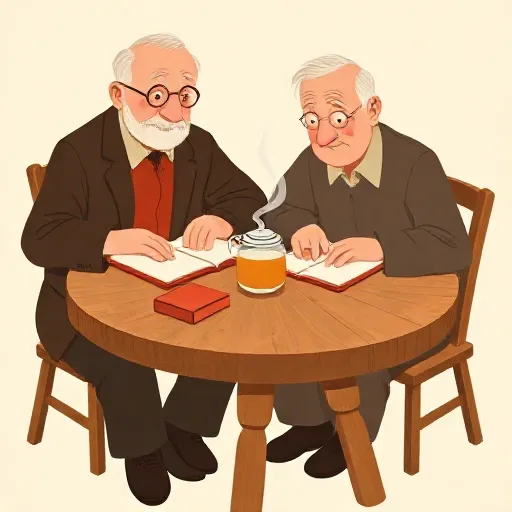
Dilthey, the friend who had shared so many working holidays at Yorck’s estate, agreed about almost everything. He too thought modern philosophy had become bloodless, that history was not a natural object but something lived, and that inwardness was the key. But they parted ways on what to do with this insight.
Dilthey dreamed of a true science of human experience — a discipline that would study inner life, history, and culture with the same seriousness that natural science gives to matter. He saw Christianity’s turn inward as the first spark of that science. The task was to complete it with better concepts, perhaps building on Kant and Schleiermacher.
Yorck shook his head. To him, making history into a science was like freezing a river in order to understand how it flows. Any attempt to represent life as a fixed object — even a very subtle one — misses the central point, which is that life transcends every object it produces. He argued that the Christian breakthrough was not a step toward a better theory; it was an invitation to live differently before God. Where Dilthey looked to Kant, Yorck looked to Martin Luther, whom he saw as the great re‑affirmer of the early Christian stance: a life of personal feeling, responsibility, and transcendence, with no scholastic detour.
This was a friendly but deep disagreement. Dilthey wanted to understand history; Yorck wanted philosophy itself to become historical — to stop pretending it can stand outside time. He challenged his friend in a letter: “Luther should and must be more topical to the present time than Kant, if this present time is to have a historical future.”
Why a 19th‑Century Count Still Speaks to You

It would be easy to think that a Prussian count writing in the 1890s has nothing to say to a twelve‑year‑old today. But Yorck’s questions are exactly the kind that don’t expire.
Every time you feel the weight of a family tradition, or the strange closeness you can feel to a great‑grandparent you never met, you are brushing against historicity. When you sense how much your own choices are shaped by things that happened long before you were born, you are living the same tension Yorck named: are you just a product of the past, or can you actively shape what comes next?
He would also nudge you to notice that not every kind of knowledge works the same way. You can memorise the date of the Battle of Hastings, and that is a cognitive grasp. But knowing a date does not feel the same as standing in a very old building and sensing all the lives that have passed through it. That second kind of knowing — feeling history as a living presence — was, for Yorck, the soil out of which any real understanding must grow.
His debate with Dilthey leaves us with a live question, not a settled answer. If we try to turn everything about our inner life into data, do we lose something essential? Or is that exactly the way to give our feelings and traditions the respect they deserve? Yorck staked his life on the first option. Dilthey leaned toward the second. The conversation is still open.
Think about it
- If a tradition in your family feels alive and meaningful, does it matter whether you can prove, like a scientist, exactly how it started?
- Yorck said feeling realises that everything passes away. Is that awareness something to avoid, or could it make you value the present more?
- If you could download all of history into your brain as perfect facts, would you understand history better, or would you miss something crucial?