
Could a Board of Sliding Pegs Reason Like a Human?
The Gold Assayer Who Cracked the Code of Reason
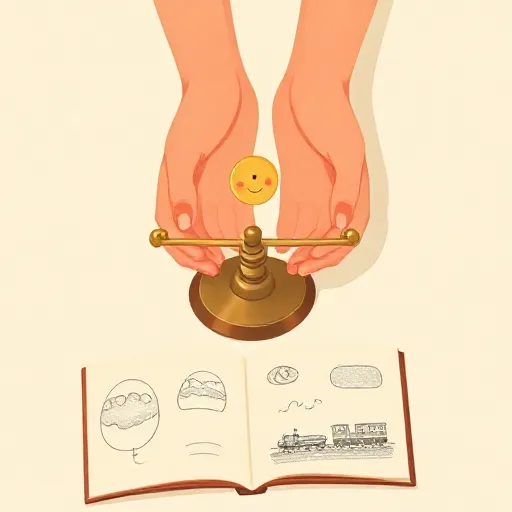
In 1854, a shy nineteen-year-old named William Stanley Jevons (1835–1882) stepped off a ship in Sydney, Australia. He had come to test the purity of gold at the mint, but his restless mind roamed far beyond coins. He studied cloud formation, railway planning, lightning, and even the true meaning of value—what makes one thing worth more than another. Those lonely years of study planted a seed: what if all reasoning, no matter how messy, could be reduced to a few simple, machine-like rules? Jevons would spend the rest of his short life trying to build those rules into a “thinking” board of wooden pegs.
After returning to England in 1859, he had two breakthroughs. He grasped the “true comprehension of value” and, even more importantly, the substitution of similars—the idea that if two things are identical in some way, you can swap one for the other in any argument without losing truth. Like replacing “5 + 3” with “8” in a sum, Jevons believed all reasoning was just a grand game of substitution. That game, he decided, could even be played by a machine.
The Three Unprovable Laws Behind Every Thought

Before you can build a logic machine, you need to know the rules it must follow. Jevons started with what he called the Laws of Thought—the deepest patterns he believed every mind, and maybe every machine, must obey. He claimed there were three, and that they were not just habits of our brains but actual features of the world itself.
The first is the Law of Identity: a thing is itself. If you point to a marble and say “that marble,” it is what it is. The second, the Law of Contradiction: something cannot be and not be at the same time. An apple cannot be entirely red and entirely not-red in the same spot. The third, the Law of Duality (often called the excluded middle): a thing either is or is not. There is no middle option—an object is either a book or it is not a book, period.
Jevons thought these laws were so basic that you cannot prove them. Any proof you tried would secretly use them from the start. So science, and even common sense, must simply accept them as the starting point for telling correct reasoning from error. Yet he never gave a clear definition of “identity” itself. If you say two things are “the same,” how much sameness is enough? That fuzzy gap would haunt his whole system.
When Logic Becomes a Board Game
With the Laws of Thought in place, Jevons began to turn reasoning into a kind of puzzle. He represented ideas with capital letters (A, B, C) and their opposites with small italic letters (a, b, c). The sign “=” meant identity. So “A = B” was the simplest judgement: these two terms are the same. This move abolished the old grammar of subject and predicate; logic became just equations of sameness, governed by the substitution of similars. If A = B, then wherever you see B you can write A, and vice versa.
Jevons then built a logical alphabet—not one made of letters you read, but a table of all possible combinations a set of ideas could form. For two terms A and B, there are four: AB, Ab, aB, ab. To solve a problem, you would list every combination, cross out any that contradicted your premises, and read off the survivors. It was, he said, an exercise of “fully developing all terms and eliminating the contradictory terms.” The trouble was, as you added more letters, the number of combinations exploded. With six terms you had 64 rows to check.
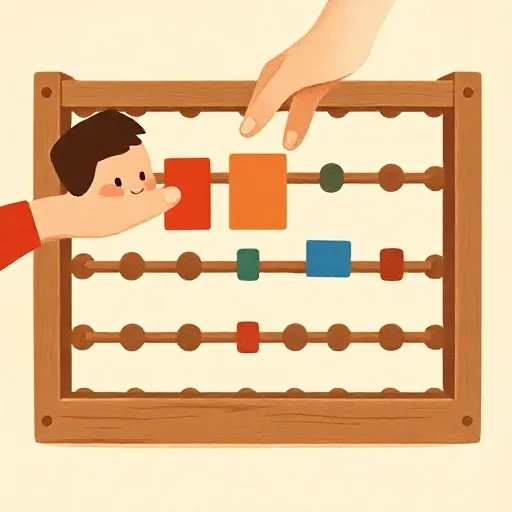
To speed things up, Jevons invented a logical abacus—a wooden frame with sliding pegs that let you see possibilities mechanically. Some historians call it one of the very first computers. Yet his dream of a perfect reasoning engine ran into a more basic snag: counting. Jevons tried to build mathematics out of logic. He said numbers came from “units”—any object you can tell apart from others in the same problem. But if you count five identical coins, each is labeled “C,” yet you need to treat them as separate things in space. How can the same symbol C stand for both a single distinct coin and every coin? Jevons never resolved that contradiction, and the problem of what makes a “unit” still provokes philosophers today.
Chasing Certainty: Induction and the Gambler’s Arithmetic

Jevons knew that real knowledge cannot be deduced from a few fixed truths. Most of what we know comes from induction—spotting patterns and guessing that they will continue. You see the sun rise a thousand times and conclude it will rise again tomorrow. But you can never be completely certain. The next day might break the pattern. Jevons called induction the “inverse process of deduction”: you start with messy observations and work backwards to find the hidden equations.
To handle our inescapable uncertainty, he turned to probability and statistics. He was one of the first social scientists to use hard data and the geometric mean (a special way of averaging that balances out wild swings). His 1863 book on the falling value of gold used index numbers to track how a flood of new ore from Australia and California affected prices. He argued that when you study huge groups of people, individual accidents cancel out, and a fictitious mean emerges—an average that works like a “typical” person, even if no real person is exactly like it.
This move was powerful but dangerous. The average person might be a useful tool for predicting trade, but it was only a shadow of the real, diverse crowd. And Jevons often forgot that shadow was his own creation.
The Average Human: Economics, Stereotypes, and a Flawed Plan

Jevons approached economics as if human beings were little godlike calculators. In his Theory of Political Economy, buyers and sellers act with perfect rationality, perfect foresight, and perfect information, driven only by the “mechanics of utility and self-interest.” He thought this stripped-down model could explain market prices just as Newton’s laws explained the planets.
But he realized that real people are not identical. So he introduced the idea of character—the fixed mental and moral qualities that supposedly belong to a class, race, or gender. The theory needed a representative individual to stand for a whole group. When the group was large enough, he believed, personal quirks would balance out, and the average would be predictable. Yet that representative person was not a neutral fact. It was drawn from Jevons’s own Victorian world.
He wrote that Irish labourers were more prone to drunkenness and had lower “character.” He believed women with young children should stay home, because working would lead to child neglect and encourage male idleness. In his eyes, the most far-sighted, civilized type was his own class: the educated middle-class Englishman. These were not fringe remarks—they were built right into his economic science. The theory could not say whether a pay rise would make someone work more or less without first knowing their “character.” The science of so-called rational self-interest was shot through with unexamined prejudice.
Jevons genuinely wanted to improve society, especially the conditions of the poor. He thought that once the first necessities of life were secure, a “higher calculus” of pleasures and pains could guide people towards self-improvement. He even believed that evolution itself guaranteed moral progress. Influenced by Herbert Spencer, he saw the whole universe as a vast organism unfolding from a divine first cause, moving steadily towards goodness and happiness. Science and religion, he insisted, could never truly conflict—both were searches for truth. But his faith in progress never made him question whether his own averages might be blinding him to the real people in front of him.
So Why Does Jevons’s Mechanical Dream Still Matter?

You live in a world Jevons could hardly imagine, but one his dream helped create. Every time an app recommends a song, a streaming service predicts what you want to watch, or a bank decides who gets a loan, a distant echo of his sliding pegs hums inside the machine. These algorithms grind through vast tables of combinations, crossing out options and keeping the ones that fit—just like his logical alphabet. The hope that reasoning can be automated is still with us.
But Jevons’s story also carries a warning. He could not even define “identity” without it slipping away. He could not prove the most basic laws of logic. And when he built a “representative individual” to make economic predictions, he ended up baking his own era’s racism and sexism into the numbers. Today’s algorithms are trained on data from an unequal world, and they often reproduce that unfairness without anyone intending it. The problem of building a neutral, perfectly logical machine is not just about faster processing; it is about the invisible assumptions you cannot help smuggling in. Jevons failed to notice his own. The question his life leaves you with is not only whether a board of pegs can reason, but whether any system of rules—even a very clever one—can ever be truly free of the people who design it.
Think about it
- If you could build a logic board that never made a mistake, would you trust it to make all your important life choices? What might it miss about being human?
- Jevons thought we can never prove the most basic rules of reasoning, like “a thing is itself.” Is it fair to call these rules true if we cannot prove them?
- When we use averages to make decisions about people—for example, placing students in different classes based on a test score—are we being logical or giving up too much individuality? Where would you draw the line?