
Is Freedom Really About Following the Rules?
The Fight Over What Makes a Thought Right

Imagine you’re in a heated argument. Someone tells you, “You only think cheating is wrong because your parents taught you that, or because your genes make you feel guilty.” Is there a real ought here, or are all values just facts about human psychology? In 1882, a German philosopher named Wilhelm Windelband (1848–1915) found himself in a similar fight. He had once believed that logical rules came from how our brains work. But then he changed his mind. He realized that if right and wrong, true and false, were just brain facts, then there would be no real difference between a good argument and a bad one — both would just be equal products of the mind. That scared him.
Windelband’s teacher, Hermann Lotze (1817–1881), had already drawn a sharp line. In his 1874 book Logic, Lotze said there are two kinds of laws: psychological laws, which describe how we actually think, and logical laws, which tell us how we ought to think if we want to be right. The first are facts; the second are norms. This distinction became the cornerstone of Windelband’s lifelong project: a “philosophy of values.”
At first, Windelband didn’t accept it. In his early writings from 1873 and 1875, he argued that logic’s norms come from human psychology and social history. For example, the principle of contradiction — that a statement can’t be both true and false at the same time — emerged, he thought, from conflicts between people who finally agreed to distinguish true beliefs from false ones. But by the late 1870s, he rejected that view as psychologism and relativism — the idea that truth is relative to each mind or culture. He now believed that if we reduce norms to brain facts, we lose the very idea of justification. A belief becomes just a brain event, no better or worse than any other.
”There Are Rules of Thinking, Just Like Rules of a Game”
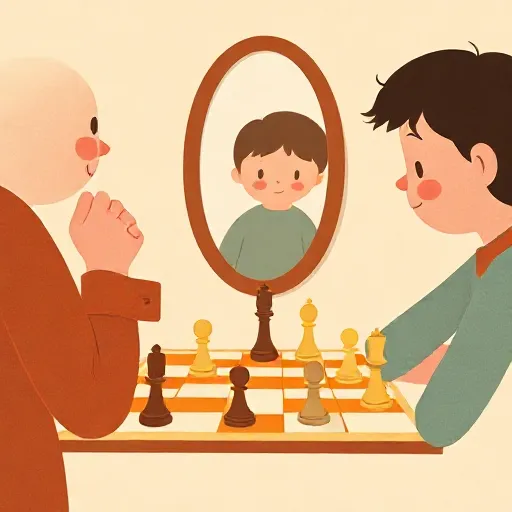
Windelband found his anti-psychologistic ammunition in the work of Immanuel Kant (1724–1804). In a crucial 1877 essay, he traced how Kant’s thinking about the “thing-in-itself” (the world beyond our senses) evolved. Windelband’s hero was the Kant who, he claimed, dropped the idea of a mind-independent object entirely and instead defined truth as the accordance of our judgments with universal and necessary rules. This was the immanent conception of truth — truth is not a mirror reflecting an outer reality; it’s like following the rules of chess. A move is correct if it obeys the rules, not if it copies some external thing.
Windelband took this idea and ran with it. He said that objects of knowledge aren’t mysterious things out there. They are “rules according to which representational elements ought to organize themselves.” In other words, when you judge “the cat is on the mat,” the object “cat-on-mat” is really a rule for combining your sensory bits in a way that everyone should accept. Truth is “normality of thinking.”
But how do we know these rules? Windelband introduced the concept of a normal consciousness. Among all the infinite possible ways our minds could combine ideas, there is a subset that follows the normative rules — the ways we ought to think. This subset is our normal consciousness: the part of our empirical mind that, at least partially, grasps the absolute values. Philosophy’s job is to uncover those values. He called it the “science of necessary and universal values” — a second-order reflection on the methods and results of other sciences, not an empirical investigation itself. So philosophy can’t use psychology; it must use a critical method: asking what rules we must presuppose if we want our thinking to aim at truth, our willing at goodness, and our feeling at beauty.
Can You Be Free If Everything Has a Cause?

Now Windelband faced a huge challenge: freedom. If everything in nature, including our minds, follows causal laws, how can we be free and morally responsible? Kant had solved this by splitting the world into appearances (determined) and things-in-themselves (where a noumenal self is an uncaused cause). But Windelband, having embraced the anti-metaphysical Kant, couldn’t accept that. He wanted to combine causal determinism with freedom, all within one world.
In his 1882 essay “Norms and Natural Laws,” Windelband argued that freedom is not the ability to break natural laws. Instead, it is the determination of empirical consciousness by normal consciousness. When you become aware of a moral norm — say, “you ought to tell the truth” — that awareness itself becomes a causal factor in your mind. The norm carries a kind of psychological pull: you feel you must act on it. So freedom is not uncaused action; it’s being caused by the right kind of thing: your grasp of what you should do. He called this a deterministic concept of freedom.
But what about the fact that we often know what we ought to do and still don’t do it? In his 1904 lectures On Freedom of the Will, Windelband refined his view. He argued that what determines whether we follow a norm is our personality — the set of relatively stable motivations and dispositions that make us who we are. When our actions are caused by our personality rather than by passing whims or outside pressures, we can call them “free.” And from a practical, moral standpoint, we are justified in holding people responsible for their personality, even though that personality itself was formed by causes beyond their control.
Windelband also offered a striking way to think about moral judgment. He said there are two ways to “construct” the world of appearances: one using causal laws, and one using normative evaluations. When we judge someone morally, we are using the normative viewpoint, which disregards causal chains. When we say “you could have done otherwise,” we don’t mean that under the exact same circumstances and with the exact same personality, you could have chosen differently. We mean that a different person — the generic concept of a human being — could have. Freedom in this sense is a placeholder in our moral discourse, not a metaphysical fact.
Why History Isn’t Just One Big Science Experiment

Windelband is also famous for drawing a sharp line between two kinds of sciences. In 1894, as rector of the University of Strasbourg, he gave a speech that would influence the humanities for generations. He argued that we shouldn’t classify sciences by their objects (spirit vs. nature). Instead, we should look at their cognitive goals.
Some sciences, Windelband said, seek general laws — they want to explain why things happen in general. He called these nomothetic sciences (from Greek nomos, law). Physics and chemistry are the classic examples: they treat every falling apple as just one instance of the law of gravity. Other sciences aim to describe the unique, individual event in all its particular detail. He called these idiographic sciences (from Greek idios, own or private). History is the prime example: the historian wants to understand the French Revolution, not a general law of revolutions.
This distinction was groundbreaking because it defended the autonomy of the historical disciplines against those who claimed that only the methods of natural science were truly scientific. Windelband said both approaches are equally valid but answer different questions. One and the same object — say, a human being — can be studied nomothetically (by a psychologist looking for general laws of behavior) or idiographically (by a biographer capturing a unique life). Crucially, idiographic sciences rely on values. The historian selects which facts are worth telling based on what matters to us — a value-laden choice. Thus, history is not a value-free mirror; it constructs its objects by relating facts to universal values. Windelband’s student Heinrich Rickert (1863–1936) later developed this idea into a full-blown theory of historical concept-formation.
Why This Matters Every Time You Decide

Windelband’s ideas may seem like dusty 19th-century debates, but they are startlingly alive today. Every time a neuroscientist claims that a brain scan shows your decision was made before you were conscious of it, we’re replaying the fight between causal explanation and normative justification. If your brain causes your choice, are you still free? Windelband would say: freedom isn’t about uncaused causes; it’s about whether your actions are guided by your understanding of what you should do. Your personality — shaped by biology, upbringing, and reflection — is still you, and holding you responsible makes sense from the normative point of view.
His distinction between facts and values also prefigures today’s moral realism debate: are there objective values, or are all values just expressions of emotion? Windelband argued that even if cultures disagree on what’s right, the demand for absolute validity is recognized by everyone. We all act as if some things really are better than others. And his nomothetic/idiographic divide echoes current battles over whether the humanities are “real” knowledge. When you choose to study history or literature, you’re stepping into an idiographic mode that values the unique and unrepeatable — something no set of general laws can capture.
So the next time someone tells you that your beliefs are “just your brain chemistry,” remember Windelband’s retort: a belief might be caused, but that doesn’t settle whether it’s justified. The question of what we ought to believe and do is a different game entirely. And you, as a thinker and a chooser, live in both worlds at once.
Think about it
- Imagine a scientist could predict every choice you’ll ever make, down to the last detail. Would it still make sense to say “you should have chosen differently”? Why or why not?
- If values like honesty and kindness are just feelings produced by evolution, can they still be said to be “true” in the same way that “2+2=4” is true? What might be the difference?
- Do you think a historian and a physicist are both doing “science” in the same sense? What might make the historian’s work just as valuable for understanding the world?