Why Can’t You Un-Break an Egg? The Puzzle of Time’s Arrow
A One-Way Street for Real Stuff
An egg falls. It splatters. That’s normal. But if you watch a video of a splattered egg pulling itself back together, you know it’s running backward. Real life almost never works like a reversed movie. Coffee cools, milk swirls into tea, and living things grow old. Yet the basic laws of physics—the rules that govern every atom—are strangely two-faced about time. Give a planet enough time, and its orbit is the same whether you run the clock forward or backward. So why does the large-scale world have such an obvious direction?
The science that first captured this puzzle is called thermodynamics, the study of heat, work, and energy. In the 19th century, engineers trying to build better steam engines discovered a deep pattern. They introduced a new quantity, entropy, which roughly measures how spread-out or disordered energy has become. The Second Law of Thermodynamics says that in an isolated system, entropy never decreases—it usually increases until it reaches a maximum. That’s why heat flows from hot to cold, why gases expand to fill a room, why your bedroom tends toward chaos. It’s a one-way street for real stuff.
But here’s the rub. The tiny particles that make up steam, coffee, or eggshells follow Newton’s laws (and, we now know, quantum mechanics), and those laws are time reversal invariant. That means if you take a movie of particles colliding and play it backward, the reversed version still obeys the same laws. So where does the arrow of time come from? That question has occupied physicists and philosophers for over a century.
A Sea of Possibilities: Boltzmann’s Insight
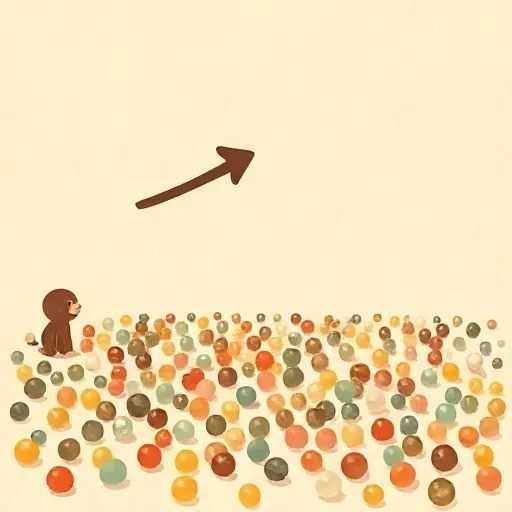
The Austrian physicist Ludwig Boltzmann (1844–1906) offered an answer that still shapes the debate today. He invented statistical mechanics, a way to connect the invisible micro-world of atoms with the large-scale world we see. Boltzmann realized that what we call a macrostate—like “gas in a box at a certain temperature”—actually corresponds to an enormous number of different microstates, the exact positions and velocities of every particle.
Imagine a child’s playroom with ten thousand toy bricks. If all the bricks are neatly stacked in one corner, that’s a very special, low-entropy macrostate. There are only a few ways to arrange bricks so they look like that. But if the bricks are scattered all over the floor, that’s a high-entropy macrostate—there are trillions and trillions of arrangements that all look equally messy. If you shake the room randomly, the bricks will almost certainly end up scattered. The system moves toward a high-entropy state simply because there are vastly more ways to be messy than to be tidy.
Boltzmann defined entropy as being proportional to the logarithm of the number of possible microstates for a given macrostate. The Second Law then becomes a statistical claim: a system is overwhelmingly likely to evolve from a low-entropy macrostate to a higher-entropy one, not because the particles “prefer” order, but because there are so many more ways to be disordered. It’s a probabilistic arrow, not an absolute rule.
The Reverse Movie Problem

Trouble arrived quickly. If the micro-laws are reversible, then for every possible history that increases entropy, there’s a time-reversed history that decreases it. The Austrian scientist Josef Loschmidt (1821–1895) pointed this out in 1876: take any process that obeys Newton’s laws, flip the direction of every particle’s velocity, and you get a physically possible process that runs backward. If entropy can increase from state A to state B, then the reverse—from B to a time-reversed A—must also be possible. So why don’t we ever see coffee un-stir itself or eggs un-break?
The mathematician Ernst Zermelo (1871–1953) added another worry. In a finite, isolated system, the particles will eventually return arbitrarily close to any previous configuration (a property called recurrence). So entropy cannot increase forever without eventually decreasing again. Boltzmann’s own earlier “H-theorem” had claimed that entropy must always increase, but Loschmidt and Zermelo showed that ingredient wasn’t in the micro-laws alone.
Here is the heart of the first problem of the direction of time: given only reversible dynamics, statistical mechanics seems to predict that if a system is out of equilibrium now, it is just as likely to have evolved from a higher-entropy past as it is to evolve to a higher-entropy future. We never observe that kind of past-increasing entropy. Something extra is needed to break the symmetry.
A Very Special Beginning: The Past Hypothesis

That “something extra” is a startling fact about our universe: it started in an enormously low-entropy state. Think of the Big Bang not as an explosion in space, but as the whole of space packed into a hot, smooth, ultra-dense broth. That incredible uniformity was a state of very low entropy—a cosmic version of the neatly stacked bricks. As the universe expanded, gravity and other processes created clumps, stars, and galaxies, and the overall entropy has been rising ever since.
The philosopher David Albert calls this the Past Hypothesis. If we assume that the universe began in an extremely tiny region of its possible microstates, then the later increase of entropy becomes practically inevitable. The probability of entropy decreasing, given that special low-entropy past, is astronomically small. The Past Hypothesis blocks the Loschmidt-style reversal: a high-entropy state in the future can’t be traced backward to a state of even higher entropy in the past, because the past fixes entropy at rock bottom.
Many of the greatest 20th-century scientists, including Albert Einstein and Richard Feynman, accepted that some such initial condition is necessary. Still, the Past Hypothesis has its critics. Some worry that the chance of the universe starting in that state, according to the standard measure of phase space, is vanishingly small. Others note that stating the hypothesis clearly in the context of general relativity or quantum gravity is fiendishly difficult. And even if global entropy increases, it’s not obvious why each little subsystem—like a cup of tea—must obey its own local arrow. The debate is far from settled.
Are All Arrows Made of Entropy?

We experience many one-way journeys besides physical decay. We remember the past but not the future. Causes seem to happen before their effects. We can change what will happen tomorrow, but not what happened yesterday. These are the epistemological, causal, and psychological arrows of time. The second big problem asks: do all these arrows ultimately depend on the thermodynamic arrow—or on what grounds it?
Some philosophers have tried to trace every temporal asymmetry back to statistical mechanics and the Past Hypothesis. Imagine discovering a footprint on a beach. You immediately infer that someone walked there earlier. The footprint is a low-entropy arrangement of sand grains that could not plausibly arise from random jostling; it must be a record of a past interaction. Albert and others argue that the whole universe is like that footprint. The incredibly low-entropy big bang acts as a universal “ready state,” making records of the past possible in a way records of the future are not. In this picture, the package of dynamical laws, the Past Hypothesis, and a uniform probability distribution over initial microstates—nicknamed the Mentaculus—may let us derive everything from the direction of heat flow to the fact that we can make memories but not pre-memories.
This grand reduction is elegant but contested. A bombed city is not obviously lower in entropy than an un-bombed one, yet we can infer the bombing from the rubble. The link between entropy and ordinary ideas of order is messy. And the psychological arrow—our feeling that the future is open and the past is fixed—may have roots in how our brains process information, not just in particle physics. So while many arrows seem connected, the dependency map is still being drawn.
The Arrow in Your Life

The direction of time isn’t just a riddle for physicists in lab coats. Every time you stir milk into coffee, every time you drop an ice cube into a drink, every time you clean your room only to see it drift back toward disorder, you are touching the same mystery that Boltzmann grappled with. The arrow of time is why you can’t un-live a day, why your memories form in one direction, and why stories have beginnings, middles, and ends.
Our best current answer points to the strangeness of the universe’s birth. The past is different from the future not because the fundamental laws demand it, but because the universe started in a state of breathtaking order. Why that happened remains an open question. Some researchers explore ideas from quantum gravity and inflationary cosmology; some wonder whether a “time potential” field might orient every moment; others think the arrow might even flip if the universe ever collapses. No consensus exists.
So the next time you see a dropped egg hit the floor, you are not just watching a mess. You are seeing a fingerprint of the cosmos. The puzzle of why it never un-breaks sits at the boundary of physics and philosophy, still demanding an answer.
Think about it
- If you saw a movie of a shattered glass jumping back together, you would say it’s impossible. But can you explain why—using only the idea that atoms can move in any direction? What else do you need to assume?
- Imagine a universe where entropy is always decreasing. Would beings in that universe remember the future instead of the past? What would that feel like?
- Is the past truly “fixed” and the future “open,” or is that just a feeling we have because we know much less about the future?