Can an Egg Unscramble Itself? The Puzzle That Haunted Boltzmann
The Impossible Film
Imagine you’re watching a movie. A drop of black ink falls into a glass of water. It spreads into feathery swirls until the whole glass turns gray. Now imagine the film playing backwards. The gray water clears, and the ink pulls itself back into a tight black pearl. Would that make any sense?
It doesn’t. We know the difference between past and future perfectly well. Milk never unmixes from tea. A shattered glass never flies off the floor and reassembles in your hand. Time seems to have a direction, and disorder always increases.
But here’s the thing that kept the physicist Ludwig Boltzmann (1844–1906) up at night: the tiny particles that make up that ink, water, or glass don’t care about time’s direction at all. Their microscopic laws of motion work just as well forward as backward. If you filmed two molecules colliding and then ran the film in reverse, the reversed version would still obey the laws of physics perfectly. So why, when we zoom out to the world we can see, does the future look so different from the past?
Pool Balls and Time Machines
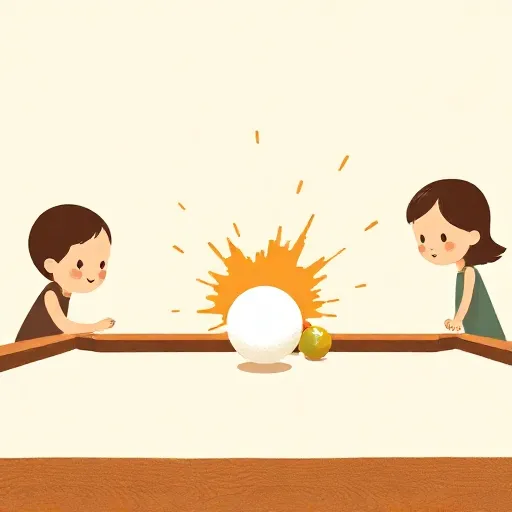
To understand the puzzle, think of a game of pool. You strike the cue ball. It smashes into the triangle of balls, sending them scattering. Now, reverse all of their velocities at once—like pressing the rewind button on every atom. If you could do that, the balls would exactly retrace their paths, collide in reverse, and gather back into a perfect triangle. The same mechanical rules allow both films. One direction is a break shot; the other is an “un-break.” Physics doesn’t prefer either one.
Gas molecules bouncing inside a box are just like those pool balls, only billions of them, moving at enormous speeds. Every collision obeys time-reversible laws: if the motion works one way, the exact opposite motion works too. So a gas should be just as capable of organizing itself as disorganizing itself. And yet, if you pump a little bit of gas into a corner of an empty box, it will instantly rush to fill the whole space. You never see it all gather back into that corner on its own.
This mismatch bothered Boltzmann and his colleagues deeply during the 1870s. The rules of the game don’t force the gas to spread out—so why does it?
The Coin Shaker’s Secret

Boltzmann’s breakthrough came when he stopped thinking about individual molecules and started thinking about probability. He realized that the second law of thermodynamics—the law that says heat flows from hot to cold and disorder always increases—isn’t a strict mechanical law like gravity. It’s a statistical one.
Here’s the idea. Imagine you have a jar with 100 pennies, all showing heads. That’s an orderly state. Now shake the jar. After one shake, you’ll probably have a mix of heads and tails—maybe 51 heads and 49 tails. That’s more disordered. After many shakes, you’ll almost never see all heads again. Why? Because there’s only one way to have all heads. But there are about (10^{29}) ways to have 50 heads and 50 tails. The numbers are so staggeringly lopsided that you’re virtually certain to end up with a messy mix.
Boltzmann applied this same counting logic to gases. The “microstate” of a gas is the exact position and velocity of every single molecule. A “macrostate” is what we can see from the outside: temperature, pressure, volume. Countless microstates all look like the same macrostate. A gas that fills the box evenly (a disordered macrostate) corresponds to an absolutely enormous number of microstates. A gas bunched up in one corner (an ordered macrostate) corresponds to only a tiny number. Left to itself, the gas spends almost all of its time in the macrostate that has the most microstates—the spread-out, messy one. That’s why it looks like disorder always wins. It’s just far, far more probable.
Loschmidt Says: Reverse It!

Not everyone was convinced. In 1876, Boltzmann’s colleague Joseph Loschmidt (1821–1895) posed a famous challenge, now called the reversibility objection. He said: take a gas at the very moment it has just finished spreading out evenly. Now—imagine you could magically freeze time, and reverse the velocity of every single molecule, so that each one is now heading exactly back the way it came. The laws of motion are like a perfect film running backward: the gas would retrace its steps, pull itself out of the corners, and clump back together into a tiny patch. Disorder would decrease. The second law would be violated.
Loschmidt’s point was sharp. If the molecular laws allow such an “un-mixing” movie, then you cannot claim the second law follows from mechanics alone. Boltzmann had to admit he was right. A purely mechanical gas is, in principle, capable of going against the second law. But Boltzmann’s reply was just as sharp: such a reversal is not impossible—it’s just ridiculously improbable. To get the reversed state, you would have to fine-tune every molecule’s path exactly. That’s like shaking the penny jar and having them all land on heads a thousand times in a row. You shouldn’t hold your breath.
This debate forced a huge shift. Boltzmann now made it explicit: the second law isn’t a guarantee. It’s a statement about overwhelming odds.
What Boltzmann Couldn’t Prove

Boltzmann spent decades refining his theory, but he never managed to nail down every loose end. One problem was that to calculate probabilities, he sometimes needed to assume something called the ergodic hypothesis—the idea that a gas, over a long enough time, will visit every possible microstate that has the same total energy. That’s a strong assumption. In fact, later mathematicians showed it can’t hold for real systems. Even Boltzmann himself was nervous about it, scribbling doubts in the margins of his own papers.
He also shifted strategies more than once. His famous 1872 paper used an equation (the Boltzmann equation) and a quantity (H) that always decreases, a bit like an entropy meter. But that relied on a subtle assumption about collisions that secretly built in the arrow of time. His 1877 paper instead used the coin-counting style argument, defining entropy in terms of the number of microstates. This approach—now called Boltzmannian statistical mechanics—is what many physicists today find the most satisfying foundation. Yet Boltzmann himself later returned to his 1872 collision-based method, never settling on a single unified theory.
Another deep problem, raised by the young mathematician Ernst Zermelo (1871–1953) in 1896, was the recurrence objection. A famous theorem says that a confined mechanical system, given enough time, will eventually return arbitrarily close to its starting state. That means a gas should, after an unimaginably long time, spontaneously un-mix. Boltzmann’s response was again probabilistic: yes, recurrences happen, but the waiting times are so vast—far longer than the age of the universe—that we will never observe them. Probability doesn’t just explain why things happen; it explains why we don’t see certain perfectly legal possibilities at all.
Why Your Cup of Tea Matters

Boltzmann’s story doesn’t end in a tidy package. He suffered from bouts of deep depression and took his own life in 1906, just before other physicists proved the reality of atoms beyond any doubt. The myth that he was crushed by critics is mostly wrong—he was widely respected—but the sheer difficulty of his questions surely weighed on him.
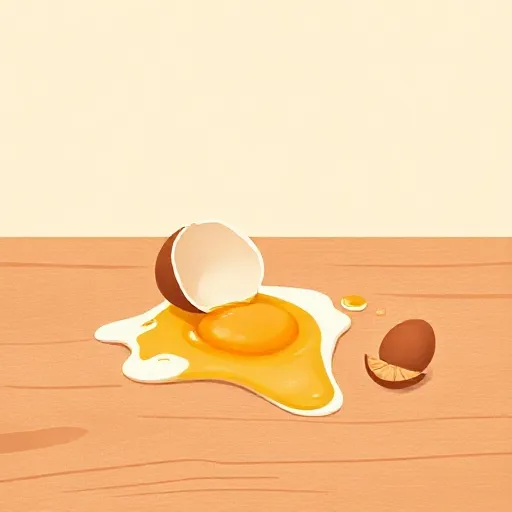
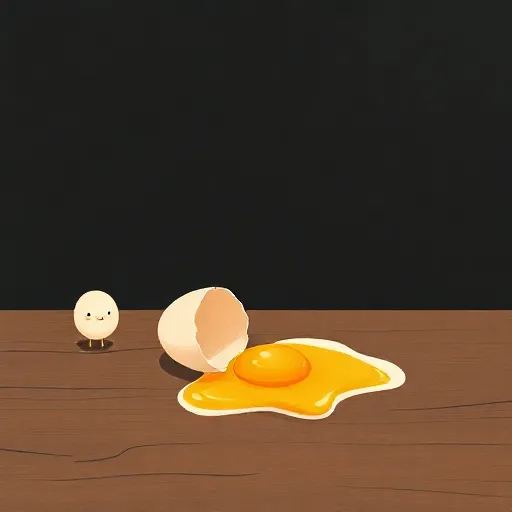
Today, his ideas stand at the heart of how we understand time itself. The reason you remember the past but not the future, the reason an egg breaks but never unbreaks, the reason biological aging moves in one direction—all these trace back to the fact that the number of possible messy states is astronomically larger than the number of orderly ones. Our universe started in an extremely special, low-entropy state (we still don’t know why) and has been rolling downhill probabilistically ever since.
The next time you stir a cold drink and watch the ice melt, you’re witnessing one of the deepest secrets of reality. The laws of physics don’t forbid the water from refreezing and the syrup from pulling itself apart. But you are overwhelmingly unlikely to see it happen before the sun burns out. The arrow of time isn’t a command—it’s a bet with impossible odds.
Think about it
- If you had a perfect computer that could track every molecule in a room, could it predict the exact moment a broken glass might spontaneously reassemble? Would you still call it a “miracle”?
- Our brains are made of the same particles that obey time-reversible laws. Why, then, do we feel so sure that time flows in one direction?
- If a universe started in a completely random, high-entropy state, would life be possible in it? What would the creatures in that universe think about the past and future?