Can You Talk About Something You've Never Seen?
The Thermometer Mystery: How We Talk About Heat

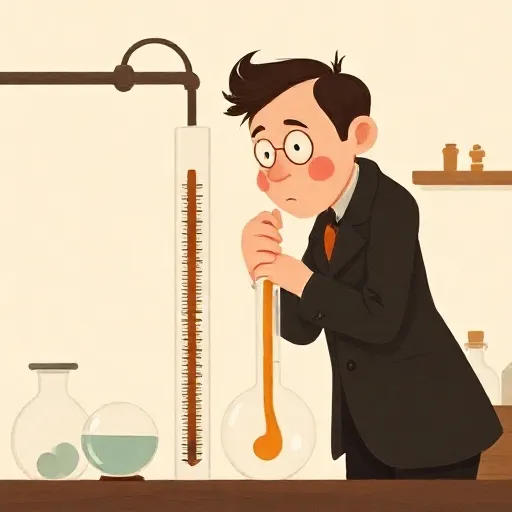
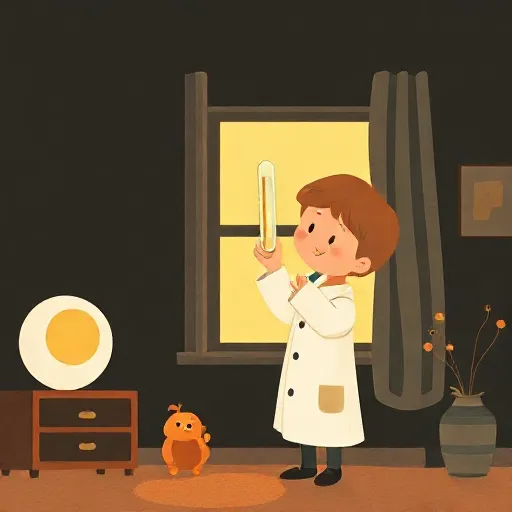
You are in a science class. You dip a glass thermometer into hot water and watch the red line creep up. You say, “the temperature is rising.” But do you actually see temperature? You see a red line, not heat. The word “temperature” names something you cannot point at — something invisible that you know only through instruments and theories. That makes it a theoretical term: a word that gets its meaning from a scientific theory, not from anything you can directly observe.
Philosophers have wondered for over a century how such words work. If you can’t see, taste, or touch what a word refers to, how does it get its meaning? And if you need a theory to understand the word, can you ever really test the theory independently? The German‑American philosopher Rudolph Carnap (1891–1970) noticed that physicists and philosophers answer these questions very differently — and his attempt to sort them out launched a debate that is still alive today.
Two Ways a Word Can Be “Theoretical”

Carnap pointed out that a philosopher uses “observable” in a narrow way: something is observable only if you can perceive it directly with your senses, without any instruments and without making any guesses. “Blue,” “hard,” and “colder than” count. A physicist, on the other hand, happily says that temperature or electric current is observable — because you can measure them with a simple device. But Carnap insisted that when you read a thermometer, all you truly observe is the position of the liquid, not the heat. To claim the liquid’s height means something about heat requires an extra little theory.
So the first way to be theoretical is simply to name something non‑observable in the philosopher’s strict sense: electrons, gravitational fields, genes. But Carnap thought there was something deeper going on. A term can also be theoretical in a second way: if its meaning depends on the axioms of a scientific theory.
The French physicist‑philosopher Pierre Duhem (1861–1916) and the mathematician Henri Poincaré (1854–1912) argued that for many scientific words, you cannot pin down their meaning without the whole theory they are part of. You don’t learn what “force” means by seeing force; you learn it by seeing equations like Newton’s second law. The philosopher Paul Feyerabend (1924–1994) pushed this idea even further, saying the meaning of a term is not a fixed property — it shifts when the theories around it change. This is the contextual theory of meaning: a theoretical term’s meaning comes from the web of scientific statements in which it lives.
Why the Line Gets Blurry

Not everyone liked this two‑worlds idea. Critics noticed problems. First, instruments let us observe things that were once invisible. With cloud chambers, scientists could see the tracks of electrons. Second, if you say “observable” must exclude all instruments, then wearing glasses would make the world unobservable — which feels absurd. Third, some words that seem plainly observational, like “red,” get used to describe things too small to see, like light particles. Does that make “red” a theoretical term?
Carnap had replies. He said, fine, the distinction is not a sharp line — it’s a continuum from direct sensing to highly indirect measurement. He even admitted that we choose where to draw the boundary depending on what we need for a logical analysis. He was willing to say that a color‑blind person’s “observation” is different from yours. So the theory‑observation divide is not a fixed fact about the world; it is a tool, and sometimes it gets fuzzy.
The historian Thomas Kuhn (1922–1996) and others added a deeper worry: observation itself might be theory‑laden. What you see is shaped by what you already believe. When the astronomer Tycho Brahe watched the sunrise, Kuhn claimed, he might quite literally see something different from what Kepler saw, because they had different background theories about the heavens. If even seeing is soaked in theory, then maybe no word is purely observational. That challenge rattled philosophers of science for decades.
The Sticky Circle: Measuring What You Can’t See
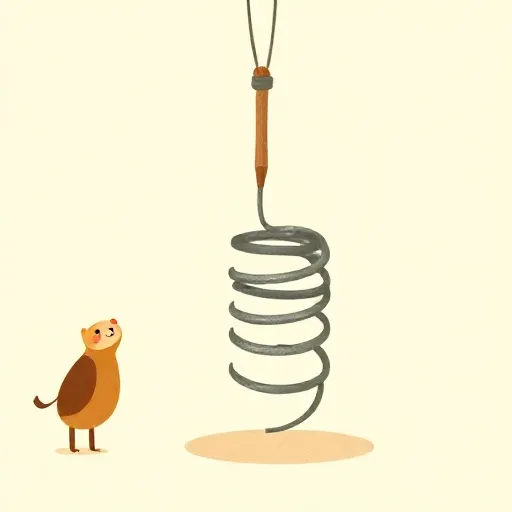
The philosopher Joseph Sneed (1941–2015) sharpened Carnap’s ideas into a precise problem. He defined a term as T‑theoretical (theoretical with respect to a particular theory T) if every method of determining that term’s extension relies on some axiom of T. In classical particle mechanics, “force” is T‑theoretical: you cannot measure force without using Newton’s second law, Hooke’s law, or the law of gravitation. Even a spring scale works because we believe Hooke’s law is true.
Now here is the puzzle. Suppose you want to test whether Newton’s second law holds in a new situation. To do that, you need to measure force. But to measure force, you must already assume the very law you are testing — because your measurement device depends on it. It looks like a vicious circle: you cannot gather evidence for the law without already trusting the law, and you cannot justify your measurement without the law. Sneed called this the problem of theoretical terms.
The same trap appears for many core scientific concepts. To measure temperature, you use a gas thermometer that relies on the ideal gas law. To check that law, you need temperature again. We seem stuck. Is there a way out?
How Philosophers Tried to Escape the Circle

The British philosopher Frank Ramsey (1903–1930) proposed a clever move. Take a theory that speaks about theoretical terms like “force” or “temperature.” Now, replace every one of those terms with a blank — a variable — and say: “There exists some set of things that makes the whole theory true, given what we already know about observable things.” The result is the Ramsey sentence of the theory. It does not use the original theoretical terms at all. Instead, it claims that some unknown relations and properties, out there in the world, satisfy the theory’s structure.
The Ramsey sentence has exactly the same observable consequences as the original theory. But it avoids the circle: because it does not name force or temperature directly, there is no circular need to measure them before testing. The theory becomes a promise that something fills the roles. Ramsey himself thought this captured how scientists really talk — theoretical claims are like stories that get their meaning from the whole context, not from pointing at individual pieces.
Carnap later added a tool to help us recover the familiar theoretical language when we need to do real calculations. He introduced the Carnap sentence: “If the Ramsey sentence is true, then the theoretical terms mean whatever makes the original theory true.” This lets scientists keep using words like “electron” in ordinary reasoning, but it grounds their meaning in the success of the whole theory.
Another, more radical approach stays closer to science as it is practiced. Carnap’s notion of indirect interpretation says that the axioms of a theory do not describe theoretical entities in the usual way; they partly define them, just as a definition partly fixes the meaning of a new word. The theory’s job is to narrow down the possible meanings until you have a manageable set of admissible interpretations. If the axioms contradict observations, the theoretical terms simply fail to be interpreted — you cannot use them to pick out anything in the world. This means you can understand scientific words even when your theory is imperfect: you grasp them by grasping the role they play in the theory’s rules.
Why It Still Matters: Science as a Web of Trust
You use theoretical terms every day. When you hear “DNA,” “gravity,” or “antibody,” you are not picturing something you can directly observe. You trust a vast network of theories that give those words their meaning. The puzzle Sneed spotted — that measuring a theoretical property always borrows from some law — is still with us whenever a new scientific instrument is calibrated using old theories. Philosophers of science nowadays often see theories not as single, provable blocks but as interdependent webs. You cannot test one strand without leaning on many others.
This does not make science shaky; it makes it resilient. The fact that theoretical terms gain meaning from their place in a theory means that when we improve a theory, the meaning of its words can grow sharper and more useful. Carnap’s insight — that the line between observable and theoretical is chosen, not found — also reminds us that good science mixes careful observation with imaginative construction.
So next time you trust a thermometer, watch a weather forecast, or read about a new medical study, remember: you are handling invisible things named by theories. The words work because science has learned to define them not by pointing, but by telling a coherent story — and philosophers helped make that story clear.
Think about it
- If you couldn’t see air but could feel wind on your skin, would the word “air” be a theoretical term? Why might it sit somewhere on Carnap’s continuum?
- A detective uses a theory about criminal behavior to identify a suspect. If the theory later turns out to be partly wrong, did the detective ever really refer to the real criminal? How is that like measuring temperature with a law you aren’t sure of?
- Scientists say electrons are real even though nobody has ever seen one directly. What would you need before you felt confident calling something “real” when you can’t perceive it with your unaided senses?