Are the Things Science Can't See Really Real?
The Invisible Dance: Seeing Without Seeing

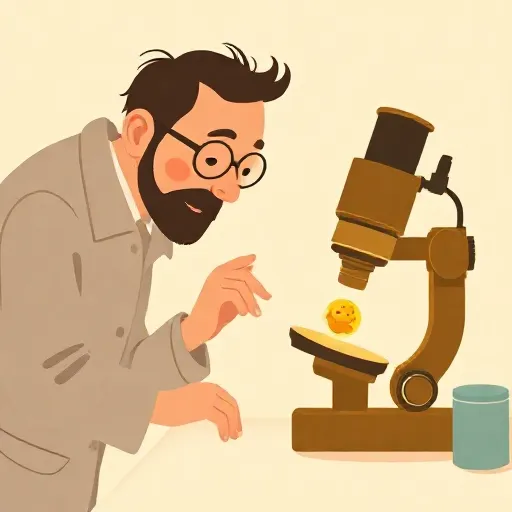
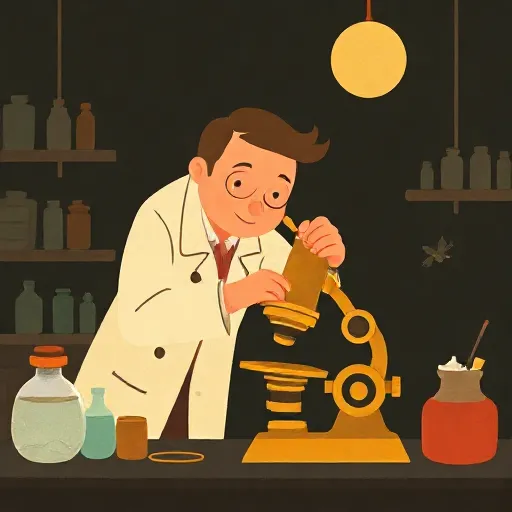
In 1908, the French physicist Jean Perrin stared into a microscope at a drop of water. Inside, small grains of pollen never stopped jiggling. He couldn’t see the water molecules themselves — they were far too tiny — but he could see the pollen dance, kicked around by invisible forces. Perrin argued that this jittery motion, called Brownian motion, was solid evidence that molecules existed, even though nobody would ever see them with the naked eye. His experiment forced people to ask a question that still matters today: should we believe in things we cannot see?
Scientists constantly talk about unobservable things — entities too small, too far, or too strange for our senses to detect directly. Electrons, genes, black holes, and dark energy are all examples. Philosophy of science calls things like planets and platypuses observable because you can, under good conditions, see them without instruments. But the real fight is over the unobservable.
The position known as scientific realism says we should treat our best scientific theories as if they really describe a world that exists independently of our minds — a world that includes unobservables. Realists don’t claim every detail in a textbook is perfect. They accept that theories can be approximately true — close to the truth, even if not exactly right. They also tend to be selective: they believe in the parts of a theory that are crucial for its success, not every side detail. But the core idea is bold: science gives us genuine knowledge of an invisible realm.
To be a realist involves three commitments. The first is metaphysical: the world studied by science is mind-independent — it would exist even if no human ever observed it. The second is semantic: when scientists talk about electrons, we should take those claims literally, as statements that are either true or false. The third is epistemological: we can gain knowledge from those literal claims. As we’ll see, not everyone agrees with all three, and that disagreement spawns a colorful family of antirealist views. But the realist’s picture is simple: science works so well because it gets reality right.
The “No Miracles” Argument: Why Would Science Work So Well?

Walk into a hospital for an MRI scan. Use a smartphone to talk to someone across the ocean. Fly in an airplane. All of these marvels rely on theories about unobservable things — magnetic fields, radio waves, aerodynamics. The most famous argument for scientific realism starts with this astonishing success. The American philosopher Hilary Putnam (1926–2016) put it bluntly: realism “is the only philosophy that doesn’t make the success of science a miracle.” If theories like quantum mechanics were completely wrong about the unseen, why do they work so perfectly? The realist answer: the best explanation is that they are approximately true.
This is called the miracle argument or the no miracles argument. It is a form of inference to the best explanation — a way of reasoning we use every day. If you hear scratching in the attic and see droppings on the floor, you infer there’s a mouse, because a mouse explains the evidence better than any ghost or gust of wind. Similarly, realists infer that theories roughly describe real unobservables because that explains their staggering success.
Of course, critics push back hard. The Dutch philosopher Bas van Fraassen (born 1941) offers a different picture. He says successful theories are like well-adapted animals: the ones that survive are the ones that fit the data. We shouldn’t be surprised that only successful theories stick around. No miracle needs explaining. Van Fraassen’s view, called constructive empiricism, accepts that scientific theories are perfectly useful for predicting what we can observe, but insists we should stay agnostic about the unobservable part. You don’t have to believe in electrons to use electron theory — you just need it to forecast where a spot will appear on a screen.
Other critics point to a statistical trap called the base rate fallacy. Imagine a medical test that’s 90% accurate for a rare disease that only 1 in 10,000 people have. If you test positive, your actual chance of having the disease is still tiny — because the disease itself is so rare. Similarly, if most theories are actually false (as history suggests), then the fact that one theory is successful doesn’t prove it’s true. The success might just be lucky. Realists reply that this misreads the argument: they aren’t calculating a probability, they are asking what best explains the evidence. The debate remains lively.
The Pessimistic Induction: A History of Getting It Wrong

For centuries, scientists believed that a mysterious substance called phlogiston flowed out of burning wood. The caloric theory said heat was an invisible fluid. Nineteenth-century physicists filled the universe with a weightless ether to carry light waves. Every one of these theories was highly successful in its day — it made correct predictions, guided experiments, and put bread on the table. Yet from our modern perspective, all of them are considered false. Their central unobservable things — phlogiston, caloric, ether — don’t exist.
The antirealist argument known as the pessimistic induction (or the pessimistic meta-induction, because it’s an induction about scientific induction) takes this pattern very seriously. The American philosopher Larry Laudan (1941–2022) argued that the history of science is a graveyard of successful theories that turned out to be wrong about unobservables. If so many past theories failed to refer to real things, why should we trust today’s theories? The induction is pessimistic: like a grey sky before rain, the past suggests a cloudy future for our current beliefs.
Realists have two main replies, both involving selectivity. The first is to say that only mature and non-ad-hoc theories count — ones that have passed rigorous testing and made surprising, novel predictions. When you focus only on those, the number of total failures shrinks. The second reply is to shift confidence to specific parts of theories. Entity realism, championed by the Canadian philosopher Ian Hacking (1936–2023), says that if you can reliably manipulate an unobservable thing — say, firing electrons to produce a signal — you have excellent reason to believe it exists, even if the surrounding theory changes. Structural realism goes further: what science really captures is the mathematical structure of the world, not the inner natures of things. We know the relations between electrons, not what an electron “feels like.”
These realist strategies keep the debate alive. Even so, the antirealist can smile and point out that selectivity may just be a way of moving the goalposts — praising the parts of old theories that survived while ignoring the mountains of discarded junk.
Trusting the Invisible: Why This Debate Matters to You

So why should a twelve-year-old care about a philosophical scrap over microscopes and equations? Because the question of whether unobservables are real touches nearly every part of your life. When you get a vaccine, you’re trusting that a tiny, unseeable virus exists and that the shot trains your immune system to fight it. When you learn about climate change, you’re accepting that invisible greenhouse gases trap heat. When you watch a documentary about the Big Bang, you’re believing a story about events trillions of miles and billions of years away. Every one of these leaps of faith dances on the edge of the realism debate.
If scientific realism is right, you can feel confident that science isn’t just a handy fiction — it’s genuinely mapping a mind-independent world. If some form of antirealism is closer to the mark, then you might still use science perfectly well to predict and control things, but you’d have to hold back from saying those invisible things are “really there” in the same way your desk is there. In everyday life, most of us act like realists: we trust bridge engineers, weather forecasts, and MRI machines without a second thought. But philosophy pushes us to ask whether that trust is rational.
Jean Perrin’s jiggling grains of pollen eventually convinced almost everyone that atoms are real. Today, the same question applies to even stranger candidates: dark matter, which no one has ever directly detected, or superstrings in ten-dimensional space. The history of science shows that some of our current beliefs will almost certainly be overturned. The realist’s hope, and the antirealist’s challenge, is to figure out which ones deserve our belief and which are merely useful stories. That puzzle — what counts as good evidence for invisible things — is one you’ll confront every time you open a science book.
Think about it
- If a scientist tells you that dark matter exists, but no instrument has ever directly detected it, would you believe it? What would it take to change your mind?
- Imagine you’re using a map that gets you to every destination perfectly, even though it shows imaginary mountains along the way. Is the map true? How would you test whether the mountains are real?
- Thousands of years ago, people explained the sunrise by believing the sun was a god. That theory worked for them. Could our current theory of the sun turn out to be wrong in some deep way? What might make us abandon it?