Do Scientists Discover Invisible Worlds or Just Save the Phenomena?
A Startling Question: Does Science Need Invisible Things?
In 1980, a philosopher named Bas van Fraassen (b. 1941) asked a question that shook up the philosophy of science. What if science isn’t trying to tell us the true story about invisible things like electrons, viruses, or black holes? What if all science needs to do is “save the phenomena” — get the things we can see, touch, and measure right? Most people assume science aims to give us a literally true description of the whole world, both the parts we can observe and the parts we can’t. That view is called scientific realism. If you accept a theory as a scientific realist, you believe it’s true.
Van Fraassen proposed a different view: constructive empiricism. It says that science only aims to describe the observable parts of the world correctly. It doesn’t aim to tell us the truth about unobservable things. According to constructive empiricism, when a scientist accepts a theory, they don’t have to believe the theory is true. They only need to believe it is empirically adequate — that it correctly describes everything we can observe. Talk about atoms and electrons is still perfectly meaningful, but you can remain agnostic about whether those unobservable entities really exist. This wasn’t the old logical positivist idea that unobservable talk is meaningless. Van Fraassen admitted theories can be taken literally — their claims are genuine statements that could be true or false — but he thought we should hold back on believing the parts that go beyond what we can perceive with our unaided senses.
The Aim of Science, Not Your Personal Belief

Constructive empiricism isn’t about what individual scientists personally believe or what you should believe. It’s about the aim of the scientific enterprise itself — what counts as success for science as a whole. Van Fraassen distinguishes between two kinds of thinkers. A scientific gnostic believes the theories they accept are true, right down to the unobservable parts. A scientific agnostic accepts theories but believes only that they are empirically adequate; they remain neutral about whether the unobservable parts are true or false.
You can be a scientific gnostic and still think constructive empiricism is correct about science’s aim. That just means you’ve chosen to believe more than science requires. Van Fraassen thinks science’s goal is determined not by polling scientists, but by looking at what makes the scientific enterprise rational and intelligible. A calm river of works, not the moods of individual rowers.
Accepting a theory, for the constructive empiricist, has two parts. There is a belief: the theory is empirically adequate. And there is a commitment: to keep testing new phenomena within that theory’s framework and to bet that all relevant observations can be handled without giving up the theory. This commitment is partly pragmatic. Scientists often act as if a theory is true — answering questions, using its language — even when they only accept it in this modest way.
Observable or Unobservable? The Crucial Line

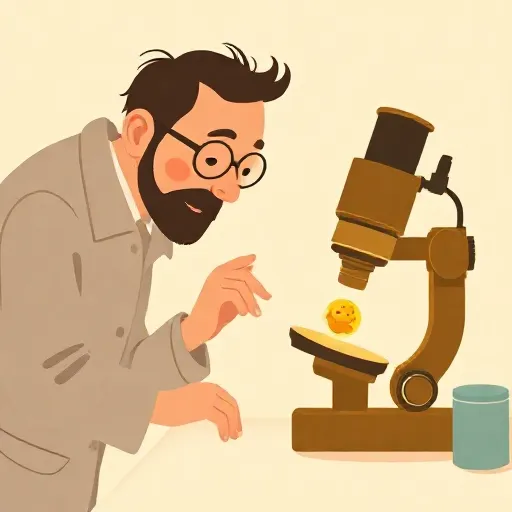
For constructive empiricism to work, you need a clear difference between what’s observable and what’s not. Van Fraassen offers a rough guide: something is observable if there are circumstances in which, if it were present to us unaided, we would observe it. A distant galaxy is observable because if we were close enough, we would see it. A virus is not observable because no matter how close you get, your naked eyes cannot see it. When you look through a microscope, you’re not observing the virus itself — you’re seeing an image, a kind of public phenomenon like a rainbow.
This point is subtle. A rainbow is not a physical object; you can photograph it, but it doesn’t occupy a fixed place in space the way a rock does. Van Fraassen argues that what we see through microscopes is similar: we detect certain visual patterns, but we don’t directly observe the tiny objects scientists talk about. That doesn’t make the patterns useless; it just means we can be agnostic about unobservable things while still using the images.
A theory is empirically adequate if all actual observable phenomena — past, present, and future — can be fitted into the structures the theory describes. On the semantic view of theories that van Fraassen prefers, a theory isn’t just a list of sentences. It’s a family of models — abstract structures — along with designated “empirical substructures” that are supposed to match what we observe. Think of a video game world. The game’s rules produce everything you see on screen. You don’t know if there’s a deeper reality behind the pixels, but the game saves the phenomena: it predicts exactly what will appear. Believing the theory is empirically adequate is like believing the game engine correctly renders the observable world, without committing to the invisible machinery underneath.
Why Would Anyone Be a Constructive Empiricist?
Constructive empiricism appeals to a spirit of epistemic modesty. Both believing a theory’s truth and believing its empirical adequacy go beyond what we can know for certain at any moment. But empirical adequacy is a much weaker claim. Van Fraassen famously remarked that “it is not an epistemological principle that one might as well hang for a sheep as for a lamb.” Just because you already stick your neck out a little, you aren’t forced to stick it out a lot more. You can believe a theory correctly predicts every observable event without taking the extra leap to believe its invisible parts are real.
Another reason comes from theory choice. When scientists pick between competing theories, they often praise virtues like simplicity, mathematical elegance, and explanatory power. Constructive empiricists think these are pragmatic virtues, not reliable signs of truth. The world might well be complicated rather than simple. Experimental psychology backs this up: in studies, people prefer simpler explanations even when they know a more complex one is more likely to be true. These preferences come from our minds, not from the world. Similarly, many false theories in history — Newton’s gravity, Huygens’s optics, Bohr’s atom — were wonderfully explanatory. So explanatory power doesn’t guarantee truth. Van Fraassen argues that scientific explanation is itself a pragmatic thing: it answers particular questions in a context-dependent way, highlighting parts of a theory’s structure that interest us. It doesn’t give us a metaphysical pipeline to reality.
Finally, constructive empiricism helps us avoid what van Fraassen calls inflationary metaphysics — beliefs in laws of nature, necessary connections, or possible worlds. An empiricist who wants to keep their worldview lean finds that comforting. Science can thrive without those heavy extras.
But Wait — Objections!
Of course, not everyone agrees. One famous challenge is the miracle argument, pushed by Hilary Putnam (1926–2016). If scientific theories weren’t at least approximately true, how could they be so spectacularly successful? That success would be a miracle. Van Fraassen replies with an evolutionary analogy: theories compete fiercely, and only the ones that latch onto actual observable regularities survive. A theory can be empirically adequate without being true; natural selection among theories explains the success without needing truth.
A related challenge is inference to the best explanation. Realists say we should infer that the best explanation of our observations is true. Constructive empiricists reject that rule. They point out that we might not even have the right candidate explanations in front of us, and that giving extra weight to the best-sounding story can lead us astray. They also note that scientists themselves often treat theories as empirically adequate rather than committing to their full truth.
The sharpest attacks target the observable/unobservable distinction itself. Paul Churchland imagined beings born with electron microscopes permanently attached to their left eyes. Would viruses count as observable for them? If so, the line seems arbitrary — a matter of biology, not a deep difference in the world. Van Fraassen replies that we only count those beings as part of our epistemic community if we already trust their reports. Otherwise, we treat them as we treat any instrument: they produce reliable images, not direct observations. Ian Hacking described a machine that makes tiny grids, too small to see unaided. Look through a microscope, and you see the same grid pattern you designed. Doing this with many different kinds of microscopes would be an incredible coincidence if the grid weren’t really there. Van Fraassen answers that this argument assumes what’s in dispute — that the persistent similarity of images must be explained by a true, mind-independent object. The constructive empiricist can simply remain agnostic.
Then there is the hermeneutic circle objection. We use science to tell us what is observable (facts about our eyes, light, etc.), but then we use that account of observability to judge whether theories — including that very same science — are empirically adequate. Isn’t that circular? Constructive empiricists acknowledge the circle, but they think it’s unavoidable. We have to start somewhere, using our best current understanding, and revise as we go. Perfect guarantees are not available.
Why This Matters When You Read a Science Textbook

So where does this leave you? Every day you hear about atoms, DNA, climate models, and quantum fields—things no one has ever seen with unaided eyes. Constructive empiricism doesn’t say you must stop trusting science. It offers a way to use science wholeheartedly while being more careful about what you believe. You can accept a theory, immerse yourself in its language, design experiments, and build technology—all while remaining agnostic about the unobservable.
Think of it like using a map. You rely on the map to navigate, but you don’t believe the map is the territory. You believe it’s accurate enough to get you where you’re going. If a better map comes along, you switch. Similarly, the constructive empiricist says science gives us reliable guides to the observable world, without forcing us to swear loyalty to electrons or dark matter as ultimate reality.
The debate isn’t settled. Philosophers still argue about whether the observable/unobservable line can hold, and whether modesty like van Fraassen’s makes science weaker or stronger. But the next time someone tells you that science has proved the existence of some invisible particle, you might pause and ask: has it really? Or has it simply saved the phenomena?
Think about it
- If every time you drop a ball it falls, and a theory says invisible particles are pushing it, do you have to believe in those particles? Or is it enough that the theory correctly predicts the ball will fall?
- Your doctor says germs are real, but another physician claims “germ” is just a useful label for predicting illness. Would that change how you take medicine? Why or why not?
- Imagine scientists announce that electrons don’t actually exist, but all the equations still work perfectly. Would you still trust your phone and computer? What matters more to you — truth or usefulness?