
What If Your Happiness Depended Only on You?
What Would a Stoic Say to a Meltdown?

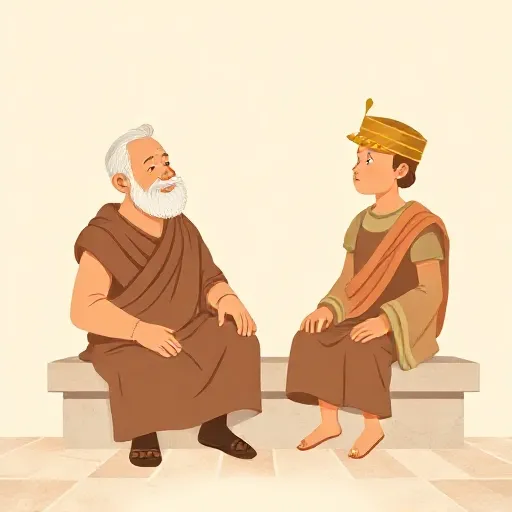
Imagine you’re playing your favorite video game, and you lose. Hard. You throw the controller, heart pounding, face hot with anger. It feels like a disaster. Now imagine someone appears beside you — a stranger in a simple robe from two thousand years ago — and asks calmly: “Is losing this game really something bad for you? Or is it just your thought about losing that makes you suffer?”
That stranger would be a Stoic. Stoicism was a school of philosophy founded in Athens around 300 BCE by Zeno of Citium (c. 334–262 BCE). Over the next five centuries, Stoic ideas spread through the Roman Empire. They were shaped by thinkers like the brilliant Chrysippus (c. 279–206 BCE), the statesman Seneca (c. 4 BCE–65 CE), and the former-slave-turned-teacher Epictetus (c. 55–135 CE). They all shared one bold goal: to figure out what a happy, flourishing life really needs — and to show that it depends on you and only you.
The Stoic Goal: Living in Agreement with Nature

The Stoics called the ultimate goal of life the telos — the end for which everything else is done. They said the telos is living “in agreement with nature.” But what does that mean? They didn’t mean camping or hugging trees. For Stoics, nature meant the rational order of the whole universe. They believed the cosmos is like a giant living thing, filled with a divine fire or breath called pneuma that directs everything in the best possible way. Your own mind is a spark of that same reason. So living in agreement with nature means using your reason to understand the world’s design and to act in harmony with it.
To help people remember this, the Stoics compared philosophy to a fruit orchard. Logic — the study of good thinking and clear language — is the fence that keeps out errors. Physics — the study of how the world works, including the divine reason that runs it — is the soil and trees. And ethics — how to live — is the fruit you actually harvest. The whole system works together, and you need all three parts to achieve happiness, which the Stoics called eudaimonia (human flourishing).
The Only Good: Virtue
Here comes the Stoics’ most shocking claim: the only thing that is truly good is virtue — that is, being a wise, courageous, just, and self-controlled person. And the only thing truly bad is vice, its opposite. Everything else — your health, your wealth, whether you win or lose, even whether you’re in physical pain — is indifferent. It can neither make your life better nor worse as a human being.
Wait. Isn’t being healthy good and being sick bad? The Stoics argued that something is good only if it always benefits you, like heat always warms. But money and health don’t always benefit you; they can be used for good or evil. Only virtue — the perfection of your own reason — always makes you a better, more flourishing person. So a wise person would be just as happy while being tortured on a rack as she was before, because her virtue remains untouched. (Yes, they really said that.)
Still, the Stoics didn’t think you should ignore health or wealth. They said some indifferents are preferred — it’s natural and reasonable to pursue health over sickness, just like you’d pick a tasty meal over a bland one. But your happiness does not rise or fall with getting them. You aim to choose well, but the outcome is not up to you. The real good is in your own excellent reasoning.
Are You Really Free? Determinism and the Cylinder
If the universe is run by a rational divine order, then everything that happens is causally determined — like a chain of dominoes stretching back to the beginning of time. This is determinism, and the Stoics fully accepted it. But that raises a scary problem. If my actions are already fated, why bother doing anything? If it’s fated that the doctor will come, why call her?
Chrysippus answered with the idea of co-fated events. The doctor’s arrival is fated together with your calling her; they are linked. Your action is part of the chain. So you still need to act to bring about the outcome. Calling is not pointless; it’s necessary.
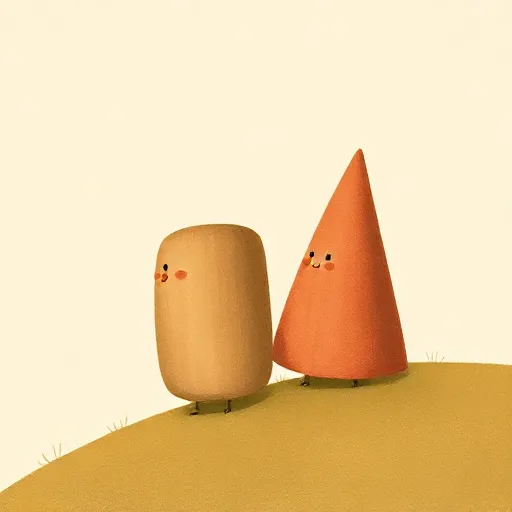
But a deeper worry remains: if my actions are caused by prior events, am I really responsible for them? Here Chrysippus offered a famous analogy. Imagine a cylinder and a cone sitting on a slope. You give both the exact same push. The cylinder rolls straight down; the cone spins and veers sideways. The push — like an outside impression you receive — gets them moving, but how each moves depends on its own shape, its inner nature. In the same way, an event outside you (like seeing a piece of cake) triggers an impulse. But whether you gobble it or not depends on your own character, on the kind of person you are. Your mind gives assent (or not) to the impression, and that assent is in your power. So you are still responsible, even though your character and choices were determined by prior causes. This view is called compatibilism: determinism and moral responsibility can go together.
The Mind’s Gatekeeper: Impressions and Assent
To make this work, the Stoics developed a careful picture of how the mind knows things. When you see a tree, your soul receives an impression — a mental representation. Most impressions are just okay; they might be blurry or mistaken. But sometimes you get a cognitive impression (from a Greek word meaning “graspable”). This kind of impression is so sharp and accurate that it guarantees its own truth. The Stoics said a cognitive impression (1) comes from a real object, (2) matches that object exactly, and (3) is so specific that no false impression could be just like it.
When you give your assent to a cognitive impression — when you mentally say “yes, that’s true” — you achieve cognition, a firm grasp of a truth. If you only ever assent to cognitive impressions, and you organize all your knowledge into a unified system, you become a Sage — a perfectly wise person. The Sage knows things in a way that can never be shaken by arguments. But the Stoics admitted this is extremely hard. They didn’t even claim that their own school leaders were Sages! Still, they believed this ideal shows what real knowledge looks like and gives everyone a target to aim for.
Mastering Your Emotions: The Passion-Free Life
If you think health is good and sickness is bad, you’ll feel passions — intense, stormy emotions like fear, grief, or craving. The Stoics defined a passion as an impulse that goes against right reason. They weren’t saying you should be a cold robot. They analyzed passions as false judgments: for example, distress is the judgment that something bad is present; fear is the judgment that something bad is coming. But since only vice is truly bad, those judgments are mistaken. A Stoic in training would examine their thoughts: “Is losing this game really bad? No — it’s just a preferred indifferent. My happiness doesn’t depend on it.”
The ideal sage, they said, is passion-free, meaning she never makes those mistakes. But she does have good feelings — calm joy in virtue, a kind of watchful caution, and goodwill toward others. There’s also room for lightning-fast flinches called pre-emotions: a Sage might startle at a thunderclap, but she won’t give assent to the thought “something terrible is happening.” Her mind stays steady.
Why It Still Matters

The big Stoic promise — that your happiness depends entirely on your own choices and judgments — may seem extreme. Most people today probably wouldn’t say you can be happy while being tortured. But the core Stoic insight has echoed for centuries. Later thinkers like Epictetus emphasized that we can’t always control what happens, but we can control how we think about it. That idea influenced modern approaches to managing anger, anxiety, and stress.
So next time you feel like hurling the controller after a loss, you might remember that visitor in the Greek tunic. Is the loss itself bad for your life, or is your judgment the only thing making you suffer? The Stoics would say you have the power to choose a different thought — and that power, not the score on the screen, is what real freedom looks like.
Think about it
- If you could choose between being a kind, wise person who is often sick and poor, or being a mean, foolish person who is rich and healthy, which life would be better? Why?
- Imagine a supercomputer that could predict every choice you’ll ever make, based on your past and your brain. If your choices are predictable, are you still responsible for them?
- Think of a time you felt really angry about something small. If you had believed at that moment that the thing wasn’t truly “bad” but just annoying, would you still have been angry?