
What Can You Trust When Every Argument Is Equally Strong?
The Lecture That Raised a Dangerous Question

In 1968, a soft‑spoken Brazilian professor named Oswaldo Porchat gave a lecture that left his colleagues uneasy. He didn’t announce a new theory. Instead, he asked: what if the whole history of philosophy is a kind of endless tug‑of‑war? For every claim about the nature of reality, knowledge, or the good life, there is a counter‑claim that seems just as convincing. If you can’t find a decisive tie‑breaker, then how can you ever be sure you’ve got the right answer?
Porchat was building on historical detective work done by an Argentinian philosopher and historian, Ezequiel de Olaso. Olaso had spent years poring over the writings of ancient skeptics like Sextus Empiricus (who lived around 200 CE) and showing that their ideas were still alive in the works of modern thinkers. Together, these two scholars set the stage for a fresh attempt at an old project: neo‑Pyrrhonism, a modern version of the ancient Greek philosophy that taught people to live well by refusing to take sides.
The central problem is what Porchat called diaphonía, a Greek word for deep, unresolvable conflict between rival doctrines. You can see it everywhere in philosophy. One thinker says the world is made of material atoms; another says it’s fundamentally mental. One argues that we can know things through pure reason; another insists we only know what we sense. And when experts disagree like this, no third expert can step in without using a standard that one side will immediately challenge. The conflict never ends.
The Skeptic’s Pause: How Suspending Judgment Feels
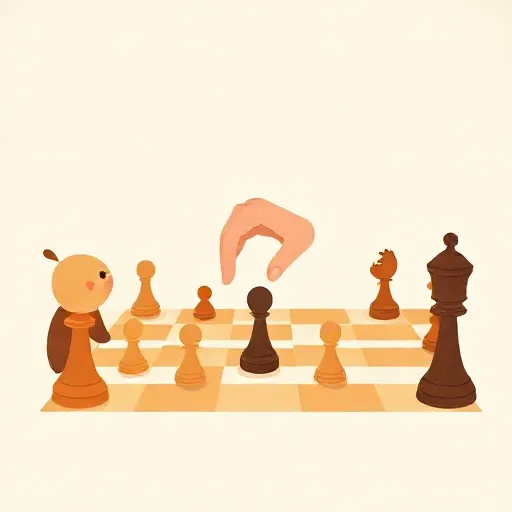
If every philosophical argument seems to have an equally strong counter‑argument, what should you do? Pick a side anyway? That, Porchat argued, is like tossing a coin and pretending the result is knowledge. The more honest move is to suspend judgment, a state the ancient skeptics called epokhé (pronounced “e‑po‑KAY”).
Learning to suspend judgment isn’t just giving up. The neo‑Pyrrhonist uses a special method to bring the mind to a peaceful standstill. They take the dogmatist’s own arguments—whether from a textbook, a scientist, or an ordinary person who is dead certain about something—and they show how the opposite position can be made to feel just as strong. The goal isn’t to prove that the opposite is true; it’s to even out the mental weight, to make the “tug‑of‑war rope” stop moving. When both sides feel equally persuasive, the urge to believe one over the other simply fades. The mind rests.
This is not the same as the famous Cartesian doubt where you pretend the world might be a dream. Porchat insisted that neo‑Pyrrhonism doesn’t trap you inside your own head. You aren’t wondering if tables and chairs are illusions. You’re just noticing that every theory about tables and chairs (Are they really collections of tiny particles? Are they just bundles of sensations? Do they exist only in God’s mind?) has a rival that looks just as reasonable. The skeptic doesn’t deny the world you live in; they stop trying to dig underneath it.
Living with Appearances: The Art of Not Digging Deeper

If you stop making judgments about what’s “really real” behind your experience, what’s left? The world you actually inhabit. Porchat used another ancient Greek word, phainómenon, meaning what appears. After suspending judgment about hidden layers of reality, you are still surrounded by appearances: the red of a rose, the sound of a friend’s voice, the fact that Brasília is the capital of Brazil. These aren’t private movies inside your head. Most phenomena are shared; they are part of what the skeptics called bíos, or common life.
The neo‑Pyrrhonist lives like everyone else. They go to school, eat meals, and enjoy music, all guided by the four everyday observances Sextus Empiricus described long ago: the guidance of nature, the push of feelings, the traditions of a community, and practical skills. Language permeates these appearances—when you see a rose, the word “rose” is already woven into your experience. So to say “roses are red” is simply to express how things appear to you, not to announce a discovery about a reality no one can see.
That’s why neo‑Pyrrhonists aren’t trapped in a lonely bubble. If almost everyone agrees that Brasília is the capital, that’s a shared appearance, a piece of common life. They can even do science. Porchat argued that scientific theories are ways of navigating and predicting appearances more reliably. They don’t have to commit to some further, invisible “real stuff”; they just need to be empirically adequate—to fit what we experience. Many neo‑Pyrrhonists accept the results of science as part of their view of the world, while still refusing to claim they know the ultimate truth about it.
Is It Even Possible to Stop Judging? Critics Push Back

Can you really live without ever making a judgment about what’s really true? Many philosophers doubted it. One group of critics, sometimes called “rustic” neo‑Pyrrhonists, argued that Porchat didn’t go far enough. Diego Machuca and Vitor Schvartz insisted that a consistent skeptic must hold no beliefs at all, not even non‑dogmatic ones about appearances. After all, the very idea that something “appears” to you might hide a sneaky judgment. If you truly follow the skeptical path, they said, it should sweep away even ordinary beliefs about the world.
Other critics attacked from the outside. Roberto Bolzani pointed out that Porchat’s neo‑Pyrrhonism is itself a philosophical view that can be dragged into the same conflict it tries to escape. Once you say “philosophical theories are undecidable,” haven’t you just put forward another theory—one that a dogmatist will immediately challenge? The Brazilian philosopher Paulo Faria put the worry even more sharply: whenever you speak, you imply that what you are saying is true. If a neo‑Pyrrhonist says “roses appear red to me,” they are claiming it is true that roses appear red. But that is already a kind of knowledge claim, an assertion about how things stand. Faria thought the skeptic’s use of language secretly commits them to the very pursuit of truth they wanted to avoid.
Porchat’s reply would emphasize the difference between talking about the world and talking within it. When we say “roses are red” in everyday life, we aren’t offering a theory; we’re expressing a shared appearance. Still, the debate is far from settled. Even friendly observers noticed that Porchat’s early hope—that skepticism could be a healthy “therapy” for dogmatic minds—might itself rest on a dogmatic assumption that doubt is always better. The fight over whether an honest skeptic can ever open their mouth without falling into contradiction remains one of the liveliest arguments in Latin American philosophy.
Why This Still Matters: Facing a World of Endless Disagreement
Today you don’t have to read ancient Greek texts to stumble into diaphonía. Open a news feed and you’ll find experts who disagree loudly about climate change, public health, or even what happened at a protest. Social media makes it feel like every opinion has a perfectly matched, equally confident opposite. It’s easy to feel dizzy and wonder what, if anything, you should believe.
If the neo‑Pyrrhonist is right, you don’t have to pick a side as if you were choosing the one and only true answer. You can live according to what appears in your community, follow the practices that keep everyday life going, and let the clash of theories stay unsettled in the background. That doesn’t mean you stop caring about the world; it means you stop exhausting yourself trying to get behind it.
But the critics’ questions still bite. In a world where appearances can be manipulated—where a video can appear to show something that never happened—is living by what appears enough? Can you take a stand on any important issue without claiming that your side is really right? The neo‑Pyrrhonist says yes, because taking a stand is itself just a part of common life; it doesn’t require a theory about ultimate reality. Whether that answer feels liberating or maddening is something you get to test for yourself, every time you face a clash of experts and wonder whom to trust.
Think about it
- Suppose two equally smart friends give opposite advice about a big decision. If you can’t figure out who’s right, is it better to pick a side anyway or to stay undecided? What might you lose either way?
- Can you go through an entire day without making any claim that you think is really, absolutely true—or does even saying “I’m hungry” assume more than you’d like to admit?
- If everything you read appears true to the person who wrote it, what should you do when two well‑meaning sources describe the same event in totally different ways?