
If a Model is Just Fancy Equations, Why Do We Trust It?
When a Paper Airplane Teaches You About a Real Jet

You have built a paper airplane. It’s a little triangle of folded paper — no engine, no passengers, no roaring sound. Yet when you talk about it with your friends, you end up talking about real airplanes: how they balance in the air, why the nose points up. Somehow, a scrap of paper has become a tool for thinking about the real thing.
Philosophers of science call this the problem of scientific representation. A representation is anything that stands for something else. A scientific model — a paper plane, a plastic skeleton, a computer simulation — is a representation of a target system, the part of the world it is about. The puzzle is: what turns one object into a representation of another?
One key feature is surrogative reasoning. That’s just a fancy way of saying you can learn about the target by playing with the model. If you bend the wings of your paper plane and see it spiral, you guess a real plane would also lose lift. The model lets you form hypotheses about something you cannot easily poke and prod. But you also notice a one-way street: the model is about the target, not the other way around. A photograph of a cracked airplane wing tells you about the wing; the wing doesn’t tell you about the photograph. Philosophers call this the requirement of directionality.
And here’s a harder twist: a bad model is still a model. If your paper plane has wings that are too short, it doesn’t stop being a representation — it just becomes an inaccurate one. Any theory of scientific representation must make room for misrepresentation. Otherwise, we would have to say a mistaken model wasn’t a representation at all, which makes no sense when scientists clearly use imperfect models all the time.
The Simple Answer: Models Are Like Mini-Me Real Things

The most natural idea is that a model represents its target because the two are similar. A globe is round like the Earth; a ball-and-stick model of a molecule looks like tiny atoms bonded together. Philosopher Ronald Giere (1938–2020) proposed that a model represents a system when a scientist claims the two are similar in important ways.
But similarity alone cannot do the job. Philosopher Hilary Putnam (1926–2016) imagined an ant crawling on a beach, leaving a trace that happens to look like Winston Churchill. The trace is similar — but is it a picture of Churchill? No. The ant never saw Churchill, never intended to make a portrait, and wasn’t connected to him. Similarity does not make something a representation.
There are other headaches. Similarity runs both ways: if A is similar to B, then B is similar to A. But a weather map represents the real storm, while the storm does not represent the map. The directionality of representation vanishes if we rely on similarity alone. Worse, if a model isn’t similar to its target — say, a model of an atom as a tiny solar system, which we know isn’t quite right — then by a pure similarity rule it wouldn’t be a representation at all. That means the rule cannot tell misrepresentation apart from non-representation. And what about models of things that don’t exist? Scientists once built models of phlogiston, a substance they thought made things burn. Since there is no phlogiston, nothing similar exists. A similarity account cannot explain such models.
Because of these snags, many philosophers concluded that similarity, while useful, is not the final answer to what makes something a representation. It leaves too many everyday scientific models unexplained.
The Puzzle of Hidden Structures
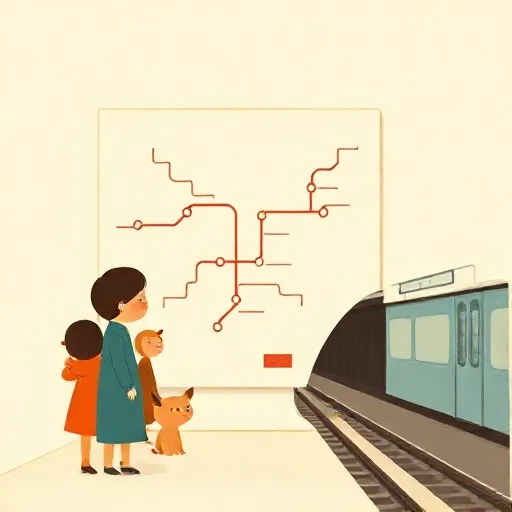
What if representation is not about looking alike, but about sharing the same hidden architecture? This is the structuralist idea. According to structuralists, a model is a structure — a set of objects connected by certain relations. A subway map, for example, is a structure of dots and colored lines. It represents the real subway network because the map and the actual tracks have the same pattern of connections. Philosophers call such a perfect pattern match an isomorphism. In an isomorphism, every station in one structure matches exactly one station in the other, and the relations (“is connected to”) are preserved.
The structuralist view, explored by thinkers like Bas van Fraassen (born 1941) and Steven French (born 1954), gives a neat answer to surrogative reasoning: if you discover a new route on the map, you can infer a real route exists. It also seems to explain why mathematics works so well in science, since mathematical structures can be matched to physical systems.
Yet the same old problems resurface. Isomorphism is symmetric and reflexive: if the map structure matches the subway structure, then the subway structure matches the map — but the subway doesn’t represent the map. And many different physical systems can share the same mathematical skeleton. The same equations that describe a swinging pendulum also describe an electric circuit with a coil and a capacitor. If representation were just isomorphism, we would have to say that anyone who studied pendulum equations long before circuits were built had unknowingly discovered radio technology. That seems wrong.
Misrepresentation is tricky again. If a model is supposed to be isomorphic to its target, but the model has the wrong structure, then by the strict rule it is not a representation at all — once more confusing a bad model with no model. Moreover, many scientific models aren’t physical objects you can hold. A set of equations isn’t something you can put on a lab bench. How can an abstract string of symbols be isomorphic to a flesh-and-blood system?” This is the problem of ontology: what kind of thing is a model, and how can such a thing share a structure with a concrete chunk of the world? Structuralism, on its own, struggles to answer.
When Models Act Like Stories: The Representation-as View
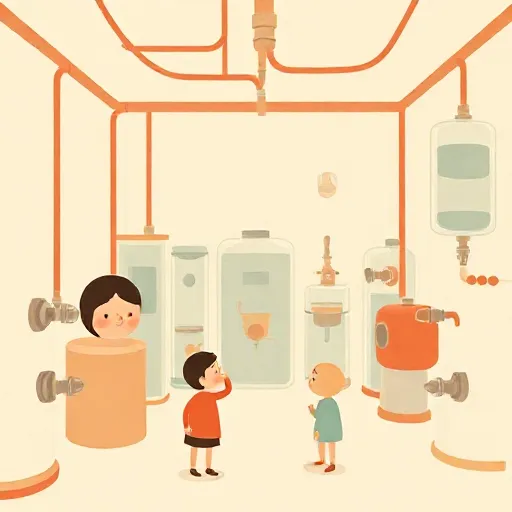
What if representation is not a simple matching game but more like how a novel or a painting works? Philosopher Nelson Goodman (1906–1998) and his collaborator Catherine Elgin (born 20th century) argued that to represent is to represent-as. A portrait of Napoleon represents him as a powerful emperor; a machine full of pipes and water — the real Phillips-Newlyn machine built in the 1940s — was used to represent an economy as a flow of liquid.
On this view, a model first denotes its target (it picks it out) and exemplifies certain features. Exemplification means the model actually possesses a property and points back to it as important — like a paint sample card that shows a colour and thereby refers to that colour. In a scientific model, the pipes exemplify fluid properties, and a key tells you how to translate those properties into economic ones (so many litres per minute stand for so many pounds of spending). The model then imputes those translated properties to the target. If the imputed properties hold true in the real economy, the model is accurate; if not, it misrepresents — but it is still a full-blooded representation.
This account, developed by Roman Frigg and James Nguyen into the DEKI frame (Denotation, Exemplification, Key, Imputation), avoids earlier traps. Directionality is built in because the model points to the target, not the reverse. Models of things that don’t exist — a bridge that was never built, a disease that never appeared — can still be representations because they exemplify bridge properties or disease properties even when they denote nothing. Representational styles multiply: any kind of object can become a model if we interpret it the right way. And the view connects science to art, showing that the way a painting teaches us about a person is not so different from how a climate model teaches us about tomorrow’s weather.
Why It Matters: From Weather Maps to Virtual Worlds
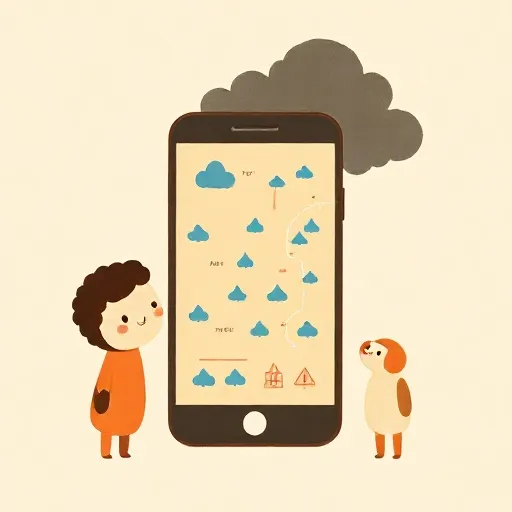
You check a weather app before school. A little cloud icon with raindrops tells you to grab an umbrella. That icon is a scientific model. It represents a real weather system, but it is not the weather itself — it is a simplified, interpreted version. The philosophical tangle about models isn’t just for dusty books. It shapes which models we build, how we use them, and when we trust them.
If you think models work only by being similar to the world, you might reject a model that doesn’t look like the target — say, a computer simulation of a virus spreading that uses wiggly graphs rather than pictures of people sneezing. If you think they work only through mathematical structure, you might miss the role of human interpretation, of the key that tells you what the numbers mean. And if we ignore the possibility of targetless models, we cannot make sense of engineers who design future cities or doctors who model hypothetical pandemics to prepare for the worst.
The choice between these theories isn’t just for philosophers. It is a choice about what counts as understanding. And every time you draw a diagram, build a game world, or squint at a map, you are right in the middle of that debate.
Think about it
- If you built a clay model of a dragon, would it represent anything real? Could you still learn something about animals from it?
- A video game uses a simplified physics engine to simulate a car crash. If the game gets some details wrong, is it still a scientific model? Why or why not?
- Imagine a scientist makes a model of a disease spreading through a city, but no such disease has ever existed. Is that model useless, or could it be valuable? Why?