
Why Do Scientists Play With Fake Atoms and Frictionless Planes?
A Toy Car in a Wind Tunnel

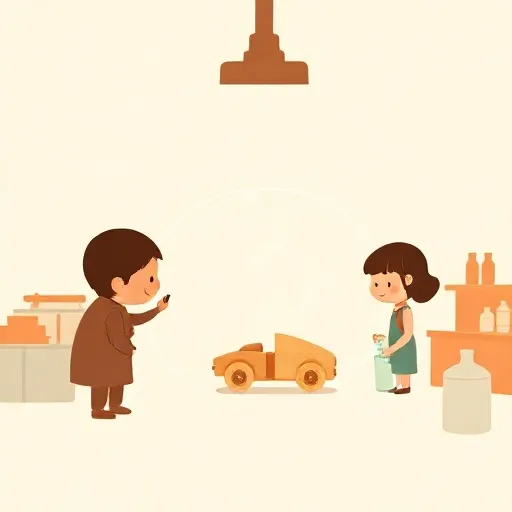
Imagine you’re visiting a science museum. In one room, a tiny wooden car sits inside a clear plastic pipe. A fan blows air past it, and smoke streams over its roof, twisting into tiny whirls. Through a window, you see a real car zooming along a track outside. Why would anyone build a little fake car to understand a real one?
Scientists call the little car a representational model — a simplified stand-in for something in the real world. The real car is the model’s target system. By studying how smoke swirls around the model, engineers can guess how the full-size car will slice through the air. But even a perfect-looking scale model isn’t perfectly faithful. The wooden car may copy the car’s shape, but not its metal skin or its engine vibrations. And the airflow isn’t simply a miniature version of the real thing: a 1:100 model ship, for instance, does not experience one hundredth of the water resistance of the real ship. The relationship is messy and nonlinear. So even the most straightforward model is a careful balancing act between truth and usefulness.
When Billiard Balls Become Gas Molecules

Many models work through analogy — comparing something familiar to something less familiar. In the nineteenth century, scientists trying to understand gas imagined it as a swarm of tiny billiard balls, all bouncing off each other and the walls of a container. This is an analogical model: the billiard balls (something you can see and touch) stand in for invisible gas molecules. The philosopher Mary Hesse (1924–2016) showed that analogies come in different flavors. Some are based on shared properties — the earth and the moon are both big, round, and rocky. But more powerful are formal analogies, where two very different systems follow the same pattern. A swinging pendulum and an oscillating electric circuit, for instance, are described by the same kind of equation. They share a structure, not a substance.
Hesse also pointed out that any analogy has a positive analogy (what the two things share), a negative analogy (what they definitely don’t share — gas molecules aren’t colored like billiard balls), and a neutral analogy. The neutral analogy is the exciting part: it’s the list of things you’re not yet sure about, like whether molecules scatter in the same way as balls. Those unanswered questions push scientists to run new experiments and invent new ideas.
Frictionless Ice and Perfect Spheres: The Power of Pretending

Real life is messy. To make problems manageable, scientists build idealized models that deliberately simplify or even distort reality. You may have seen a physics textbook assume a block slides on a frictionless plane, or that a planet is a perfect sphere. These are Galilean idealizations — named after Galileo, who was a master of stripping away complications to get at the heart of a problem. The ice rink in your mind has zero friction even though real ice always has a little bit. The pendulum bob becomes a point mass with no air resistance.
Why would anyone want a model that’s literally false? Because the distortion makes the math workable. And later you can try to add back the complications one by one — a process called de-idealization — to inch closer to the real world. Not all distortions can be removed, however. Some idealizations are baked so deeply into a model that if you took them out, the model would fall apart entirely. Still, even then, the model can give you a grip on something you couldn’t think about before.
Toy Models: When a Car Market Becomes a Cartoon

Sometimes simplicity goes to an extreme. Toy models strip a situation down to its barest bones. The Lotka–Volterra model in ecology, for instance, represents an entire predator–prey world with just two equations — no weather, no hiding places, no baby rabbits that happen to be born faster. In the social sciences, the Schelling segregation model shows how neighborhoods self-segregate even when people don’t mind living with others unlike them; all it takes is a tiny preference to be near some similar neighbors. These models aren’t trying to predict what any actual raccoon or real estate agent will do tomorrow. They’re designed to isolate a single cause and say, “Look, this one factor alone can produce surprising patterns.”
Some toy models are caricature models — they blow one feature up to cartoonish proportions to make a point. George Akerlof (born 1940) created the famous “market for lemons” model, where all the used cars for sale are secretly clunkers. In real life, not every secondhand car is a lemon, but by exaggerating the information problem (sellers know more about the car than buyers do), Akerlof showed why used-car prices are lower than new-car prices in a way that no one had quite pinned down before. A caricature can be more revealing than a photograph.
Is a Model a Real Thing? The Mystery of Imaginary Atoms

So far, we’ve talked about models as physical things — toy cars, billiard balls. But many of science’s most powerful models exist only in the mind. The Bohr model of the atom looks like a tiny solar system, with electrons orbiting a nucleus. No one has ever held a Bohr atom in their hand. So what kind of thing is that model? Some philosophers argue that models of this sort are fictional objects, much like Sherlock Holmes or Middle‑earth. When Niels Bohr talked about his atom, he was inviting scientists to imagine a made‑up world, and then use that imagining to reason about real atoms. This fiction view of models says that a model is a story we tell ourselves, not a literal description of reality.
Others disagree, worrying that calling a model “fiction” makes it sound useless. But proponents reply that not everything true in a novel is false — Tolstoy’s War and Peace contains plenty of real history — and not every false statement is fiction. What makes something fictional isn’t its falsity, but that we are supposed to imagine it, not believe it. So it’s perfectly sensible to say, “Let’s imagine a world with perfectly round planets and no friction, and see what follows.” The model lives in that shared imagination.
How a False Model Can Teach You the Truth

Wait — if models distort and simplify, and some are openly fictional, how can they ever teach us about the real world? This puzzle has a surprising answer: sometimes falsehoods are exactly what make a model illuminating. The physicist Lord Kelvin (1824–1907) once said, “The test of ‘Do we or do we not understand a particular subject in physics?’ is ‘Can we make a mechanical model of it?’” A good model helps you grasp what’s going on, even if it gets some details wrong.
The philosopher Nancy Cartwright (born 1944) argues that “the truth doesn’t explain much.” Instead, we build a model that fits a stubborn fact into the framework of a grand theory — like forcing a messy real gas into the neat ideal‑gas model. The model is the explanation, not just a stepping stone. Catherine Elgin (born 1948) calls such useful false models “felicitous falsehoods.” The ideal‑gas model is literally false — no gas behaves exactly like that — yet it sits at the heart of thermodynamics. What matters is that the model enables you to make nontrivial inferences, ask new questions, and see how different pieces of knowledge hook together.
That’s why you encounter models every day. The weather forecast on your phone comes from computer models that divide the atmosphere into giant grid boxes and simplify moisture, wind, and sunlight. The physics in a video game — gravity, bouncing, splashing — is a deliberately fake model that feels real enough to be fun. Even the map on your classroom wall leaves out almost everything about the land it represents, but it gets you where you need to go. Models are never the whole truth, and that’s what makes them so powerful.
Think about it
- If you built a model car that was exactly like a real car in every tiny detail, would it still be a model, or would it just be another car? Where do you draw the line?
- Have you ever used a deliberately wrong idea to make a problem easier — like pretending a messy room is empty to plan a new layout? When is it safe to ignore reality, and when does it lead you astray?
- A weather model tells you it will rain at 2 p.m. tomorrow, but it’s wrong and the sun stays out. Is it better to have a perfect model that takes a year to calculate, or a fast but slightly wrong model you can use today? Why?