Can You Trust a Scientist Who Trusts Other Scientists?
When a Physics Experiment Needs a Whole City
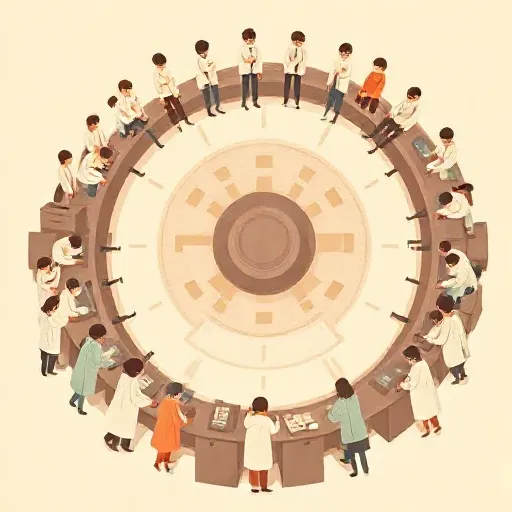
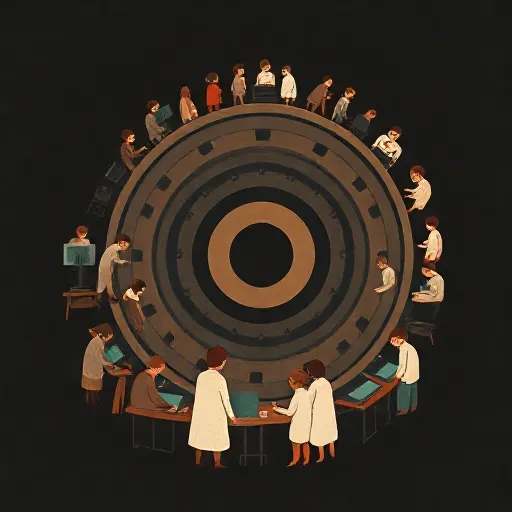
Picture a team of thousands of physicists working on one experiment. Some build detectors, others write code, others analyze data. Each group is an expert in its own tiny slice of the project. But no single person knows how every piece fits together. They have to trust that the others did their jobs correctly. This is Big Science — the kind of research that took place during the Manhattan Project and continues today in particle physics labs and the Human Genome Project.
In 1985, the philosopher John Hardwig looked at this situation and asked a sharp question: if no one scientist has all the evidence, how can the group claim to know the result? Either the whole team knows, but no individual does, or a scientist can “know” something secondhand without holding the evidence. Hardwig called this second idea vicarious knowledge, and it made him uneasy. We usually think that knowing requires having your own reasons, not just taking someone else’s word for it.
This puzzle isn’t just about giant labs. It gets at something basic: almost everything we call knowledge depends on trusting other people. You believe that the Earth goes around the sun not because you’ve measured it yourself, but because you were taught by teachers who trusted textbooks written by astronomers. When does that chain of trust break?
Three Thinkers Who Saw Science as a Team Sport

Long before Hardwig, other thinkers already believed that knowledge grows best through social friction. John Stuart Mill (1806–1873) argued in his book On Liberty that all human beings are fallible — we make mistakes. The only way to correct our errors is to let every idea face public criticism. He thought that even a true belief becomes stale if it’s never challenged; criticism keeps our reasons alive. His big claim: knowledge is a collective achievement, not a solo project.
Charles Sanders Peirce (1839–1914) went even further. He proposed that truth is what a community of inquirers would agree on in the long run, after enough investigation and debate. An individual can never reach the final truth, only the group can. Peirce put great faith in doubt and critical interaction as tools for getting closer to that goal.
Karl Popper (1902–1994) shifted the focus to falsification. In his view, science advances not by proving theories right but by trying to prove them wrong. The logical version of this is a simple argument: if a theory predicts something that doesn’t happen, the theory fails. But Popper also stressed the social side — scientists must actively try to knock down each other’s ideas. For him, criticism eliminates false theories rather than improving them. Where Mill wanted friendly debate to sharpen ideas, Popper wanted a survival-of-the-fittest battle where only the sturdy survive.
Trust, Cheating, and the Replication Mess
If science depends so heavily on trust, what stops researchers from cheating? The philosopher David Hull argued in 1988 that scientists guard their reputations fiercely. A scientist who fakes results risks losing grants, collaborations, and prizes. The reward system, he claimed, keeps people honest.
But history tells a messier story. The psychologist Cyril Burt made up data about intelligence and social class, and his fraud went unnoticed for decades. Andrew Wakefield’s 1998 claim linking the MMR vaccine to autism was finally debunked only twelve years later. And many experiments in psychology and medicine turn out to be unreproducible when other labs try them — raising what some call a replication crisis.
Even well-meaning scientists face a deeper problem: inductive risk. When deciding how much evidence is enough to accept a conclusion, researchers make choices. Should they set the bar high to avoid false positives, or lower it to avoid false negatives? These choices aren’t neutral; they can favor safety over caution, or vice versa. The philosopher Heather Douglas showed this vividly with toxicology studies on dioxins. Setting a stricter statistical threshold might protect public health but hurt industry. The decision always involves values, not just pure logic.
Recent scandal cases — from stem cell fraud to hidden drug trial results — show that Hull’s reputation mechanism isn’t enough. Philosophers now use decision theory to model how penalties and rewards shape science, adding parameters like the chance of getting caught. But even the best model can’t erase the knot: trust is unavoidable, and perfect checking is impossible.
Can Science Ever Be Value-Free?
Many of us grow up thinking science is a clean mirror of nature, free from human opinions. Douglas’s work shatters that picture. She distinguishes between direct and indirect roles of values. A direct role would be when a scientist accepts a theory because it aligns with their political beliefs — that’s obviously wrong. An indirect role happens when values shape the threshold of evidence, like deciding how much risk of error is acceptable when lives are at stake. Douglas urges scientists to be transparent about the second kind, but critics say the line between direct and indirect blurs easily.
Feminist philosophers pushed this conversation further. They noticed that for centuries, science was almost entirely a men’s activity. Could that shape what questions get asked and which answers seem plausible? Evelyn Fox Keller argued that certain ideas, like Barbara McClintock’s discovery of “jumping genes,” were dismissed because they didn’t fit the dominant male-centered framework. Similarly, the assumption that competition drives evolution better than cooperation might reflect social values, not just data.
Today many philosophers agree that the real question isn’t whether science is value-free — it never fully is — but which values help science and which harm it. This has been called the new demarcation problem. It matters because when scientists claim their results are independent of all values, they hide the choices they made, and the public loses the ability to ask hard questions.
Why a Messy, Arguing Community Might Be Smarter
If values and trust shape science, should we worry that truth will get lost? Some philosophers argue the opposite: the social messiness of science can actually make it stronger.
Miriam Solomon introduced social empiricism, the idea that a community can be rational even when its individual members are biased. A researcher might stubbornly cling to an unpopular theory because it explains some odd data. That stubbornness keeps the data alive until the rest of the community can catch up. So long as the group as a whole accepts only theories with unique empirical successes, the system works.
Other thinkers have used network theory to model how scientific communication works. Kevin Zollman showed something surprising: communities where scientists talk only to a few neighbors take longer to reach consensus, but they are less likely to all end up believing a false hypothesis. In dense networks, a wrong idea can spread like wildfire and then become locked in. Zollman points to the case of peptic ulcers: for years, doctors believed stress caused them, while the true bacterial cause was ignored. Slower spread of the dominant view might have allowed the bacterial hypothesis to survive.
This leads to pluralism — the view that multiple competing theories, models, and methods are not a sign of failure but a healthy feature of science. The world is complicated, and no single perspective captures everything. Just as a map can show roads or rivers but not both perfectly, scientific models highlight different aspects of reality. A community that tolerates dissensus, rather than forcing everyone to agree, may end up with a richer, more accurate picture of the world.
What Does This Mean for You?

You’ve probably seen headlines that scream “Scientists say…” followed a month later by “Actually, maybe not.” This can make science seem flaky or even dishonest. But once you understand the social side of science, the confusion starts to make sense — and you can become a smarter questioner.
When you hear that a vaccine is safe, or that climate change is real, you’re relying on a long chain of trust: researchers trusted their team’s data, journals trusted peer reviewers, and you trust the news outlet. Each link is a place where values, honest mistakes, or even cheating could slip in. That doesn’t mean you should distrust everything. It means you should ask questions: Who did the study? Who paid for it? Have other labs tried to replicate it? Is there genuine disagreement among experts, or is one side amplified by loud media voices?
The philosophy of science won’t give you a magic formula for spotting bunk. But it will remind you that truth is a team effort, built through argument, not proclamation. And that’s actually reassuring: the best check on science isn’t one genius, but a messy, arguing, squabbling community that keeps poking at ideas until they either break or hold. Your job is to keep listening — and to keep asking where the evidence came from.
Think about it
- If all the evidence for a scientific claim comes from reports you’ll never personally check, when is it reasonable to believe it — and when is it smart to doubt?
- Suppose a medical study is funded by a company that makes the drug being tested. Could the study still be trustworthy? What would you want to know before deciding?
- Imagine you’re on a science team where everyone must trust each other’s work. One team member finds an amazing result, but nobody else can double-check their method. Should the result be published? What might be the risks of publishing or staying silent?