
Why Would God Reveal Rules You Could Discover on Your Own?
A Sea of Doubt in Old Baghdad

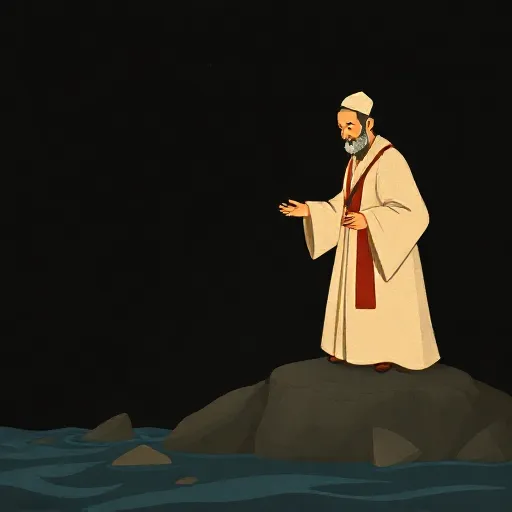
In the year 930, in the city of Baghdad, a rabbi named Saadya ben Joseph (882–942) looked around and felt a deep sadness. He saw people struggling with what to believe. Some had found true ideas but could not feel sure. Others clung to falsehoods, mistaking them for solid ground. Many kept changing their minds, never settling on anything firm. Saadya wrote that these people were like swimmers drowning in a “sea of doubt,” tossed by waves of confusion and unable to reach dry land. He decided to become their diver—the one who would plunge in and bring them to safety. But he knew he needed more than his own smarts. He needed to show how reason and revelation could lock arms and give everyone a firm place to stand.
The Four Ways You Know Anything

Saadya’s big book, The Book of Doctrines and Beliefs, starts with a question: How do humans ever get to truth? He laid out four paths. First, there is knowledge from your senses—the tart taste of an apple, the blue of the sky. Second, there is knowledge from reason—the kind of thinking that tells you two plus two must be four, or that a whole is always bigger than a part. Third, there is knowledge from inference—connecting dots from what you know to what you don’t, like seeing smoke and concluding there is a fire.
Finally, there is knowledge from tradition. For Saadya, tradition is a reliable report handed down from person to person. It is the story your parents tell you about your great-grandparents, or the writings a whole community trusts. Unlike the other three paths, which build step by step, tradition can deliver a whole package of certainty all at once. You do not have to prove it; you receive it. Saadya believed that scripture—the Hebrew Bible—was the ultimate tradition. God knew that people would need to pass the stories and laws along, so He made the human mind able to accept a trustworthy report. In Arabic, the word for revelation literally comes from a root meaning “to hear.” To Saadya, that made perfect sense: revelation is a divine report, something heard and then preserved just like any other tradition. Tradition and revelation were tightly linked.
Laws Your Brain Gets and Laws It Doesn’t

Of all the rules in the Bible, Saadya noticed a fascinating split. Some commandments seem to make instant sense even if you had never heard them from a prophet. Do not murder. Do not steal. Do not lie. Do not commit adultery. Any reasonable person, thinking carefully, would see why these are wrong. Saadya called these the laws of reason—the ones intellect can approve on its own. In Arabic, the term came from the word ‘aql, meaning intellect or reason.
Then there were rules that did not trigger any obvious “yes, that sounds right” or “no, that sounds wrong.” Why is it forbidden to eat certain animals? What makes Saturday a holy day set apart from other days? Why must a priest wear particular clothes and not others? Saadya called these the laws of revelation—literally “laws that are heard,” from the Arabic root sami‘a, to hear. Reason shrugs at them. They arrive through tradition, through a report you trust but cannot independently figure out. Saadya was not the very first Jewish thinker to notice this split, but he was the first to dig into it as a serious philosophical puzzle.
When Revelation Helps Reason—and Reason Returns the Favor

If the laws of reason are so obvious, a natural question pops up: Why did God bother revealing them? Saadya gave more than one answer. First, God was being kind. He did not want to leave us flailing around trying to figure out morality the hard way. Revealing the moral basics was a merciful shortcut. You still needed to use your mind, but the path was lit from the start. Second, by putting the obvious rules into the revealed law, God turned ordinary good behavior into acts of obedience that He could reward. If you already know you should not steal, doing the right thing is good. But if you also do it because God commanded it, Saadya argued, you get a double helping of happiness—like earning a prize for something you would do anyway. Reason judges that a bigger reward is better, so God’s plan was, in fact, supremely reasonable.
What about the laws of revelation—the ones that make no immediate sense? Surprisingly, Saadya tried to find reasons for those too. He thought God gave them to create extra opportunities to serve Him and earn even greater rewards. And he offered specific explanations for puzzling rules. For example, the dietary laws that forbid eating certain animals: he suggested they prevent people from worshipping animals—after all, you would not worship something you eat or call unclean. Whether you find that convincing or not, Saadya was showing that even the “heard-only” rules could be looked at through the lens of reason.
Revelation also helped reason by filling in missing details. Reason might tell you “be grateful to God,” but it does not spell out exactly when, in what posture, or with what words. That is where the tradition passed down from prophets and rabbis came in—providing the concrete shape of prayer and practice. So reason got a helping hand from revelation, and revelation, in turn, was defended and explained by reason. The two were not enemies; they were partners.
The Diver Who Needed a Gift from Above
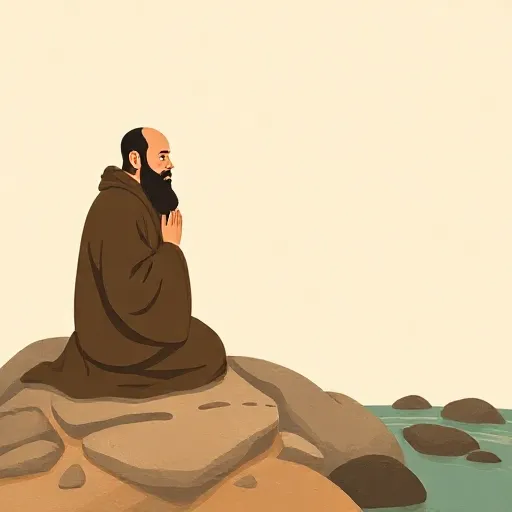
You might think Saadya was purely a champion of independent thinking. But in his own writing, he revealed a humbler foundation. In the very first pages of his book, he described himself as the diver leaping in to rescue the drowning. Then he immediately added that his Lord had granted him knowledge and endowed him with ability. He saw his own understanding not as something he built brick by brick, but as a gift from above. His voice, he said, was the voice of one who had been taught—by God.
This pattern appears throughout his work. Every line of reasoning is paired with a verse from the Bible, a prooftext. Even when he is making a purely logical argument, a scripture quotation stands beside it like a grounding anchor. For Saadya, this was not just decoration. It showed that reason, at its deepest level, rests on revelation. Faith runs underneath the whole project. A later Jewish philosopher, Moses Maimonides (1138–1204), criticized this style, saying it looked more like dressing up pre-chosen beliefs in fancy reasoning than truly free thinking. But Saadya would likely reply that there is no shame in starting with trust in what you have been given and then using your mind to understand it better.
Why This Puzzle Still Matters

You might not live in 10th-century Baghdad, and you might not spend your days sorting biblical laws. But Saadya’s tension is yours too. You rely on things you have figured out yourself—like knowing that sharing is fair or that a shaky online claim probably is not true. At the same time, you trust things you have been told: your parents’ rules, what your teachers teach, the stories about your own family. Sometimes the two clash. You might wonder whether a rule at home really makes sense, or whether a tradition you have always followed is genuinely good.
Saadya did not solve the puzzle once and for all. But he showed that it is possible to hold both reason and trusted tradition together, each checking and supporting the other. He believed you could be both a thinking person and a receiving person, and that certainty—about life, about right and wrong—comes from letting them work in partnership. Almost a thousand years later, we are still arguing about exactly how.
Think about it
- Saadya thought tradition is reliable because it comes from trustworthy people who heard it from others. But what if the very first person in the chain made a mistake? Could you ever be absolutely sure of something that has been handed down for centuries?
- Suppose you figured out a rule all by yourself (like “do not spread rumors”)—would you follow it more happily than a rule you have been told to obey without understanding why? Why or why not?
- Saadya believed God gave extra commandments simply to give people more chances to earn rewards. Does that make obeying feel like a genuine choice, or does it turn morality into a points game?