
The Philosopher Who Hid His Deepest Ideas in Plain Sight
A Hundred Subjects, One Question

Imagine you are a student in Baghdad, over a thousand years ago. Your teacher expects you to study grammar, poetry, arithmetic, astronomy, music, logic, and law. You might grumble, “Why must I learn all these disconnected things?” That is exactly the question a great thinker named Abū Naṣr al-Fārābī (10th century) decided to answer—not with a simple lecture, but with a whole blueprint for human understanding.
Al-Fārābī wrote a short book called The Enumeration of the Sciences. In it he arranged every branch of learning into a single ordered map. He started with language—how words work—because without words you could not express any idea. Next came logic, the art of sharp reasoning. Then mathematics, which included music (since he treated sound and rhythm as mathematical patterns). Then natural science, or physics, and after that metaphysics, the study of what lies beyond the physical world. Finally he placed the sciences that guide human life: ethics, politics, and even religious law and theology. Nothing was random. Al-Fārābī believed that all knowledge fits together like the pieces of a carefully designed puzzle.
Logic: A Ladder to Happiness

For al-Fārābī, logic was not just a subject—it was the most important tool a person could own. In his map of knowledge, logic comes right after language because it teaches us how to build arguments that do not fall apart. He divided human reasoning into four types, each useful in its own way.
The highest kind was demonstrative discourse. This uses airtight proofs that start from certain, universal truths and end with conclusions that cannot be doubted. Only philosophy, he thought, could truly be demonstrative. Then came dialectical discourse, the sort used by Muslim theologians (the mutakallimūn) to debate without claiming absolute certainty. Below that were rhetorical discourse, which persuades through emotional appeals and vivid images, and poetic discourse, which stirs the imagination. Al-Fārābī saw that the Qur’ān and other scriptures often speak in rhetorical and poetic language. That was not a flaw: it allowed these texts to move ordinary people who could never follow a philosophical demonstration.
But why climb this ladder at all? Al-Fārābī said that the final purpose of logic is happiness—the kind that lasts. Only a mind trained in logic can grasp reality as it truly is, and only such a mind can reach what he called conjunction with the Agent Intellect, a cosmic source of understanding. We will meet that idea soon.
The Cosmic Ladder: From the One to the Many

If logic is a ladder inside your mind, al-Fārābī also drew a ladder for the whole universe. He combined two big traditions: Aristotle’s (4th century BCE) focus on being as the most basic reality, and Neoplatonic emanation, the idea that everything flows out of a single perfect source like light radiating from the sun.
In works like The Political Regime and The Opinions of the People of the Virtuous City, he described a chain of existence. The First Being, utterly simple and perfect, overflows and produces a first intellect. That intellect, contemplating both the First and itself, generates a second intellect and the outermost sphere of the heavens. The process repeats through ten intellects, each producing a celestial sphere. The tenth and lowest intellect is the Agent Intellect, which acts as a bridge between the eternal realms and our changeable world.
For al-Fārābī, the human mind begins as a blank slate. Through experience it becomes an actual intellect, grasping particular things. Eventually, if it ascends far enough, it can become an acquired intellect and make contact with the Agent Intellect. That contact, or conjunction, is the highest happiness a human can reach—a state where your mind reflects the order of the cosmos. Whether al-Fārābī believed this contact made the soul immortal was a puzzle we will explore.
The Virtuous City and the Philosopher-Prophet
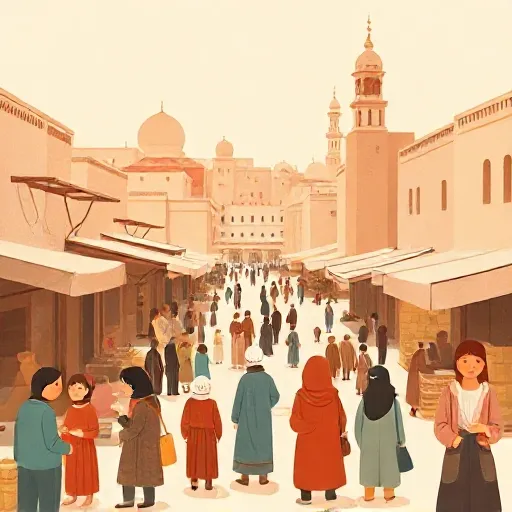
Al-Fārābī did not stop at mapping the cosmos; he wanted to map the perfect society. Taking hints from Plato’s (5th–4th century BCE) Republic, he imagined a virtuous city where every citizen does the work for which they are best suited, just as the organs of a healthy body cooperate. The city’s structure imitates the cosmic hierarchy: the ruler corresponds to the First Being, the philosophers to the celestial intellects, and so on down to the farmers and artisans.
But his ideal ruler was not simply a philosopher-king. Al-Fārābī added a crucial twist: the ruler must also be a prophet, someone who can translate the truths grasped by reason into vivid images and laws that ordinary people can follow. In this way, religion and philosophy are not enemies but partners. Philosophy gives the bare truth; religion wraps it in stories and commands that shape a community’s habits and morals. That is why he placed theology (kalām) and Islamic law (fiqh) at the end of his classification—they are practical tools, not the highest science.
He also imagined this city as vastly larger than a Greek city-state. It would be an empire open to many languages, cultures, and earlier religions, united by wisdom rather than force. This was a bold vision in 10th-century Baghdad.
The Hidden Message: Two Kinds of Book?

Many scholars accept that al-Fārābī’s system is a genuine synthesis of Aristotle and Neoplatonism. But a powerful alternative reading, first championed by the political philosopher Leo Strauss (20th century), claims that the surface of al-Fārābī’s texts is a clever disguise. According to this view, the whole edifice of emanations, intellects, and the afterlife is exoteric—a teaching for the public meant to seem pious—while the esoteric truth, hidden between the lines, is that only rational philosophy deserves belief and that religious talk is merely a useful political tool.
The strongest evidence for this comes not from al-Fārābī himself but from three later Andalusian philosophers: Ibn Bājja, Ibn Tufayl, and Averroes (12th century). They all referred to al-Fārābī’s lost Commentary on the Nicomachean Ethics. In that commentary, they reported, he flatly denied that the human soul lives on after death and dismissed the idea of conjunction with the Agent Intellect as a fable. Yet in his popular works like The Virtuous City, he speaks of the soul’s survival as a real goal. If the Andalusians read him correctly, then at least on these crucial points his public and private teachings pointed in opposite directions.
Not everyone agrees. Some scholars argue that the lost commentary may have been a report of Aristotle’s own views, not al-Fārābī’s. Others say that a true philosopher could believe that some truths must be expressed differently for different audiences without being dishonest. The controversy remains alive and far from settled.
Why This Old Puzzle Still Matters

Al-Fārābī’s project might seem like a dusty relic of the Middle Ages. But think about your own day. You learn science that tells you the world is made of atoms and forces. You hear stories that say being a good person matters. You might listen to music that makes you feel things words cannot describe. Are these separate islands, or do they somehow point toward a single true picture? Al-Fārābī spent his life trying to show that they can be woven together.
The controversy about his hidden messages raises a deeper worry. How often are the “facts” we are told in public actually simplified versions meant to keep things calm? Do some truths need to be sugar-coated or even concealed so that society does not fall apart? No one thinks you should start writing secret codes, but noticing that ancient thinkers wrestled with such problems reminds you to ask, “What am I not being told, and why?”
Al-Fārābī’s answer—whatever his real one was—still echoes. Maybe all knowledge really is one beautiful structure. Maybe some parts are built with careful logic, others with images and rhythm, but the whole thing belongs together. If he was right, every subject you tackle is a step not just toward a grade, but toward understanding the universe and your place in it.
Think about it
- If a perfect ruler could be both a great scientist and a persuasive religious leader, would you trust that person to decide what truths to share with the public and what to keep hidden? Why or why not?
- Al-Fārābī thought music, math, and political justice were connected. Can you think of a song or piece of art that made you understand an idea better than a textbook could? Does that mean art is another way of knowing, or just a feeling?
- Could it ever be right for a philosopher to write “popular” works that she does not fully believe, in order to protect people from ideas they are not ready for? What might be the dangers?