Could Consciousness Be What the Universe Is Made Of?
What Physics Never Tells You
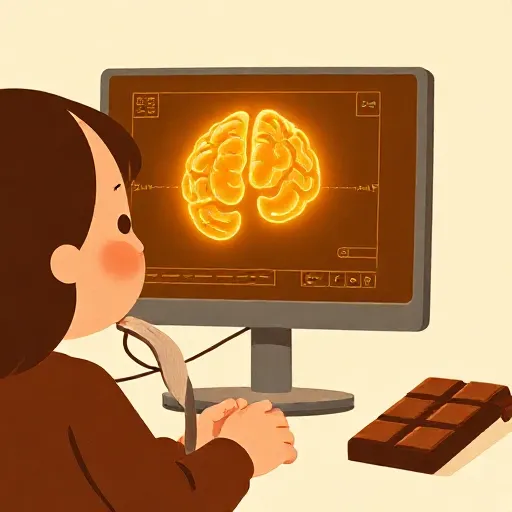
Imagine you look at a brain scan of someone tasting chocolate. You see neurons firing and chemicals flowing from point to point. But you do not see the taste of chocolate — the rich, sweet, slightly bitter sensation itself. Physics describes the dance of particles, the push and pull of forces, the coordinates in space and time. It never describes what the world feels like from the inside.
Many philosophers believe physics gives us only structure. That is, physical theories tell us how things relate to one another — how a particle attracts another, how energy transfers, how mass resists acceleration. Mass itself, they say, is just a label for a set of tendencies: a particle with mass tends to be accelerated by certain forces. The what that has those tendencies is never described. This view is called structuralism about physics. It is like having a huge instruction manual for a city’s traffic flow, but never a single picture of the buildings, the streets, or the stuff they are made of.
If physics is only structure, then something else must provide the actual substance. Think of a video game character: you can define it by hit points, speed, and armor ratings, but those numbers don’t tell you what the character really is — a hero made of pixels, code, and light. Many philosophers say the real world must also have hidden properties that fill the structural skeleton. They call these properties quiddities, from a Latin word for “whatness.” Quiddities are the non-structural features that ground the tendencies physics describes, like the solidity of a brick that makes it impenetrable, not just the fact that it resists penetration.
The Wild Idea: Could That Hidden Stuff Be Consciousness?
The really bold move is this: what if quiddities are the same thing as consciousness? That is the core of Russellian monism. The theory is named after the philosopher and mathematician Bertrand Russell (1872–1970), who suggested that the inner nature of matter might be made of the same kind of stuff as our own sensations. Instead of leaving a ghostly mind detached from the physical world, Russellian monism says the physical world already has an inner side, and that inner side is conscious experience — or at least the building blocks of it.
There are two main varieties. Russellian panpsychism holds that quiddities are tiny bits of full, familiar consciousness — what it feels like to sense brightness, pressure, or warmth — only at the micro-level. These microphenomenal properties would be incredibly simple, nothing like a whole thought or a full-blown pain. They would be more like a faint, primitive hum of being. Because they exist in every fundamental particle (pan- means “all”), consciousness is everywhere.
By contrast, Russellian panprotopsychism holds that quiddities are protophenomenal properties — special features that are not themselves conscious at all, but that can combine to form full consciousness when arranged in the right structure, much as letters, which are not stories, can be arranged into a novel. This avoids the claim that a single electron is feeling anything, while still making consciousness a natural part of the physical world.
Russell himself wrote in 1927 that what we know about matter is its structure, and that the stuff doing the relating might be what he called “percepts” — the raw sensations that make up our experience. Later, in the late twentieth century, philosophers like Michael Lockwood and Galen Strawson revived and sharpened these ideas.
From Leibniz to Kant: An Ancient Suspicion
Long before Russell, a few towering philosophers already suspected that the physical world might have a mental inside. Gottfried Wilhelm Leibniz (1646–1716) argued that matter, as described by Descartes, was nothing but extension — length, breadth, depth — which is just a set of spatial relations. He insisted that any real thing must have some absolutely intrinsic property, not merely relations, and he thought the ultimate reality consisted of mind-like “monads” whose inner life was a kind of perception and appetite.
Immanuel Kant (1724–1804) agreed that the physical world we know is only appearances — a web of relations. But he said we can never know the “things-in-themselves” that ground those appearances. Even so, he thought those hidden things must have some absolute inner nature, and he hinted that they might underlie consciousness, though we cannot say how.
Arthur Schopenhauer (1788–1860) went further, claiming that the inner nature behind the world of appearances is will — a blind, striving impulse akin to what we feel inside our own bodies. Though their vocabularies differed, all three can be read as early Russellian monists.
Why It’s an Attractive Solution
Russellian monism seems to solve two deep puzzles in one stroke. First, it gives a foundation to physical structure: the quiddities are what underpin the tendencies physics describes. Second, it integrates consciousness into physical causation. Your pain, your seeing red — these are not spooky extra things hovering above your brain. They literally are the inner nature of some physical processes. So consciousness does real work in the world without needing mysterious new forces.
This also helps answer famous anti-materialist arguments. Consider the zombie argument: we can imagine a world physically identical to ours but with no consciousness at all — everyone is a zombie. If such a world is possible, then consciousness must be something over and above the physical. Russellian monists reply that a true zombie world would have to duplicate all structural features and all quiddities. But if quiddities are consciousness (or its building blocks), then such a world is impossible. You can imagine a structural zombie — a world that copies only structure — but that just shows structure alone doesn’t give you mind, which the Russellian monist already accepts.
Or take the knowledge argument about Mary, a scientist who knows every physical fact about color but has never seen red. When she leaves her black-and-white room, she learns something new: what red looks like. Russellian monists say that Mary’s physical knowledge was incomplete because she only knew the structural facts, not the quiddistic ones. The new things she learns are still physical — they are the inner, non-structural properties of seeing red — so physicalism can survive.
The Combination Problem: Pixels into Pain?
The biggest challenge for Russellian monism is the combination problem. If quiddities are micro-phenomenal properties — tiny specks of proto-feeling — how do they merge to form a single, unified experience like the pain of a headache or the smooth blueness of the sky? It seems possible that all those micro-quiddities could exist without anyone having any larger experience at all. That possibility suggests that macro-experience is not simply made of smaller ones.
A related difficulty is the subject-summing problem. If each fundamental particle has its own micro-subject, how do those tiny subjects combine to form one big subject — you? Putting a hundred little minds together does not automatically give you one big mind, any more than putting a hundred tiny hearts in a jar makes one large beating heart.
Some Russellian monists reply that our inner awareness of experience might simply fail to reveal its composite nature. Just as a taste of lemonade can seem simple even though it is made of sweet, sour, and cold, maybe the unity of consciousness hides a deep structure of quiddities. Others argue that the problem is not fatal because we just don’t yet understand the kinds of fusion that might be involved. But so far, no solution satisfies everyone.
Why You Should Care

Russellian monism remains one of the most exciting ideas in philosophy today. If it is even partly right, then your own consciousness is not a mysterious extra in a clockwork universe. It is woven into the very fabric of reality. The red of that sunset, the pang of a sad memory, the coolness of water on your skin — these might be glimpses of what the universe really is, on the inside.
No one yet knows whether Russellian monism will prove correct. Perhaps consciousness is something entirely different. But the view forces us to ask a deeper question: is the world just a giant web of relations, or does it have a hidden inner life? And if it does, maybe the thing we call “mind” is not a tiny island but the whole continent.
Think about it
- If every particle had a tiny, primitive kind of feeling, would a rock have a mind? How could we ever find out?
- A perfect scientist knows every structural fact about chocolate. When she finally tastes it, does she learn something genuinely new? If so, what is that new thing?
- If your own mind is just the inner side of physical stuff, does that make you more a part of nature — or less free?