Is the World Still There When You Close Your Eyes?
Lying in bed, staring at the moon

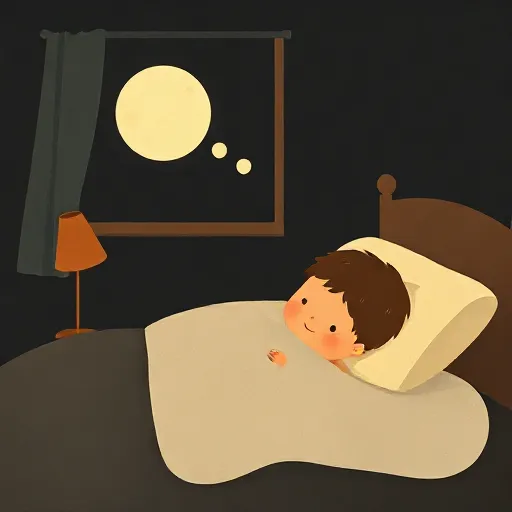
You crawl under the covers and turn off the lamp. Through the window, the moon is a silver coin. You shut your eyes. The room disappears. But is the moon still up there? Does it keep shining when nobody sees it?
That old riddle isn’t just for bedtime. For centuries, philosophers have debated a much bigger version of it — not just about the moon, but about everything. Rocks, numbers, the laws of physics, the shape of a dinosaur’s foot. If every mind in the universe vanished, would any of those things still be real? And how would we ever know?
The world that doesn’t need you

The view that the world exists just as it is, whether or not anyone thinks about it, is called metaphysical realism. Realists believe that objects, their properties, and the laws that link them all form a structure that is completely independent of our minds. Your idea of a rock and the rock itself are two different things. If every human fell asleep and never woke up, the rock would still be there, heavy and gray.
Realism isn’t just about physical stuff. Realists about numbers, for instance, say that the number 7 exists just as solidly as the rock, and it doesn’t need anyone to count in order to be real. Realists about the laws of nature say that gravity pulled things to the ground long before Newton thought about it, and would keep doing so even if science never existed.
Notice the key idea: mind-independence is about whether something exists, not about how we find out. The moon is still there when you blink, even though your experience of seeing it blinks away. To a realist, even if our grandchildren decided that mountains are illusions, the mountains would still be there, silently disagreeing.
If no one can ever check, is there a fact?

Here’s a challenge, raised most famously by the philosopher Michael Dummett (1925–2011). Think about this sentence:
Socrates sneezed in his sleep the night before he drank the hemlock.
We have no way to investigate this. No ancient scroll records it. No time machine can take us back. Yet a metaphysical realist insists that the sentence is definitely either true or false, and always was, even if we can never know which. This is called the law of bivalence: every meaningful, non-vague statement is either true or false.
Dummett pushed back. How, he asked, did we ever learn to understand a sentence like that? Normally, you learn the meaning of a word by connecting it to something you can observe or experience. But this sentence refers to a state of affairs no one can ever detect. If truth can float totally beyond our reach — what philosophers call verification-transcendent truth — how does a child ever figure out what the sentence means? How does anyone show that they truly grasp it?
Anti-realists like Dummett argue that the meaning of a sentence is completely tied to how we use it in public — the conditions under which we’re allowed to assert it, to argue for it, to doubt it. And when we look at our actual language habits, we find that speakers rely on shared evidence, not on secret links to invisible truth-makers. The realist seems to be imagining a connection between our words and a hidden world that nothing in our behavior could possibly reveal.
Realists have a reply: we understand the Socrates sentence by understanding its parts and how they are put together, not by inspecting the ancient past. You know what “Socrates” means, you know what “sneezed” means, and you know how to combine them. From there, the whole sentence is as understandable as saying “I sneezed in my sleep last night.” This is the compositionality reply. The fact that we can’t check the truth value doesn’t mean we don’t know what would make it true or false.
The argument isn’t settled. Anti-realists think that accepting verification-transcendent truth makes us imagine a reality full of spooky, undetectable facts, and they claim we only think we understand such talk because we overgeneralise from cases where we can check. Realists counter that we talk easily about uncheckable facts all the time — for example, that the exact number of dinosaurs that ever lived was either odd or even. This feels trivially true, and even young children seem to grasp it.
Are you a brain in a vat?
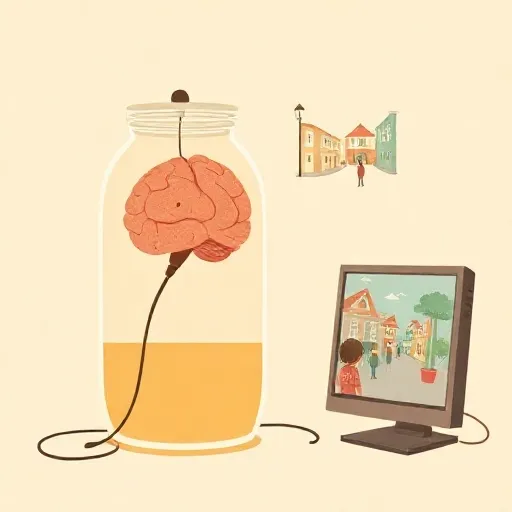
Hilary Putnam (1926–2016) made the debate even wilder. Suppose a mad scientist removed your brain and kept it alive in a nutrient bath, connected to a supercomputer that sends perfectly realistic signals — making you think you have a body, friends, and a whole world around you. You’d be a brain in a vat. Could you ever know you weren’t? A realist who believes in mind-independent reality has to say yes, it’s at least possible that everything you experience is a dream with no way to wake up.
Putnam tried to prove that this nightmare scenario is actually impossible. His argument relies on a view about language called semantic externalism. According to externalism, the meaning of your words isn’t just determined by what’s inside your head; it depends on your actual history with the outside world. Imagine a twin Earth where everything is identical except that the clear liquid called “water” is made of XYZ rather than H₂O. When you say “water,” you refer to H₂O; when your twin says “water,” they refer to XYZ. The word means something different because the stuff in the environment is different.
Now apply this to the vat. If you really were a brain in a vat, your word “brain” wouldn’t refer to real brains — it would refer only to the virtual brains in your computer-generated illusion. So the sentence “I am a brain in a vat” would, in that situation, mean something like “My virtual self is a virtual brain,” which is either false or refers to something completely different. Putnam concluded that the statement “I could be a brain in a vat” can never be true from your own point of view. He argued this shows realism leads to an incoherent possibility.
Many philosophers think Putnam’s argument doesn’t quite close the door. Just because you can’t conceive of being a brain in a vat if you are one, that doesn’t prove it’s impossible. You might still be a brain in a vat, even if you’d never be able to describe it correctly. Yet externalism remains a powerful idea: it suggests that our thoughts depend on the world outside us in ways that make radical skepticism harder to sustain.
When words can mean too many things
Putnam launched a second, more technical attack on realism: the model-theoretic argument. Imagine a perfect scientific theory — one that captures absolutely every fact we could ever gather and makes every correct prediction. How could such a theory be wrong about the world? The realist must say it’s possible: maybe the words in the theory just don’t hook onto the real objects out there.
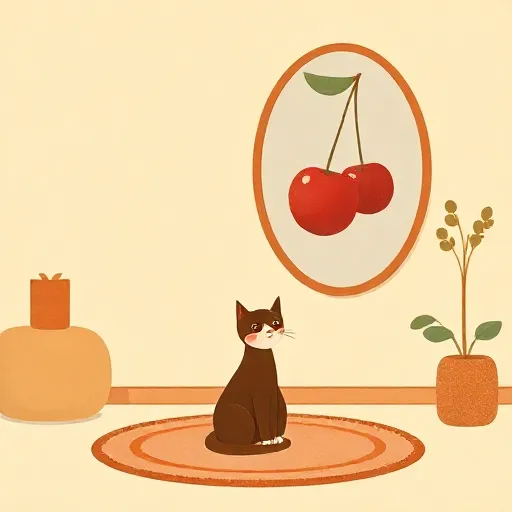
But Putnam showed that if a theory is logically consistent and the world contains enough things, we can always reinterpret the theory’s words so that every sentence comes out true, no matter how the world really is. For instance, take the sentence “A cat is on a mat.” Suppose, in every possible world, we secretly reassign the word “cat” to mean cherry and “mat” to mean tree. Then “A cat is on a mat” would still be true exactly when it was before, even though the words now pick out different objects. You can permute the reference of every word in this way, creating an infinite number of interpretations that all make the theory true. So how can the realist claim there is one intended meaning, the one that matches how things really are?
Realists fire back: making a description of a constraint come out true is not the same as genuinely meeting that constraint. If I say “the word ‘cat’ must refer to cats,” the tricky reinterpretation will simply make that very sentence mean something else, so that it seems satisfied — but the actual connection is still wrong. The intended model isn’t just any model that makes the theory look correct; it’s the one where reference is the real, genuine relation we can’t fully define from inside the language. Whether that reply works is fiercely debated; the argument has forced everyone to think hard about what it means for a word to really refer to something.
Why it still matters

These arguments are not just puzzles for dusty books. They touch how you think about truth every day.
When your teacher says that an event in history definitely happened a certain way, even though no one alive saw it, that’s realism at work. When a scientist claims that the Big Bang happened 13.8 billion years ago, that’s realism about a past we can never visit. When you believe that your best friend’s secret thought — something they will never tell anyone — is either true or false, you’re siding with the realists. Without such a belief, a lot of ordinary talk about facts starts to wobble.
But anti-realists remind us to be humble. They ask us to notice when we’re pretending to have knowledge we can never get. Are we comfortable saying there are true-but-forever-hidden facts about who did what a thousand years ago? Or does our concept of truth only make sense where there is, at least in principle, some way to find out?
The debate hasn’t ended. Even today, philosophers argue about whether questions like “how many objects are in this bag?” have a single correct answer or just depend on the words you choose to describe it. That’s the living spine of the realism/anti-realism fight. Lying in bed, you can still wonder — and that’s the whole point.
Think about it
- If two detectives believe they have the right suspect, but one has solid evidence and the other just a hunch, is the case equally decided in both worlds? What if the truth is something no one will ever uncover?
- Imagine a universe where everyone agrees numbers don’t exist. If a star explodes and creates three new planets, are there really three of them, or does counting require a mind?
- If a machine could predict every choice you’ll ever make, would it still make sense to punish someone for a bad decision? What if your choice was determined before you were born?