
Does the World Still Exist When No One Is Looking?
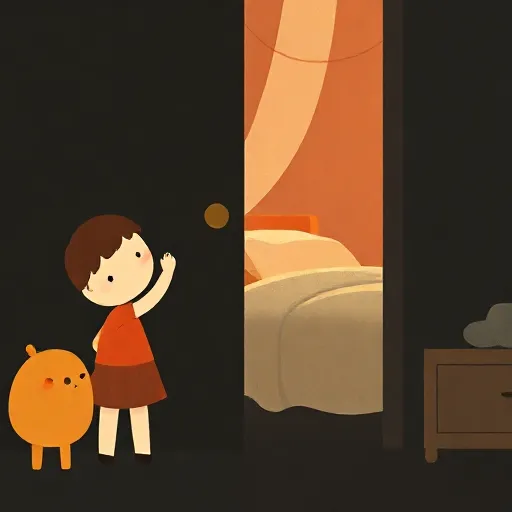
What if your room disappears the moment you leave?

You walk out of your room, shut the door, and head to school. The bed, the books, the lamp on your desk — are they still there, solid and real, while no one is looking? Your gut says yes. Of course they are. But how do you know? Could the whole world just be a kind of dream that exists only while someone perceives it?
An Irish philosopher named George Berkeley (1685–1753) spent most of his life arguing that the familiar world of houses, trees, and rivers is made entirely of ideas — and that nothing exists unless it is being perceived. His famous slogan was esse est percipi: to be is to be perceived. That sounds impossible. But Berkeley thought it was the only way to avoid a worse problem: that we can never truly know what real things are like.
The attack on the ordinary view

Most people, and most philosophers in Berkeley’s day, believed that material things exist outside our minds. These things — stones, mountains, apples — are supposed to be mind-independent: they would exist whether or not anyone was thinking about them. Berkeley thought this belief leads straight to skepticism (the fear that our senses lie to us) and even to atheism (because a material world could run on its own, without God).
To attack materialism, he started with a short, powerful argument. Look at an apple. What do you actually perceive? You see a certain colour and shape; you feel a smooth, cool surface; you taste sweetness and smell a fruity scent. All of these are ideas — the immediate contents of your senses. Berkeley pointed out that you never perceive anything besides your own ideas. So, he concluded, ordinary objects like apples are nothing but collections of ideas.
But wait. His opponents — especially René Descartes (a 17th‑century French philosopher) and John Locke (an English philosopher of the same period) — agreed that we directly perceive only ideas. Yet they still believed in material objects. How? They thought ideas represent material things. You see a colour‑idea that resembles the real colour on the apple’s surface. This is called representationalism.
Berkeley hit back with the likeness principle. He insisted that an idea can be like nothing but another idea. How could a colour‑idea, which exists only in a mind, resemble a completely mind‑independent object? You cannot compare the two, because you can never get outside your own mind to check. So the supposed resemblance is meaningless, Berkeley said. If materialists cannot say what matter is like, they are talking about nothing at all.
The master argument (and why many think it fails)

Berkeley had another argument he loved — so much that he once said he would put the whole debate on it. Try this: close your eyes and imagine a tree standing alone in a forest, with no person anywhere near it. You can do it easily. But Berkeley would say you are tricking yourself. The tree you imagine is still an idea in your mind. You cannot actually conceive of a tree that exists without any mind thinking of it, because to conceive of it, you must be thinking about it. So the idea of an unperceived object is a contradiction.
Most philosophers today think this argument goes wrong. When you imagine a tree alone in a forest, you are thinking of a tree that is unthought‑of. The content of your thought is a tree with no mind around it, even though the thinking process happens in your mind. It is like drawing a picture of an empty room — the paper isn’t empty, but the room in the drawing is.
Still, Berkeley’s version of the argument is more subtle. He believed you cannot meaningfully represent “unperceivedness” because you have never experienced it. But that version relies on representationalism again, so it wouldn’t worry someone who says we perceive things directly.
If everything is ideas, how does the world stay solid?

If objects are just bundles of ideas, why doesn’t the world feel like a chaotic daydream? Berkeley’s answer depended on two kinds of things: spirits and laws. Besides ideas, he said, there are spirits — active minds that perceive and will. Your own mind is one finite spirit. God is an infinite spirit.
Sensory ideas (the ones you don’t control, like seeing the desk when you open your eyes) are caused by God acting according to regular patterns. Those patterns are the laws of nature. The world is orderly because God, who is wise and benevolent, follows set rules. That is why a watch has an internal mechanism: not because the gears cause the hands to move (only spirits truly cause things), but because God has chosen that whenever you open the watch, you will have ideas of that mechanism. Science, in Berkeley’s view, isn’t about hidden material causes — it is about discovering the regularities in your ideas.
This also helps with a stubborn problem: the tree in the quad at 3 a.m. when no student is there. If to be is to be perceived, does the tree pop out of existence? Berkeley sometimes said that unperceived objects continue to exist because God, who sees everything, always perceives them. In his later work, he suggested that objects exist as intentions in God’s will: God decrees that if a finite mind were in the right place, it would have a tree‑idea. This keeps things stable without requiring God to have exactly the same colour‑ideas you do (which would be odd, since God does not have sensory experiences like ours). Even so, many readers find it puzzling: does the tree really exist continuously, or only in a “hypothetical” way? Berkeley’s system keeps the world predictable, but it pushes common sense about as far as it can go.
Why this still matters

You have probably played a video game where the on‑screen world appears only when your character is nearby. A hallway exists as data on a server, but it is only rendered — brought to life — when a player looks at it. That sounds a lot like Berkeley’s universe: things are there when perceived, and their stable existence depends on a hidden mind (the game’s code or a divine programmer).
Berkeley forces you to ask: what does it really mean to exist? If every direct experience you have is mental, how could you ever prove there is a solid world outside your mind? He didn’t think you could — but he thought you didn’t need to. The world of everyday life, he insisted, is perfectly real as a world of ideas sustained by God. Whether or not you accept his answer, his challenge has kept philosophers awake for three centuries. Next time you walk out of your room, you might wonder what holds it together while the door is closed.
Think about it
- If a scientist could perfectly predict every idea you will ever have, would that make the world any less real?
- Can two people ever truly see the same tree, or does each person have a private world of colour‑ideas that can never be shared?
- If you lived in a perfectly realistic simulation that never glitched, could you ever know it wasn’t the real, solid universe? Should you care?