
Can Something Be Real Even If You Can’t See It?
Is Your Bed Still There When You Shut the Door?

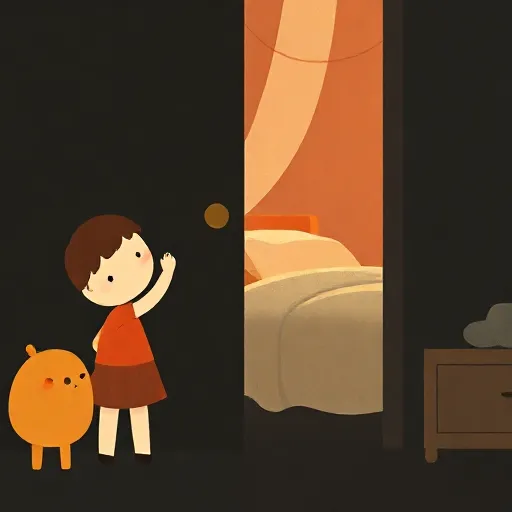
Imagine walking out of your room and closing the door behind you. You can no longer see the bed, the desk, or the pile of books. Do those things still exist? Almost everyone would say yes. But how do you know? You might say you remember them, or you trust that they are still there. A philosopher named George Berkeley (1685–1753) took a much more radical view. He argued that objects like beds and tables are not independent things at all — they are simply ideas in the minds of people who experience them. When nobody perceives a chair, it doesn’t exist. As Berkeley put it, “all the choir of heaven and furniture of the earth … have not any subsistence without a mind.”
This is a form of idealism, the view that the everyday world of objects is mental, not mind-independent. For a realist about everyday things, this is shocking. A realist holds that tables, rocks, and mountains exist, and that their existence and properties do not depend on anyone’s beliefs, languages, or thoughts. Berkeley’s idealism directly attacks the independence that realists claim for the world. Most philosophers today reject idealism, but his challenge still forces us to ask: how can we be certain that the world exists when we aren’t looking?
Is Wrongness a Fact, or Just a Feeling?

Now shift from tables to right and wrong. Consider the sentence “Stealing is wrong.” A moral realist says this sentence can be true, and its truth does not depend on what anyone believes. The fact that stealing is wrong exists independently of our minds, just as a realist thinks the table does. But J. L. Mackie (1917–1981) argued that moral facts, if they existed, would be incredibly strange. He defended error-theory: the view that atomic moral sentences like “Stealing is wrong” are systematically false because there are no objective moral facts to make them true.
Mackie claimed that our concept of a moral fact is the concept of something objectively and categorically prescriptive. That means a moral fact would tell you how you must act, regardless of your own desires or goals. If torturing innocent people is wrong, then you have a reason not to do it whether you want to or not. This is different from a merely practical rule like “If you want to keep your job, don’t be late every day” — you can release yourself from that by simply not caring about the job. Mackie’s conceptual claim is that moral requirements are supposed to bind you no matter what.
His real knockout punch is the argument from queerness. Objective moral values would have to be utterly different from everything else in the universe: they would have “to-be-pursuedness” or “not-to-be-doneness” built into them, as if the situation itself demanded a certain action. Moreover, to know about such weird things, we would need a special faculty of moral intuition, unlike ordinary seeing or reasoning. Mackie finds both the metaphysical weirdness and the epistemological weirdness unacceptable. So he concludes there are no objective, categorical facts of the sort morality needs. All simple moral statements are false.
“Stealing Is Wrong” — a Statement, or a Shout of Disgust?

There is another way to reject moral realism without saying that moral sentences are false. Expressivism (also called non-cognitivism) denies that moral sentences are even the kind of thing that can be true or false. According to A. J. Ayer (1910–1989), when you say “Stealing is wrong,” you are not stating a fact at all. You are expressing a feeling of disapproval — much like saying “Stealing!” in a special tone of horror. The sentence doesn’t have a factual meaning; it simply vents an emotion.
This avoids Mackie’s picture of a world full of false claims. But expressivism faces a famous obstacle called the Frege-Geach problem. Think about an argument like this:
- Murder is wrong.
- If murder is wrong, then getting your little brother to murder people is wrong.
- So, getting your little brother to murder people is wrong.
If “murder is wrong” in (1) merely expresses a negative feeling, what does it mean in the “if” part of (2)? There, you are not expressing a feeling — you are entertaining a possibility. For the argument to be valid, the phrase must mean the same thing in both places. But an expression of feeling doesn’t seem to fit inside an “if” clause. That would be like trying to fill a test tube with a scream. So expressivists have to explain how moral language can work in logic without secretly being truth-apt. This is a deep puzzle, and philosophers like Simon Blackburn and Allan Gibbard have spent decades crafting solutions.
The Numbers in Your Head — Are They Out There?
Morality isn’t the only place where realism gets challenged. Consider a simple arithmetic claim: “7 is prime.” A platonic realist about numbers says that the number 7 is a real object — but not a physical one. It is an abstract object: it has no location in space or time, and it cannot bump into anything. The truth “7 is prime” depends on this abstract object and its properties, and those exist independently of what anyone thinks.
But if numbers are outside space and time, and never cause anything to happen, how can we ever know anything about them? In the 20th century, Paul Benacerraf sharpened this worry: if knowledge requires some kind of causal connection to what you know, then abstract objects seem totally unknowable. Hartry Field, a contemporary philosopher, reframed the challenge. He argued that a platonist cannot explain why mathematicians are so reliable. When mathematicians accept a mathematical sentence p, it almost always turns out that p is true. If numbers are mind-independent and acausal, there seems to be no way — causal or non-causal — to explain this remarkable track record. Field’s conclusion: we should be suspicious of claims to know facts about such a disconnected realm.
Field doesn’t just criticize; he offers an error-theory of arithmetic. He says that sentences like “7 is prime” are actually false, because numbers do not exist. Yet mathematics is still extremely useful, not because it’s true, but because it is conservative. That means combining mathematical theories with ordinary, non-abstract truths never lets you derive a new conclusion about the concrete world that you couldn’t have reached using only the ordinary truths. Mathematics is like a shortcut that makes reasoning easier without inventing any new false claims about chairs, stars, or people. So we can keep using math without believing in the existence of numbers.
Why Does It Still Matter?
These debates are not just dusty quarrels among professors. Whether moral facts exist affects how you think about rules, punishment, and making hard choices. If Mackie is right, nothing is really wrong — we just talk as if it were. Yet we still feel that hurting innocent people is different from breaking a rule about being on time. If expressivism is correct, our moral language is a tool for coordinating feelings, not for discovering a hidden moral universe. But then we must face the Frege-Geach problem and ask whether our arguments about right and wrong can hang together.
The case of numbers matters, too. If platonism is false and arithmetic is an error-theory, does that make your math homework less trustworthy? Not necessarily — math’s usefulness doesn’t require that numbers exist as weird abstract objects. But it changes what you think you are doing when you solve an equation. You might be manipulating a brilliant fiction that helps you navigate the physical world, rather than glimpsing an eternal realm of numerical objects.
And don’t forget Berkeley’s table. Even if idealism seems wild, the question of how much the world depends on our minds still echoes in science. When physicists talk about unobservable particles, they usually assume those particles exist mind-independently. The realism debate forces us to examine what “real” means and how we can ever step outside our own experience to check. As you close your bedroom door tonight, you might pause and wonder: is that bed still there when no one is watching? Philosophy can’t give you a final answer, but it can make you realize that — just for a moment — you aren’t entirely sure.
Think about it
- If everyone on Earth agreed that stealing is fine, would stealing still be wrong? Why or why not?
- Imagine you discovered that the number 7 doesn’t exist as an object. Would math still be a reliable guide for building bridges or sending rockets?
- Can you think of an experiment that could prove the world exists when nobody is looking? If not, does that mean realism is just a guess?