Can a Country Be Strong and Good at the Same Time?
The Strong and the Weak at Melos
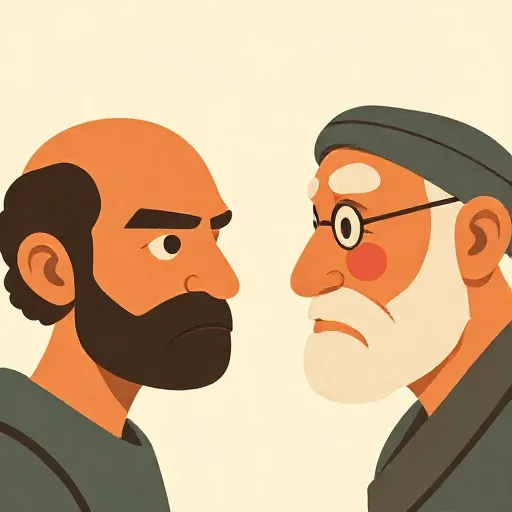
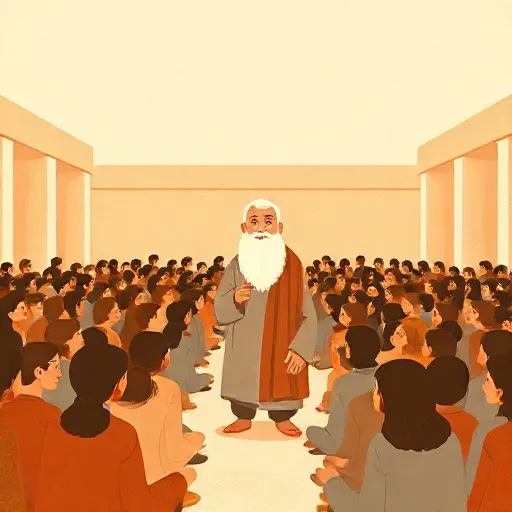
Imagine the year 416 B.C.E. The tiny island of Melos wants nothing more than to stay neutral in a giant war. Its people, the Melians, have never attacked Athens. Yet one morning Athenian warships fill the harbor. Envoys march into the assembly and present the Melians with a terrible choice: surrender and become subjects, or be destroyed. They ask the Melians not to speak of right and wrong. They say that the decisions about justice are only made when both sides are under equal compulsion, but when one side is stronger, it gets as much as it can, and the weak must accept that.
This moment—recorded by the Athenian historian Thucydides (c. 460–c. 400 B.C.E.) in his History of the Peloponnesian War—is one of the most famous confrontations in all of political thought. It launches an argument that has never stopped. When one state holds overwhelming power, must it use that power without worrying about morality? Or do principles of justice still apply, no matter how uneven the forces? The Melian Dialogue puts the big question on the table: Is international politics just a contest of strength, or can it be something more?
Thucydides himself does not simply cheer for the Athenians. He shows both sides. The Melians appeal to fairness, the gods, and their Spartan allies. The Athenians reply with icy logic: in a world without a common authority, only the powerful survive (5.97). In his view, the real cause of the war was something deeper than any particular incident—the growing power of Athens that made Sparta afraid. This “Thucydides trap,” where a rising power rattles an established one, still makes strategists nervous today. But Thucydides also hints that power without moderation or justice leads to ruin. After crushing Melos, Athens overreaches, attacks faraway Sicily, and loses everything. The historian seems to teach that dismissing morality is not just cold—it can be self-defeating.
Machiavelli’s Rude Question

For centuries, political thinkers inherited from Plato, Cicero, and Christian teachers the idea that politics should be governed by virtue. A ruler ought to be just, moderate, and keep his word—to his own people and to other states. Then Niccolò Machiavelli (1469–1527) marched into the conversation and turned that idea upside down. In The Prince, he said he wanted to pursue “the effectual truth of the matter rather than the imagined one.” What really matters, he argued, is what keeps a state strong and its citizens safe, not what looks noble in a book.
Machiavelli separates ethics from politics. Ancient virtue—the moral quality of a person—gets replaced by virtù, a kind of energetic ability to do whatever the situation demands. For him, a prince who insists on being good all the time will soon lose power and bring suffering to his people. Sometimes a leader must break promises, deceive enemies, or even be cruel if that is what survival requires. This is a radically unsentimental version of realism, later called realpolitik: the doctrine that the national interest justifies any means.
Machiavelli never pretended that such actions were morally pure. He admitted they were evil, but he thought they became necessary. Later followers pushed his ideas further, inventing the notion of a “double ethics”—one public, one private—and arguing that the state’s own good was the highest moral law. That shift, over centuries, would be used to justify conquest and even atrocity. Modern realists often try to avoid these extremes. Still, Machiavelli’s blunt challenge remains: if acting morally might cripple your country, which duty wins?
Hobbes’s World of Permanent Insecurity

Thomas Hobbes (1588–1679) gave the realist tradition a different kind of foundation. Human beings, he thought, are driven by a restless desire for “power after power, that ceases only in death” (Leviathan XI 2). Add to this the fact that there is no global government, and you get a terrifying picture. Hobbes called this the state of nature: a condition of anarchy—the absence of a common ruler—where each person has a right to everything and no one is safe. Life in such a state, he wrote, is solitary, poor, nasty, brutish, and short.
What does this have to do with countries? Hobbes mainly wrote about individuals, but he saw the same grim logic operating among states. When people create a government—a sovereign—they escape the war of all against all within their borders. Between states, however, no such escape happens. Countries remain in a permanent state of nature. “For their own security,” Hobbes wrote, they “enlarge their dominions upon all pretences of danger” (XIX 4). Even when the guns are silent, they are disposed to fight.
This idea gave realism two of its core concepts: the anarchic international system and the self-help system. Because there is no world police force, every state must look out for its own survival. It cannot rely on anyone else. Hobbes did not say states should be reckless—he thought reason recommended peace—but he did insist that morality between states has no firm ground. Treaties may be signed, but they are obeyed only as long as they serve the interests of the powerful. That grim view remains the skeleton of modern realist theory.
Realism in the 20th Century: Learning from World Wars
After the slaughter of the First World War, many people believed that sensible institutions and international law could make another great war impossible. They founded the League of Nations and pushed what realists call idealism or liberalism. These idealists trusted reason, international cooperation, and the harmony of shared interests. The peace didn’t hold. The League failed, and the world slid into an even more terrible war. That failure gave realism a powerful boost.
E. H. Carr (1892–1982) delivered one of the strongest realist replies. In The Twenty Years’ Crisis (1939), he tore apart what he called “utopianism.” Morality, Carr argued, is never universal—it always reflects the interests of the dominant groups. The great powers who benefit from the current order call it “just” and preach peace, while the unsatisfied powers call the same order unjust and prepare for war. For Carr, the language of universal values often cloaks self-interest, and order is ultimately built on power, not on shared ideals.
Hans Morgenthau (1904–1980) systematized these insights. In Politics among Nations, he set out six principles of political realism. The keystone is interest defined in terms of power. Whatever their motives or ideologies, political leaders think and act in terms of power. Realism, he insisted, is not amoral. It simply understands the tension between what morality demands and what political success requires. Universal principles “cannot be applied to the actions of states in their abstract universal formulation” but must be filtered through concrete circumstances and prudence—the careful weighing of the likely consequences of any action. A leader who is nothing but a moral idealist is a fool; a leader who is nothing but a power calculator is a beast. Both dimensions matter.
Morgenthau’s framework gave generations of diplomats a way to think about the world, even if many critics noted that his key concept—power—is slippery. Is power a goal in itself, or only a tool? That question would soon be sharpened by a more scientific kind of realist.
The Science of Power: Is Anarchy Everything?

Kenneth Waltz (1924–2013) wanted to turn realism into a rigorous science. In Theory of International Politics (1979), he argued that classical realists like Morgenthau made the same mistake as liberals: they focused too much on individual states, their motives, and their ideologies. What really matters, Waltz said, is the structure of the international system. And that structure is defined by one brutal constant: anarchy. Because there is no higher authority, the system is a self-help arena. All states are functionally similar—each must provide for its own security. The only way they differ is in their relative capabilities, their power.
This neorealism or structural realism changes the story about power. For Morgenthau, rational states seek to maximize power. For Waltz, the fundamental goal is security. The system forces states, even the well-intentioned ones, to worry endlessly about what others might do. They fear that cooperation will give another state a bigger advantage, leaving them dangerously dependent. So even when everyone would benefit from working together, the system pulls them toward competition.
Waltz’s theory was elegant and influential. But critics quickly spotted problems. He predicted that a bipolar world of two superpowers would remain stable, yet the Cold War order collapsed soon after. Others pointed out that neorealism could not explain change: it froze international politics into an unchanging cycle. Constructivists like Alexander Wendt argued that anarchy does not automatically force states into self-help. “Anarchy is what states make of it,” Wendt wrote. Shared ideas and identities can reshape interests. A world dominated by diplomatic habits and international law is possible—not just a permanent Hobbesian jungle. In short, realism’s skeleton was too rigid to account for the real messiness of global life.
Why This Debate Never Ends

Picture a playground with no teacher on duty. You and your friends want to play a fair game. But someone bigger could grab the ball and set the rules by force. Without a referee, do you have to become tough enough to protect yourself, even if that means pushing others around? That small-scale dilemma is the same one realism places at the center of world politics.
Realism’s cautionary voice is something we need. It reminds us that good intentions without power can be helpless, and that pretending self-interest doesn’t exist often benefits the already powerful. At the same time, a world run on pure “might makes right” is a world of permanent fear—just as the Athenians learned when their empire collapsed. Most classical realists, from Thucydides to Morgenthau, knew this. They argued for prudence and for paying attention to moral consequences, not for a cold race to dominate.
Today’s headlines keep the debate alive. When a rising power hits a ruling one, the “Thucydides trap” appears once again. When a country justifies aggression by saying it’s merely pursuing its national interest, Machiavelli’s rude question echoes. And when diplomats build new institutions to solve common problems—from climate change to pandemics—they are testing whether the anarchic world can become something more cooperative. The clash between realism and idealism is not just an old story. It’s the argument that decides whether the playground gets safer or scarier, for everyone.
Think about it
- If there’s no one to enforce rules on a playground, do you have to be the strongest to stay safe, or can kids still cooperate without a boss?
- Can you think of a time when a powerful person did something unfair simply because they could? Did that make them better off in the long run?
- If every country only chased its own power, what would happen to global problems like climate change or a fast-spreading disease?