What Makes a Government Just? The Ancient Greek Debate
The Philosopher on Trial
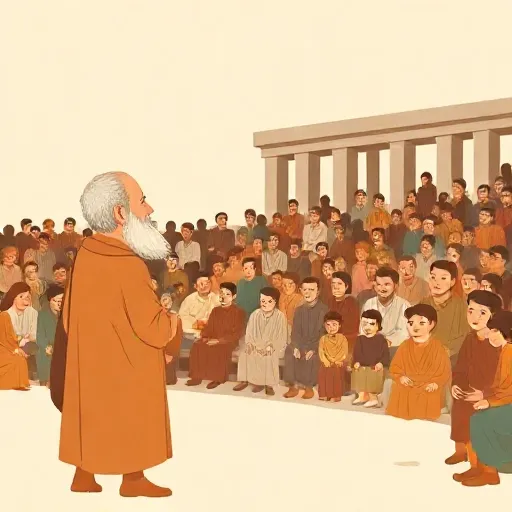
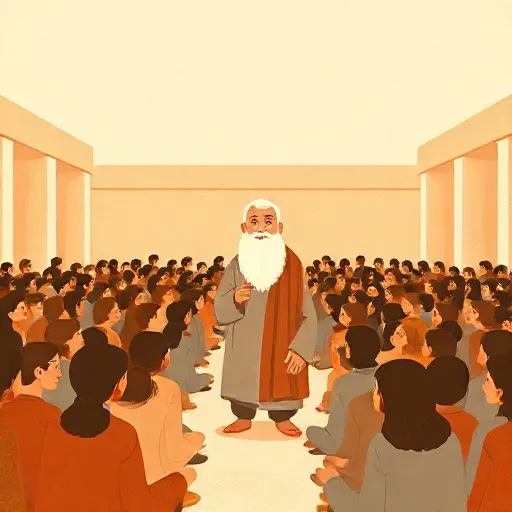
On a spring day in 399 BCE, a seventy-year-old man named Socrates (469–399 BCE) stood before a jury of 501 Athenian citizens. His city—the polis, or independent city-state—was a democracy where ordinary men voted on laws, served on juries, and held office by lot. Socrates had lived quietly as a stonemason turned questioner. But now he was on trial for his life, accused of not honoring the city’s gods, introducing new gods, and corrupting the young.
Socrates spoke in his own defense. He told the jury that “the unexamined life is not worth living.” He saw himself as a gadfly, a fly that stings a sleepy horse awake—the horse being Athens. His mission, he said, was to make people care about virtue (excellence of character) more than money or reputation. When the jury found him guilty and asked what punishment he deserved, he suggested free meals for life, like an Olympic champion. The jurors voted to put him to death.
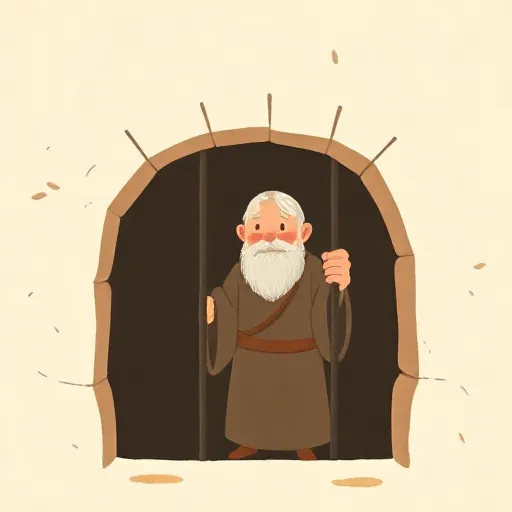
While waiting in prison, Socrates refused an easy escape. In a dialogue written by his student Plato (424/3–348/7 BCE), he imagined the Laws of Athens speaking to him. The Laws claimed that he owed them obedience because they had given him his whole life in the city. They offered him a choice: he could try to “persuade or obey” — change the laws through argument, or follow them. Socrates had obeyed the law when it required him to fight in war, but he had also once refused an illegal order from a short-lived oligarchy. This time, he accepted the death sentence, drinking poisonous hemlock. His trial raised a question that still stings: when does a government deserve our obedience, and when should we resist?
Justice by Nature or Only by Agreement?
Long before the trial, traveling teachers called Sophists had started a fierce debate. They asked whether nomos (law and custom) reflected physis (nature), or was just something humans invented to protect themselves—or to exploit others. Some, like Protagoras, saw law as a proud human invention that made cooperation possible. Others, like Thrasymachus in Plato’s Republic, argued that “justice” was simply whatever the powerful wanted it to be.
Plato thought this debate was dangerous. In the Republic, he set out to prove that justice is not a trick of the strong, but a real good that makes both a person and a city healthy. He imagined building a perfect city, a kallipolis (beautiful city), from scratch. Just as a human soul, he argued, has three parts—reason, spirit (courage and anger), and appetite—so a city needs three classes: rulers who love wisdom, soldiers who protect, and producers who farm and craft. Justice means each part does its own work and does not meddle in the others. A just person has a soul where reason rules, spirit supports it, and appetites are kept in check. Such a person is genuinely happy. The tyrant, by contrast, is a slave to his own worst desires and miserable.
In this ideal city, the rulers must be philosophers who understand the eternal Form of the Good. They must hold no private property or families, living only for the common good. The Republic also traces how such a regime would decay: from rule by honor-lovers, to rule by the wealthy, to rule by the many, and finally to tyranny. Throughout, Plato holds that a truly just life is better than an unjust one—no matter what anyone else thinks.
Aristotle’s Zoo of Governments
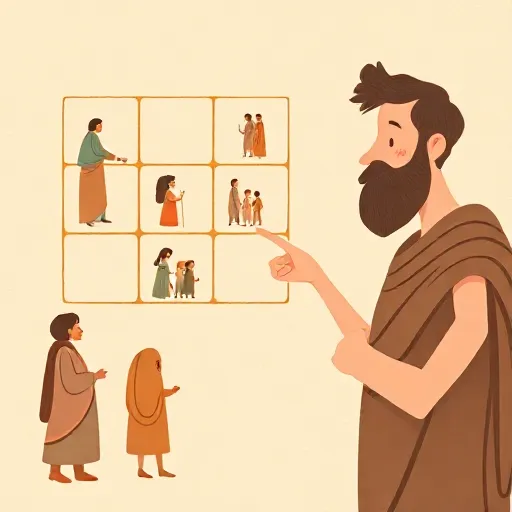
Aristotle (384–322 BCE), who studied in Plato’s Academy for twenty years, shared many of his teacher’s concerns. But he had a different approach. He and his students collected 158 real constitutions. Looking at them, Aristotle sorted governments into six main types. There were three good ones: monarchy (rule by one for the common good), aristocracy (rule by the best), and politeia—a moderate form of democracy where the many rule for the common good. Each had a twisted version: tyranny, oligarchy (rule by the rich for themselves), and a bad form of democracy that served only the poor majority.
Aristotle claimed that “man is by nature a political animal.” By that he meant that humans can only live a fully good life—achieving eudaimonia (flourishing)—within a polis. But not everyone, in his view, was cut out for full citizenship. He thought women, manual laborers, and farmers lacked the necessary leisure for politics. Most troubling to modern readers, he argued that some people are “natural slaves,” supposedly lacking enough reason to govern their own lives. That idea would have a long and destructive afterlife.
For most cities, Aristotle’s best practical advice was a mixed regime with a strong middle class. Where neither the rich nor the poor dominate, the city avoids the worst civil strife. He also imagined a supremely virtuous individual who might be so far above others that he should rule as a king for life. Yet in the most typical case, citizens should rule and be ruled in turn, taking turns in office. Aristotle’s zoo of governments gave later thinkers a powerful tool: instead of asking only “who should rule,” you must also ask “for whose advantage?”
The Roman Republic: Mixing One, Few, and Many
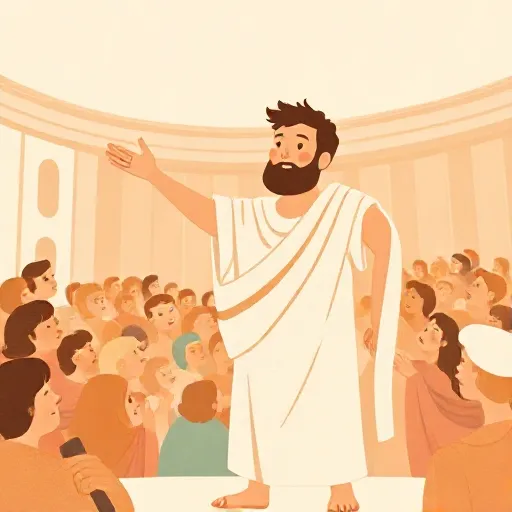
When Rome threw out its last king in 509 BCE, it built a republic that mixed elements of monarchy, aristocracy, and democracy. Two annually elected consuls held executive power; the Senate, made up of former officeholders, deliberated on policy; popular assemblies passed laws and elected magistrates. The Greek historian Polybius admired how each part checked the others, preventing any one from becoming too powerful.
Marcus Tullius Cicero (106–43 BCE), Rome’s greatest philosophical statesman, defended this mixed constitution in his dialogue De re publica (On the Commonwealth). He defined a res publica—literally “the public thing”—as the property of a people united by agreement on law and shared interest. If a regime became corrupt and stopped serving the common good, Cicero argued, it was no longer a true commonwealth at all.
Drawing on Stoic ideas, Cicero insisted that natural law exists: a universal moral order that human laws must respect. Justice means giving each person their due. In his book De officiis (On Duties), he even argued that a tyrant who acts like a wild beast breaks all human fellowship and may justly be removed. At the same time, Cicero fiercely defended private property and opposed radical efforts to redistribute land. His vision of mixed government and natural law would echo through the centuries, shaping thinkers like the American founders and anyone who wonders whether a constitution should blend different kinds of power.
Why Does It Still Matter?

The ancient arguments are not behind glass in a museum. They are alive every time a protestor risks jail for an unjust law, or a student council debates whether a handful of officers should make all the rules. When Plato argued that only those who really know what is good should govern, he was raising a question modern democracies face whenever they balance expert advice with the will of the people. Aristotle’s classification of regimes still helps us ask whether a government is serving everyone or just a wealthy few. Cicero’s mixed constitution planted the seed for the separation of powers that many countries use today to prevent tyranny.
Socrates chose to obey a death sentence rather than escape. But he also said he would never stop philosophizing, even if the state ordered him to. That tension—between obeying the law and following your conscience—is still with us. The Greeks and Romans did not agree on a single answer. They gave us a set of sharp tools: the idea that politics is about the good life, that justice is not just a word for power, and that how we organize power is something we must keep thinking about, together.
Think about it
- If you knew for sure that a law was unjust, would you still be required to obey it? Why or why not?
- Aristotle thought only some people should be full citizens. What would a just city look like if everyone, regardless of wealth or background, had an equal voice?
- Imagine designing a government from scratch. Would you give all power to a wise and kind expert, or divide power among many groups? What are the risks of each?